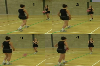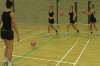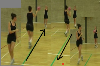
Netball: chest pass

July 2026

Ask any coach what wins tight matches in the last ten minutes and most will say fitness. But the fitness netball demands is a very particular kind. A netballer does not run one long, even effort - they produce a burst of pace to break free, stop dead, change direction, hold, then explode again seconds later. It is a game of repeated high-intensity efforts, and the players who fade are usually the ones who trained steady-state running all summer and hoped it would carry over.

Pre-season, which for most UK clubs falls across July and August, is the one window in the calendar where you can genuinely change what a player's body is capable of. The season itself is about maintaining and sharpening. Now is the time to build. Get this block right and your team arrives in September able to repeat their best movement in the fourth quarter, not just the first.

Why Repeated Efforts, Not Endurance

The single biggest mistake in club pre-season is treating conditioning as long, slow running. A netballer covers only a few kilometres in a match, but does so in hundreds of tiny, intense fragments. Training the wrong energy system - long aerobic jogging - builds a body that is efficient at exactly the pace netball never asks for.

What you want instead is the ability to sprint, decelerate and reaccelerate over and over with incomplete recovery. That means intervals: short, hard efforts with structured, deliberately insufficient rest, so the body learns to clear fatigue and go again. Aerobic base still matters - it is what lets players recover between those bursts - but it should be built through repeated efforts, not endless laps.

A Four-Week Pre-Season Framework

You cannot build an engine in a fortnight, and you cannot build one by going flat out from day one either. Sequence the work so the body adapts safely and peaks as the first friendlies arrive. Here is a simple progression any club can run twice a week.

Step One: Rebuild the base (Week 1). After an off-season break, start with movement quality and continuous shape-running before any all-out sprinting. Longer efforts at a controlled pace, lots of change of direction, no maximal work. This is the week that protects you from soft-tissue injuries later.

Step Two: Introduce intensity (Week 2). Shorten the efforts and lift the pace. Shuttle work with clear stop-start demands, full recovery between reps so quality stays high. You are teaching the body to accelerate and decelerate hard, cleanly.

Step Three: Squeeze the recovery (Week 3). Keep the efforts sharp but shorten the rest. This is where repeated high-intensity capacity is genuinely built - the player learns to produce a quality effort while still carrying fatigue from the last one. Expect it to feel uncomfortable. That is the point.

Step Four: Make it netball (Week 4). Convert the engine into game-specific conditioning. Fitness inside drills - shooting when tired, driving repeatedly, small-sided games with short work-to-rest ratios - so the fitness shows up as better decisions and cleaner skills under fatigue, not just a faster bleep test.
Conditioning Through the Ball

The best pre-season conditioning does not look like conditioning by the time you reach Week 4. Rather than running players into the ground with a ball nowhere in sight, build the fitness into netball actions. A shooting drill that forces repeated sprints out and back before every attempt trains the engine and the skill at once - and it exposes the players whose technique falls apart when their heart rate is high.

This matters because matches are won by tired players executing skills, not by fresh players in a fitness test. Conditioning through the ball also keeps sessions engaging across a long summer block, which protects attendance - and a player who turns up is fitter in September than one who found the running dull and drifted away in August.

Managing Load and Avoiding the July Casualties

Every year a handful of keen players get hurt in pre-season, usually calves, achilles or shins, because they went from an off-season of nothing to three hard sessions a week. The fix is not to train less - it is to ramp up sensibly. Increase the total running load gradually week to week, keep the first sessions submaximal, and give players honest rest days between hard efforts.

Watch your goalkeepers and shooters especially. They cover less ground than the mid-court but do a lot of jumping and landing, so their conditioning needs power and landing mechanics as much as running volume. Build strength and landing work into the block from the start rather than bolting it on after the first ankle rolls.

Key Coaching Points

  • Train the game's demand: short, sharp, repeated efforts with incomplete recovery - not long, even-paced running.
  • Sequence the block: base first, then intensity, then squeeze recovery, then make it netball-specific. Do not skip to the hard stuff.
  • Condition through the ball in the final weeks so fitness shows up as skill under fatigue, not just a faster test score.
  • Ramp load gradually - the biggest injury risk is a sudden jump from off-season rest to full sessions.
  • Include change of direction in every conditioning drill, because netball fatigue is as much about decelerating as sprinting.
  • Measure something - a simple repeated-sprint test in Week 1 and Week 4 shows players the engine they have built and keeps them bought in.

Recommended Drills

VIEW ALL FITNESS DRILLS

Frequently Asked Questions

How many conditioning sessions a week should a club team do in pre-season?

Two focused conditioning sessions a week is plenty for most club sides, alongside skill and team training. What matters more than frequency is the progression - building from a controlled base to squeezed-recovery intervals over four to six weeks. Three hard running sessions from a standing start is the fastest route to the physio's table.

Do I still need long-distance running for netball fitness?

Not much. Netball is a repeated-sprint sport, so the aerobic base is best built through intervals and shape-running with lots of change of direction rather than steady jogging. A little continuous running early in the block is fine to ease bodies back in, but the bulk of your work should mirror the stop-start demands of a match.

My players find pre-season fitness boring and attendance drops. Any fix?

Condition through the ball. Once you are past the first base-building weeks, put the fitness inside netball drills - repeated drives before a shot, small-sided games with short rest, timed shooting under fatigue. Players stay engaged, and the fitness transfers directly to match actions. A player who enjoys August turns up fitter in September than one who quietly stopped coming.

chest pass DRILLS
View All
Unfortunately there were no results for your search! Please try again
chest pass ANSWERS
View All

What are the best passes when playing against tall?

What are the best passes when playing against tall players. Beside the bounce pass

Archived User Coach

Any drills to get girls to run forward for passes,?

Any drills to get girls to run forward for passes, ie not stand behind players?

Archived User Coach

How can you strengthen a chest pass?

How can you strengthen a chest pass?

Archived User Coach

What drills can get the passer to look long, with receiver moving back?

what are some drills to get passer to look long and a receiver to go back to get pass? thanks

Tracy Hall Coach, New Zealand

Chest pass or shoulder pass

I coach 10 and 11 year olds that need quite a bit of work. They still need to build their upper body strength and passing accuracy. I am teaching them to use chest passes as the pass that they should use the majority of the time and use shoulder passes for longer range passes. I find that their shoulder passes are weak and not accurate, but something we are working on progressively. We have an umpire that constantly yells at the kids and demands that they use shoulder passes all of the time and has told me that I am coaching them wrong and that I don't know what I am doing. What are your thoughts on this? I do the best I can as a volunteer coach.

Archived User Coach

What drills for 1st time players

Hi there I am coaching for the first time to some 7th graders. Most haven't played before. Can anyone recommend some drills to help me get them started with catching and pivoting?

Cristina Coach, Australia

Motivating an under 11s team

I'm a coach for an under 11s teams, at the moment I'm doing basic drills to make them understand footwork, marking and passing,etc. But I think they get bored doing those drill so how do I motivate them and get them to be enthusiastic and have fun about the sport but also they can learn?

Abby rees Coach, Wales

Man Marking Defence

What are the best drills to use for a session on man marking? and in what order so that the session progresses?

Archived User Coach

Gr 1 coaching. Whats the first thing to teach them.

where do you start coaching Gr 1 netball. I need some tips please.

lindie swarts Coach, South Africa

How to Improve stepping

How to improve you players stepping

Teresa Coach, Australia

What would be three learning objectives

I need three learning objectives for a netball lesson focusing on chest pass with progressions! Many thanks Asked using Sportplan Mobile App

leigh oyebanji Coach, England

NetSetGo Girls Training

I’m new to coaching and have a team of 9 NetSetGo girls aged 8/9. While they have played two seasons already, they lack basic skills such as chest passing, shoulder passing, pivoting, etc.Does anyone have any helpful tips or useful drills which could be used to help teach the girls these skills. Asked using Sportplan Mobile App

Celeste Coach, Australia

Chest pass drills

How can i reinorce chest pass as a strenght in netball

Lefika Metlha Wadikgosi Coach, United Kingdom

Chest pass drills

How can i reinorce chest pass as a strenght in netball

Lefika Metlha Wadikgosi Coach, United Kingdom

progression

how can i progress using this skill

Mafika Coach, South Africa

netball

conditioned chest pass practice for netball

Treasure Okusun-Usifoh Coach, United Kingdom

Chest pass or shoulder pass - ...

I coach 10 and 11 year olds that need quite a bit of work. They still need to build their upper body strength and passing accuracy. I am teaching them to use chest passes as the pass that they should use the majority of the time and use shoulder passes for longer range passes. I find that their shoulder passes are weak and not accurate, but something we are working on progressively. We have an umpire that constantly yells at the kids and demands that they use shoulder passes all of the time and has told me that I am coaching them wrong and that I don't know what I am doing. What are your thoughts on this? I do the best I can as a volunteer coach.

Archived User Coach

How can you strengthen a chest...

How can you strengthen a chest pass?

Archived User Coach

Bounce Pass in a game - Sportp...

how can I use a bounce pass effectively in a game?

Archived User Coach

Passing Problems !!!! | Sportp...

Hi I am a first year coach of a 9 and under team.My girls are struggling with the concept of running to space and receiving a pass on the move while advancing the ball to our attacking third.It seems no matter how hard i try to implement drills for passing at practice, come game day the girls still group together and call for the ball standing still. Any ideas/drills anyone could suggest would be greatly appreciated. Regards Mark

mark roberts Coach, Australia

JOIN SPORTPLAN FOR FREE

  • search our library of 700+ netball drills
  • create your own professional coaching plans
  • or access our tried and tested plans

Sportplan App

Give it a try - it's better in the app

YOUR SESSION IS STARTING SOON... Join the worlds largest netball coaching resource for 700+ drills and pro tools to make coaching easy.
LET'S DO IT