






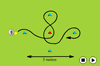
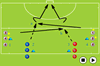
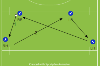




Excellent drills, very detailed videos. Useful site for my U15 boys team.

can anyone give me some field hockey scenarios that i could use for a lesson i will be teaching the pupils in which they will learn through the game and will be stopped and told a scenario and will need to try to work out with their team what they think they should do?

I am coaching a JV team and my girls keep sending the ball back to where the ball came from. Are there any good drills that would train them redirect?

I have just returned from coaching my first high school hockey tournament. It was great fun but the girls really felt it by the end of the tournament. I want to offer guidance in the form of a fitness build up to the girls for next season but am not sure what my expectations should be. How fit should you be looking to get if you are preparing to play 7 50min games over 5 days? And what types of fitness should I be suggesting? Sprinting and Intervals along with Swimming are things I feel that could be introduced. Ideally it needs to be accessable (not expensive or require special equipment), self managed (to an extent) and let it fit in with their daily rountine as best possible to give them the best chance to commit (i.e. I feel like suggesting they power walk to school rather than get dropped off will work better than asking them to join a gym to do the pelaton classes) Any ideas? Or things that have worked in the past?
Hi all,I've got my level 2 assessment coming up on Sunday and I just wanted to quickly check whether there's a 'recommended' structure to the session plan.Btw, this is a level 2 practical assessment and is with juniors (U14s).One coach has suggested a 3 part approach:1) techniques and skills required2) unopposed 3) opposedThe theme I'm choosing, which is a bit of a generic one, is defending in a channel (as I'm a defender and it's pretty straight forward).I'm not really looking for info on what exactly to include (i.e. theme specific) but rather general structure or whether E.H. have an approved structure to sessions?My session's on Sunday, so a quick reply would be awesome.Thanks,Gary

Anybody any ideas on a conditioned game to encourage receiving the ball in a forward facing position?

With pre season looming can you give any advice as to the best training method for ladies hockey team
Hi there. I'm looking for some ideas on activities to maintain fitness. I have been doing intervals with my team for the last few weeks but want to change it up to keep it interesting while achieving the same result. Any ideas would be greatly appreciated!! Thanks in advance!
How to coach fast attackers to control the pace of the ball as they accelerate? At higher speeds, the players' touch on the ball needs to be "softer" but this requires hands and feet to work at varying intensity. I see a lot of speedsters push the ball too far ahead of themselves, the faster they go. The outcome is often a failed shot at goal because the ball runs out of reach or out over the back line.
Hello, can someone please help with this question: Describe two different training types and methods which would have a positive impact on sports performance for AFL players. I need to provide 2 training methods for the 2 training types where the training methods include (examples are the training methods): Aerobic-eg continuous, fartlek, aerobic interval and circuit. Anaerobic- eg anaerobic interval. Flexibility-eg static, ballistic, PNF, dynamic stretching. Strength training- eg free/fixed weights, elastic, hydraulic. So i have information on dynamic stretching but if i am to do that I have to pick another form of stretching from the example methods above such as PNF, static ballistic. Not sure what to say if I had to pick one of those. Also I think aerobic interval seems good, how does it better AFL players performance?
What kind of defensive presses do you all run for highshoolers? And is there a resource that will make it easier to teach to them? We play a 4-4-3 with 2 sitters in the midline. Iâm used to a Fall Away Press, but am having a hard time teaching it. Asked using Sportplan Mobile App

I want to involve some drills that isolate the escaping drill (recognising a threat and turning away to keep possession) and incorporate into a game situation.
With the 2 meter or 6 feet distance rule due to COVID-19, I was looking for FUN and HIGH INTENSITY warm-up games/drills for beginner players. I would love to hear the ideas of others. Please include a small description and/or drawing of the drill, as well as what aspects of the game the drill focuses on.
we are often the better team,for three quarters we push the opposition but in the last quarter we concede 2 or more goals.We have a massive national tournament coming up with the best teams in the country,and I am afraid that this might cost us dearly.Does anyone have a drill or structure plan I could use?
what is the positioning and tips to no left them through the centre by heading to the lineand them cutting in
how to tackles defender passing ball by attacker, pressing with high intensity by attacking players made the defenders have more space to put the ball out of danger zone

With pre season looming can you give any advice as to the best training method for ladies hockey team
Hello, can someone please help with this question: Describe two different training types and methods which would have a positive impact on sports performance for AFL players. I need to provide 2 training methods for the 2 training types where the training methods include (examples are the training methods): Aerobic-eg continuous, fartlek, aerobic interval and circuit. Anaerobic- eg anaerobic interval. Flexibility-eg static, ballistic, PNF, dynamic stretching. Strength training- eg free/fixed weights, elastic, hydraulic. So i have information on dynamic stretching but if i am to do that I have to pick another form of stretching from the example methods above such as PNF, static ballistic. Not sure what to say if I had to pick one of those. Also I think aerobic interval seems good, how does it better AFL players performance?
what is the positioning and tips to no left them through the centre by heading to the lineand them cutting in

in more ways than one
 sportplan_hockey




A few weeks into the league season, poor first touches are costing teams the ball. Coach body shape, scanning and receiving on the move to keep possession.

Pre-season fitness fades fast once the league starts. Build conditioning into ball work and use rolling subs well to keep your squad sharp all season.

The first weeks of the season decide whether a junior or new player sticks with adult hockey. Here is how to keep them safe, give them a clear job and build their confidence from the very first bully.
Coaches from around the world look to Sportplan for coaching confidence.
Excellent drills, very detailed videos. Useful site for my U15 boys team.

I love using Sportplan. It's been a great help for co-ordinating hockey practice and being able to help tweak skills and getting the most out of my players!

Great site. An absolute must for coaches who are willing to change and learn new drills. Superb, simply superb.

Wow what a great website, I have found sportplan an important tool for me when planning my netball sessions with my netball team. There are alot of very helpful tips/ideas/skills that I can learn and teach to my team. Thank you sportplan I hope to continue to use your helpful tips and to learn more about improving my teams netball skills. Thanks again....keep it up....

I have been using Sportplan now for 3 years and can honestly say that I have never repeated the same session twice. My girls are always focused and are improving every year. Thanks Sportplan.
What a fantastic tool. The Chalkboard and session tools make an unbelievable difference in making training plans in both time and organization. I will be instructing all of my assistant coaches that this tool must be used for all sessions during the season, so that we may build a club coaching resource library.
I can't get enough of the Sportplan, It has given me back the enthusiasm i was starting to lose. My girls are so keen and are ready at 14 to take the next up in their game. Sportplan will help no end.



