







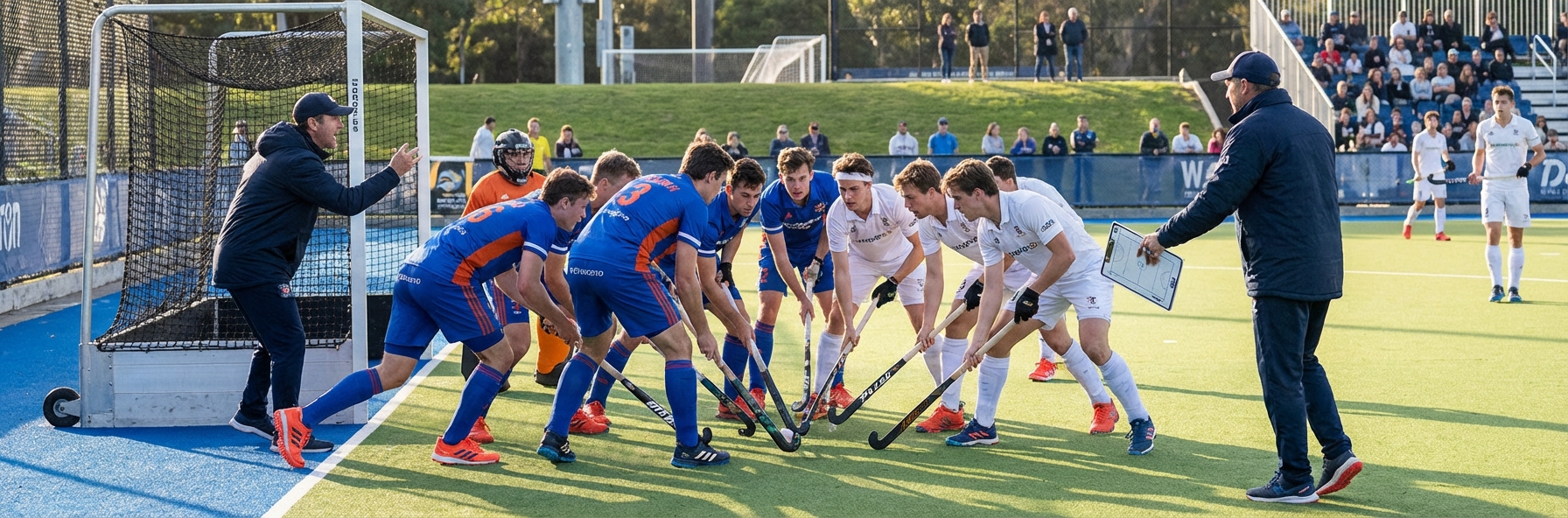
The full press has become the defining tactical feature of modern hockey. Watch any international match and you'll see teams hunting the ball high up the pitch, forcing errors in dangerous positions, and converting turnovers into goals within seconds.
But here's what separates elite teams from the rest: they don't press constantly. They choose their moments. And those moments are based on specific triggers that every player recognises.
Understanding the Risk-Reward Balance
The high press is not a defensive system. It's an attacking weapon disguised as defence. When executed correctly, it wins the ball in areas where your team can immediately threaten the goal. When it fails, it leaves vast spaces behind your midfield for the opposition to exploit.
This is why random, individual pressing is often worse than no pressing at all. One player breaking the line creates a passing lane. The opposition moves the ball through that gap, and suddenly your press is broken with players caught high and out of position.
The 5 Pressing Triggers
1. The Backward Pass
When an opponent passes backward, they're admitting they can't go forward. This is your green light. The receiver is typically facing their own goal with limited options. Train your front line to recognise this trigger and attack with intensity.
2. The Poor First Touch
A heavy touch, a bobbling ball, or a reception that takes the player away from their intended direction - these are moments of vulnerability. The player needs extra time to control the ball, and that time belongs to your press.
3. The Predictable Rotation
Teams often fall into patterns. The same passing sequence repeated two or three times becomes predictable. Teach your players to recognise when they can anticipate the next pass and cut it off before it arrives.
4. The Trap Zone Entry
Create areas of the pitch where you want the opposition to play. Typically this is the sideline zones where their options are limited. When the ball enters your trap zone, that's the trigger to press with numbers.
5. The Goalkeeper Distribution
Modern hockey goalkeepers are expected to play out from the back. This creates pressing opportunities. When the goalkeeper receives, your press should already be in motion, cutting off the easy options and forcing difficult decisions.
Press Variants: Choose Your System
The V-Press
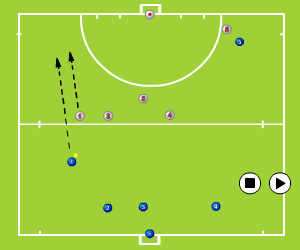
Two forwards press the ball while a third sits deeper, covering the central passing lane. This is the most common system because it provides coverage while still applying pressure. The "V" shape funnels the ball toward the sidelines.
The Hook Press
Initiated with two high strikers and one deeper. The ball-side striker curves their run to force the ball inside, where the second striker and the deeper player are waiting to trap.
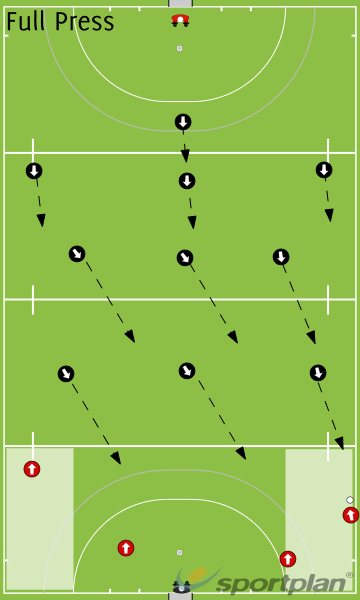
The Full Court Press
Every player pushes high, creating maximum pressure across the entire width. This is exhausting and risky, but devastating when it works. Use it selectively - after a goal, at the start of a half, or when you need to force the issue.
Training Press Recognition
Stage 1: Freeze Frame
During small-sided games, call "freeze" at random moments. Ask your players: "What's the trigger here? Should we press?" This builds constant awareness.
Stage 2: Trigger Scoring
Play games where pressing on correct triggers scores points, but pressing at wrong moments gives points to the opposition. This creates accountability and sharpens decision-making.
Stage 3: Video Review
Record training games and review pressing moments with your squad. "Here - why did we press? What was the trigger? Did we press as a unit or as individuals?"
The Unit Mentality
Individual pressing is chaos. Unit pressing is organised pressure. The difference is communication, coordination, and trust.
The ball-side player applies pressure. The help-side players anticipate the release and position to intercept. Everyone moves together, compressing the space, giving the opposition no time and no options.
Communication is constant: "Now!" "Hold!" "Trap left!" Without it, you have individuals chasing shadows. With it, you have a hunting pack.
When Not to Press
The best pressing teams also know when to drop off. If the opposition has strong aerial players, a high press invites the overhead ball that bypasses your entire structure. If you're protecting a lead late in the game, the risk-reward shifts.
Teach your team that not pressing is also a decision. Holding a mid-block, staying compact, and waiting for the opposition to come to you can be equally effective - especially if they're expecting your press.
Key Coaching Points
- Press on triggers, not on every ball
- Move as a unit - if one goes, all go
- If the press is broken, recover immediately
- Create trap zones and funnel the ball there
- Communication is non-negotiable

 sportplan_hockey









