







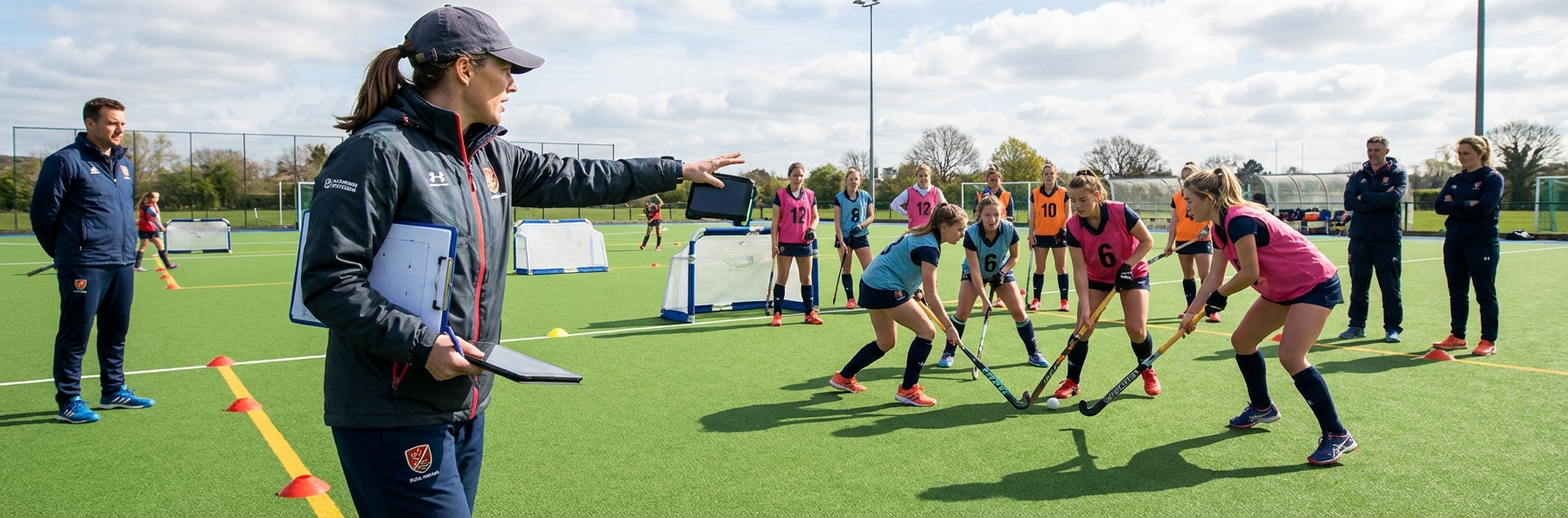
The Coaching Problem
Your players look great in drills. They execute skills perfectly when there's no pressure. But come match time, they freeze. Decisions are slow, techniques break down, and all that drill work seems to disappear.
The problem isn't the players - it's the training. Traditional isolated drills remove the decision-making that makes hockey hockey. Players learn to execute skills, but not when to use them.

What Is Constraints-Led Coaching?
The constraints-led approach (CLA) has moved from academic theory to standard practice at federations like England Hockey and Hockey Australia. The core idea is simple: instead of telling players what to do, you design practice environments where they discover solutions themselves.
By manipulating constraints - the rules, space, and conditions of practice - you create problems that players must solve. The learning sticks because players own their solutions rather than copying instructions.
The Three Types of Constraints
1. Task Constraints
Rules you impose on the activity:
- Scoring rules: "Goals only count from inside the circle"
- Passing rules: "Maximum two touches" or "Must pass before shooting"
- Number constraints: "3v3" or "4v2 overload"
- Time constraints: "Score within 30 seconds"
2. Environmental Constraints
The physical setup of practice:
- Space: Smaller areas force quicker decisions; larger areas allow more time
- Goals: Multiple goals create different options; small goals demand accuracy
- Zones: Channels or areas that restrict or encourage certain movements
- Equipment: Different ball types or reduced stick length
3. Individual Constraints
Limitations placed on specific players:
- Dominant hand: "Left-hand side only for this player"
- Movement restrictions: "This player can't move when they have the ball"
- Touch limits: "This player has unlimited touches; that one has one touch"

Designing a Constraints-Led Session
Step 1: Identify the Learning Outcome
What do you want players to learn? Be specific: "recognise when to eliminate 1v1" is better than "improve dribbling".
Step 2: Choose Your Constraints
Select constraints that make the desired behaviour the best solution. If you want players to eliminate, create narrow channels where passing is difficult.
Step 3: Let Them Play
Resist the urge to instruct. Observe. Let players discover solutions. Failed attempts are learning, not mistakes.
Step 4: Adjust the Constraints
Too easy? Add defenders or reduce space. Too hard? Remove constraints or add supporting players. The activity should challenge without overwhelming.
Step 5: Use Questions, Not Instructions
Instead of "you should have passed", ask "what did you see?" Guide players to their own insights.
Example: Teaching 1v1 Elimination Through Constraints
Setup
Narrow channel, 3m wide, 15m long. One attacker, one defender. Attacker scores by dribbling past the end line.
Why It Works
The narrow space removes passing as an option. The only way to score is to beat the defender. Players naturally explore elimination skills because the constraints demand them.
Progressions
- Widen the channel - now attackers might choose to go around
- Add a goal - now attackers must also decide when to shoot
- Add a supporting attacker - now passing becomes an option again
Each progression changes the problem. Players develop a repertoire of solutions rather than a single technique.

Recommended Drills
These Sportplan drills work well as constraints-led activities:


Common Questions Answered
- Is this the same as game-based learning? Yes, constraints-led coaching is a form of game-based learning with a theoretical framework from motor learning science.
- When should I give direct instruction? When safety is at risk, when players are completely stuck, or for very specific technical corrections that players can't discover alone.
- How do I assess progress? Watch for players making better decisions more consistently. Look at transfer to matches, not just performance in practice.
- Will players learn bad habits? If the constraints are well-designed, efficient solutions emerge naturally. Trust the process.
Frequently Asked Questions
How is this different from just playing small-sided games?
Small-sided games are a good start, but constraints-led coaching is intentional about the design. Each constraint is chosen to guide players toward specific learning outcomes. Random small-sided games help fitness; designed games develop skills.
Won't some players never figure it out?
Adjust the constraints to meet players where they are. If someone is struggling, add supporting players or make the space larger. The principle is challenge without overwhelm.
How do I explain this approach to parents who expect "proper coaching"?
Explain that this is how elite academies train worldwide. Show them that players make more decisions in 10 minutes of constrained play than in an hour of isolated drills. The learning is deeper and transfers better to matches.
Can I mix constraints-led activities with traditional drills?
Absolutely. Some technical elements benefit from isolated practice, especially for beginners. The key is ensuring players get plenty of decision-making practice, not just technique repetition.

 sportplan_hockey









