







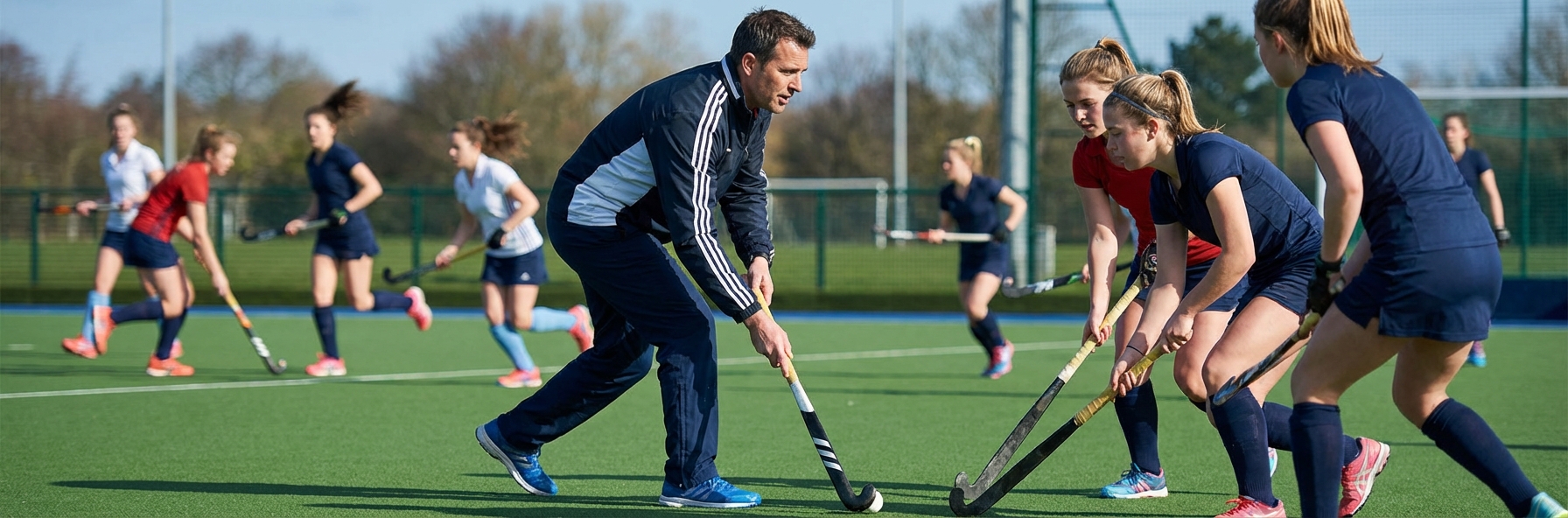
Field hockey coaching continues to evolve rapidly. Safety requirements are changing how we train, tactical approaches are becoming more sophisticated, and coaching methodology is shifting toward player-centred learning. Here's what's shaping our coaching in 2026.
These are the six biggest developments every field hockey coach should understand.

1. Mandatory Face Masks for Penalty Corner Defence
2026 is the first full year with mandatory face masks for defending penalty corners across all levels. The FIH introduced this requirement in early 2025, and it's now filtering through to domestic and junior competitions. With drag flicks exceeding 150 km/h, athlete welfare is non-negotiable.
The FIH now certifies masks in two categories: Category 1 masks withstand 80 mph shots (all levels), while Category 2 masks handle 60 mph (junior and recreational play). Look for the FIH certification stamp on approved equipment.
Training adjustment: Build mask-wearing into every PC defence session. Players need to adapt to restricted peripheral vision and altered breathing under pressure. Ensure all your defenders have properly certified equipment - this is non-negotiable for 2026.

2. 3D Skills and Aerial Dribbling Standard at All Levels
What was once the preserve of elite players is now expected throughout the game. 3D skills - lifting the ball from the ground to beat defenders - have become essential at competitive club level. Aerial dribbling creates scoring opportunities in tight spaces that flat play simply cannot.
Coaches are introducing ambidextrous stick work from earlier ages. The drag flick continues to evolve as a specialist skill, with dedicated training for strength, timing, and accuracy. Players who can only play on the ground are increasingly limited.
Development focus: Integrate 3D elements into regular ball-handling warm-ups. Start simple - lift, control, play - then progress to beating static defenders. Don't wait until players are 'ready' - expose them to aerial skills early and often.

3. Counter-Pressing Becomes the Dominant Tactic
The distinction between 'set' press (from static restarts) and 'dynamic' press (immediate reaction to losing possession) is now fundamental to how elite teams defend. Counter-pressing - or 'gegenpressing' - means winning the ball back within seconds of losing it, before the opposition can organise.
The modern high press requires exceptional fitness and tactical discipline. Teams differentiate between ball-side and help-side responsibilities, channeling attackers into predetermined areas. Watch how international teams use the V-press diamond structure to protect the centre while forcing play wide.
Coaching priority: Train pressing triggers - the moments when your team attacks the ball collectively. The backward pass, poor first touch, and predictable rotation are all triggers your players should recognise instantly. Counter-pressing drills should feature in every session.

4. Wearable Technology for Load Management
GPS trackers and heart rate monitors have moved from professional to club level. These devices provide real-time data on distance covered, sprint counts, high-intensity efforts, and fatigue indicators - information that was impossible to capture just a few years ago.
The real value isn't just tracking matches - it's managing training load. By monitoring cumulative stress across weeks and months, coaches can reduce preventable injuries and optimise performance timing. Return-to-play protocols now use objective benchmarks rather than guesswork.
Practical application: Even basic heart rate data helps you understand session intensity. Track relative effort across training weeks. Players returning from injury should hit specific physical benchmarks before full match play. Data removes the guesswork from physical preparation.

5. Mental Performance Training Goes Standard
Sports psychology is no longer optional at competitive level. Visualisation, concentration training, and stress management are now built into regular training programmes. Top teams employ dedicated mental performance coaches; club teams are integrating these principles themselves.
The focus includes pre-match routines, in-game reset techniques, and post-error recovery. Players learn to control their internal state rather than being controlled by match situations. Mental resilience is trained, not just hoped for.
Start here: Introduce simple breathing exercises before high-pressure drills. Teach a 3-second reset routine for after mistakes. Discuss visualisation as homework. Mental skills need practice just like physical skills - build them into your programme.

6. Constraints-Led Coaching Goes Mainstream
The constraints-led approach has moved from academic theory to standard coaching practice. England Hockey and other national federations now advocate this player-centred methodology that prioritises game-based learning over traditional drill-based instruction.
The core principle: instead of telling players what to do, coaches design practice environments where players discover solutions through play. By manipulating task constraints (rules, space, numbers), environmental constraints (pitch size, goals), and individual constraints (which hand, limited touches), coaches create problems that players solve themselves.
Coaching shift: Move away from flow drills toward representative game situations. Ask questions rather than give answers. Design activities where the 'right' decision becomes obvious through the constraints you set. Players who learn through problem-solving transfer skills to matches far better than those who follow instructions.
What This Means for Sportplan Coaches
Field hockey coaching in 2026 requires more than sticks and cones. Safety equipment is mandatory, tactics are evolving, and player development demands a holistic approach. The coaches who thrive will be those who embrace these changes rather than resist them.
At Sportplan, we're developing resources that reflect this evolution. Pressing system drills, 3D skill progressions, mental performance frameworks, and constraints-led session designs are all areas we're expanding for 2026.
The game keeps moving forward. Let's move with it!

 sportplan_hockey









