







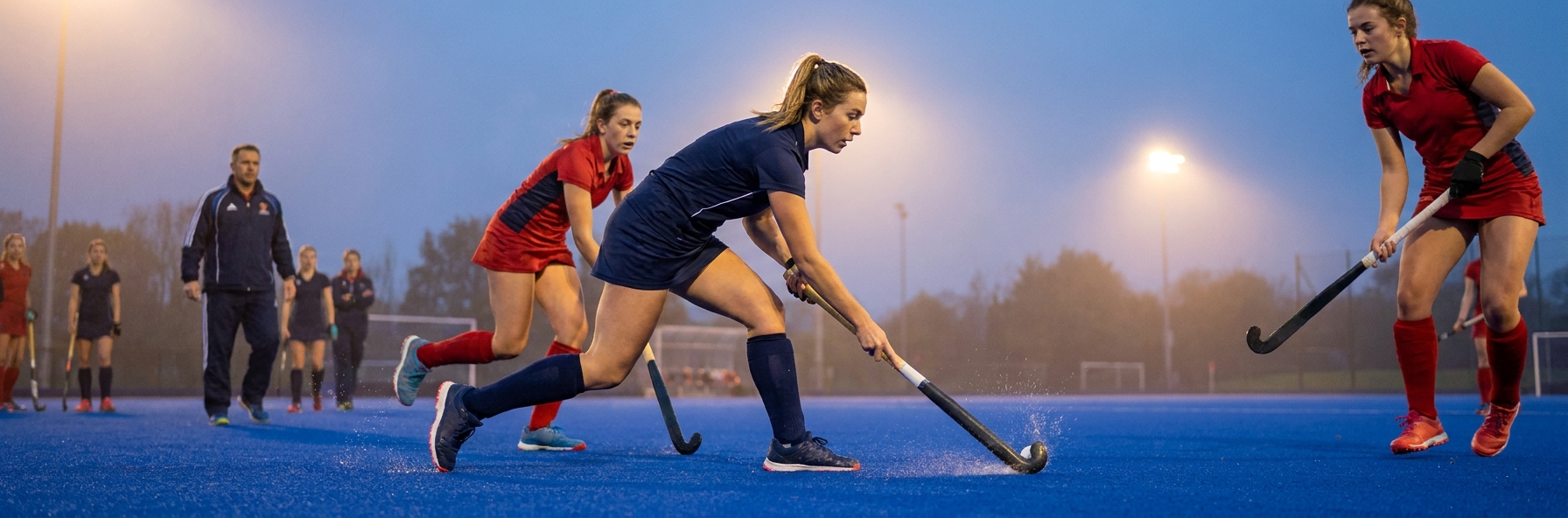
A few weeks into the league season, most coaches have a clear picture of where their team loses the ball. For many club sides it is not the tackle or the pass that goes wrong, it is the first touch. A midfielder receives square-on, the ball bounces off the stick, and the opposition press pounces before anyone can react.
Receiving is one of those skills that gets practised in warm-ups and then forgotten. Yet a clean first touch buys a player time, takes a defender out of the game and sets up the next action. Fix it now and you will see the difference for the rest of the season, especially as autumn brings wetter, quicker pitches.
Why First Touches Go Wrong
Most poor receptions start before the ball arrives. Players stand still waiting for the pass, so the defender can close them down. They have not looked over their shoulder, so they do not know where the pressure is coming from. And they receive with stiff wrists and a hard stick, so the ball rebounds away instead of settling.
The result is a touch that either stops the ball dead in front of the feet, inviting the tackle, or pushes it too far, giving it straight back. The aim is a first touch that moves the ball into space, away from pressure and towards where the player wants to go next.
A Five-Step Receiving Framework
Step One: Scan before the ball. Encourage players to check over their shoulder at least once before the pass is played. They need to know where the nearest defender is and where the space is.
Step Two: Move to receive. Lead away from the defender, then come back towards the ball. A receiver who is moving is much harder to mark than one who is waiting.
Step Three: Open the body. Receive side-on where possible, so the player can see both the passer and the pitch ahead. This makes it far easier to play forward on the first or second touch.
Step Four: Soft hands, angled stick. Relax the bottom hand and angle the stick slightly over the ball to stop it bouncing up. On the reverse side, keep the stick low and get the feet round so the ball is received in front of the body, not behind it.
Step Five: Touch into space. The first touch should take the ball away from the nearest defender, ideally forwards. If there is no forward option, a touch that protects the ball and opens up a pass is the next best choice.
How to Train It
Warm-up: Pairs passing on the move, with receivers alternating forehand and reverse receptions. Insist on a scan before every reception.
Technical: Receiving on the move and from behind, so players learn to collect the ball while running and change direction with their first touch.
Decision-making: A receiver in a small box with a passive defender. The first touch must take the ball out of the box, away from the defender. Add a second defender as players improve.
Game: A small-sided game where a team scores a bonus point for any pass received on the half-turn and played forward within two touches.
Key Coaching Points
- Scan before the ball arrives, not after.
- Keep moving; lead away, then come back to receive.
- Receive side-on so you can see the passer and the pitch ahead.
- Soft hands and an angled stick to cushion the ball, especially on fast, wet pitches.
- Get the feet round on the reverse so the ball is received in front of the body.
- Make the first touch count by moving the ball away from pressure and into space.
Recommended Drills
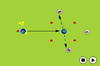
VIEW ALL PASSING AND RECEIVING DRILLS
Frequently Asked Questions
How do you stop the ball bouncing off the stick when receiving?
Relax the grip, particularly the bottom hand, and angle the stick slightly forward over the ball. Think of catching the ball rather than blocking it. Receiving in front of the body, rather than beside the feet, also gives more time to cushion it.
Should players receive on the forehand or the reverse?
Both. The forehand is more secure, but always moving the feet to get onto it costs time and lets defenders close. Players who are comfortable on the reverse can receive the ball where it arrives and play on more quickly.
How can I improve my team's first touch quickly?
Add a receiving focus to every passing drill rather than running separate sessions. Ask for a scan before each reception and a first touch that moves the ball into space. Small, consistent habits in every session make the biggest difference over a season.

 sportplan_hockey









