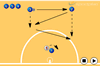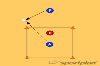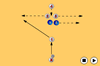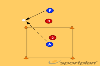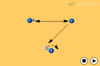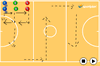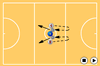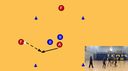
Netball: 1 on 1

The System Behind the Best Defensive Units of 2026

Statistics from the first half of the 2026 NSL season tell a clear story. The three teams with the highest goal-circle turnover rates all run a structured split-circle defensive system. The teams further down the table mostly defend the circle one-on-one. The gap is not about individual brilliance. It is about whether the defensive pair operates as two players or as a single connected unit.

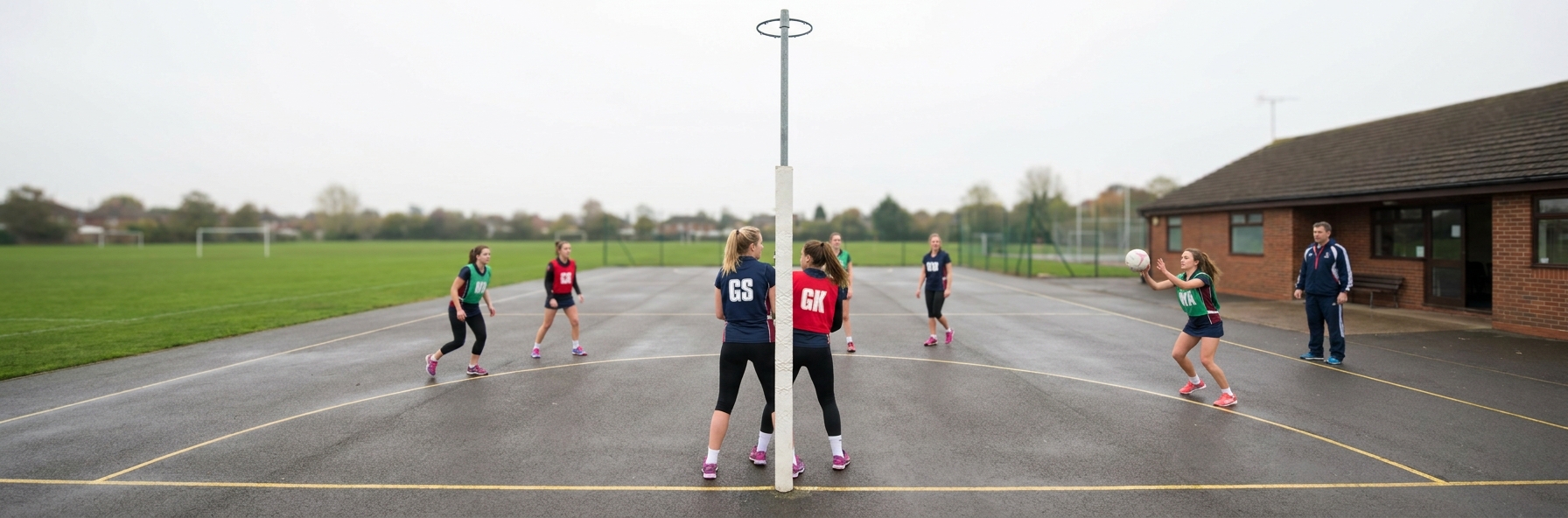
Split circle defence is built on a simple idea. Rather than each defender minding a single attacker across the whole circle, the Goal Keeper and Goal Defence divide the circle into zones, take responsibility for whichever attacker enters their zone, and switch coverage as attackers move. Done well, it makes every pass into the circle look contested even when the defenders are not on the body.

"A great split circle does not stop attacks. It makes attackers choose between bad options."

The Three Zones of the Circle

Before the system can work, every player in the defensive unit must understand the same map of the goal circle. The vocabulary matters - if your GK calls one area "the pocket" and your GD calls the same area "the corner", you have a communication problem before the contest even starts. Most elite coaches divide the circle into three zones.

1. The Post

The area immediately around and under the goal post, roughly two metres in radius. This is the highest-value scoring zone and the primary territory of the Goal Keeper. Any pass into this zone must be contested or denied. The defender in the post zone is the last line of defence on every play.

2. The Pocket

The two areas on the circle edge by the baseline, one on each side of the post. The pocket is the favourite landing spot for a strong holding shooter because the angle to the post is good and the defender's footwork is restricted by the baseline. The Goal Defence usually carries primary coverage here, but the GK must be ready to rotate.

3. The Point

The top of the circle near the transverse line, where feeds typically come from. The Goal Defence carries the point zone because they are closer to the incoming pass, while the GK reads the pass and prepares to cover whichever zone the shooter drives into.

The Switch: The Moment That Makes or Breaks the System

Split circle defence lives or dies on the switch. When an attacker moves from one defender's zone into the other defender's zone, the two defenders must hand over coverage smoothly. Done well, the attacker arrives in their new zone to find a fresh defender already in position. Done badly, both defenders end up on the same attacker, leaving the other one free.

The keys to a clean switch are timing and communication. The timing should be the moment the pass is being made or just before it - too early and the attacker can change direction, too late and the receiving defender is not yet set. The communication is verbal and immediate. The most common call is simply "switch", but many teams develop their own short codewords for specific scenarios.

Coaches must drill the switch as a specific skill. It is not enough to run general circle defensive drills and hope the switch develops on its own. Set up scenarios where attackers deliberately cross between zones and force the defenders to communicate the switch out loud every time. Over time the verbal call becomes instinctive and the movement becomes seamless.

Body Angle and the Half-Step Principle

In a split-circle system, defenders almost never stand body-on-body with their attacker. The standard position is a half-step away with the body angled side-on. The hips face the ball, not the attacker. This achieves two things at once - it lets the defender see both the ball and the attacker simultaneously, and it positions the body to drive into the passing lane the moment the pass is released.

The phrase coaches use most often is "hips to the ball, eyes split". The defender's hips give them their ready direction. Their eyes work in a split mode, one watching the ball, one watching the attacker. The half-step of distance is not weakness or laziness. It is the space the defender needs to read and react.

The exception is the moment of the shot itself. Once the shooter is set in a clear shooting position with the ball, the defending player closes the gap, gets the arms over and contests the shot directly. The half-step is for the pre-shot phase. The on-body coverage is for the shot itself.

Pressing the Feed

A common mistake when teams adopt the split circle is to focus entirely on what happens inside the circle and forget the pressure on the feeder outside it. The split circle works best when the feeders are being pressured by the WD and C. A feeder under pressure throws less accurate passes, takes longer to release, and gives the circle defenders more time to read the play. A feeder with no pressure picks the lane at leisure.

Build feeder pressure into your split circle drills from the start. Do not run circle defence in isolation. Always include the midcourt defenders contesting the ball outside the circle. The whole defensive unit must work together for the split system to deliver its full benefit.

"The split circle starts at the transverse line. If your feeders have time to think, your circle defenders are already losing."

When to Switch Off and Mark Tight

The split circle system is not the only way to defend, and it is not always the best way. Against a single dominant holding shooter who barely moves, a more traditional one-on-one marking approach can be more effective because the switches are rarely triggered. Against quick, mobile shooting pairs who constantly rotate and cross, the split circle is the better answer.

Teach your players to recognise when to switch the system off. The captain or senior defender should be able to call "tight" when the opposition's movement patterns favour direct marking. This flexibility is a sign of a mature defensive unit. The teams that get caught are the ones that stick rigidly to one system regardless of what they are seeing.

Sample Session Plan: Building the Split Circle (60 Minutes)

Session Structure

  • Warm-Up (10 min): Zone awareness. Mark the three zones of the circle clearly with cones. Pairs of defenders move around the circle calling the zone they are in. Builds the spatial vocabulary that the rest of the session depends on.
  • Technique Block (15 min): The switch in isolation. GK and GD stand in the circle. One attacker walks slowly from zone to zone. Defenders must talk through every switch out loud, then carry the switch out smoothly. No ball, no contest - pure communication and movement.
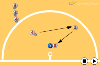
  • Development Block (15 min): 2v2 in the circle. GK and GD versus GA and GS. Feeder outside the circle delivers ten passes. Track how many clean intercepts, deflections and shots the contest produces. Discuss every switch after each pass.
  • Game Scenario (15 min): Full half-court attack versus split defence. Add WD and C to pressure the feeders. Live ten-second possessions starting at the centre circle. Defenders score one point for an intercept, the attackers score one for a goal. First to ten wins.
  • Cool-Down (5 min): Walkthrough discussion. Where did the switches go cleanly? Where did both defenders end up on one attacker? What verbal calls worked best?

Common Mistakes to Avoid

Silent defence: A split circle that does not communicate verbally will never work. The switch only succeeds when both defenders know it is happening. Train the verbal call from the very first drill. Silence is failure.

Both defenders on the ball-side attacker: The most common breakdown is when both the GK and GD drift toward the attacker currently being targeted, leaving the off-ball shooter completely free. Discipline is required to trust your partner to cover their zone.

Switching too late: If the switch happens after the pass is in flight, the receiving defender is rushing to catch up and rarely sets a proper contest. The switch must happen at the moment of release or slightly before. Drill the timing relentlessly.

Want to unlock every Defence drill?

Join Sportplan for free.

Join Free

Frequently Asked Questions

At what age should I introduce split circle defence?

The foundational concepts - side-on stance, half-step distance, hips to the ball - can be introduced from under-13 level. The switch itself requires a level of communication and game-reading that usually develops around under-15 or under-16. Avoid forcing the full system on very young players. Build the components first, then chain them together once the players have the cognitive bandwidth to manage the switches in live play.

Does the split circle work against a dominant holding shooter?

It can, but the system needs adapting. Against a strong static holder, the GK takes primary responsibility and the GD operates more as a help defender and ball pressure player. The zonal switching is less frequent because the holder is not crossing between zones. If the GA is also a holder, traditional one-on-one marking may be more effective than split coverage. Read the opposition's movement patterns and adjust.

How do I get my GK and GD to communicate more on court?

This is often a culture issue rather than a personality issue. Make verbal communication an explicit success metric in training. Reward calls in front of the group. Stop drills when communication is silent and restart them. Pair up defenders for off-court partner work so they build rapport away from the contest. The best split circle pairs talk to each other more than they do to anyone else on the team.

How does the split circle interact with the simultaneous infringement rule?

The split circle is actually a friend of the new rule. Because defenders are positioned a half-step off the body and reading the pass rather than grabbing the player, the kind of simultaneous body contact that loses possession under the new rules is much less common. Teams that defend body-on-body are the ones most punished by the rule. The split circle is one of the cleanest defensive systems under the 2025-2026 rule set.

JOIN SPORTPLAN FOR FREE

  • search our library of 700+ netball drills
  • create your own professional coaching plans
  • or access our tried and tested plans
1 on 1 DRILLS
View All
Unfortunately there were no results for your search! Please try again
1 on 1 DRILL CATEGORIES
View All
1 on 1 ANSWERS
View All

Does anyone have some good rebounding drills for GD/GK

Does anyone have some good rebounding drills for GD/GK

Archived User Coach

Any ideas/advice as to how to organise a fair roster for 2 reserves each week?

I am coaching an under 9As netball team in their first year of competition. I have 6 experienced players and 3 new players who have never played before. There are 9 in the team so there will always be 2 reserves. I am wondering if anyone has any ideas or advice as to how to organise/rotate the players each week so they each have their turn off. The girls need to have equal time on the court. I also don't want to disrupt their teamwork and want to keep the team as strong as possible at all times. Any ideas would be appreciated. Thank you.

Archived User Coach

How to create a roster to fairly rotate a team of 10 players?

How to do a roster to rotate 10 netball players

Archived User Coach

double lead on attack drill for level 1 netball

Single or double lead on attack drill for level 1

nina pasquale Coach, England

Pivoting

How do you pivot

Archived User Coach

best way to teach defending a lob pass.

best way to teach defending a lob pass. My girls are very short so opposing teams constantly lob.

Lyn Walker Coach, Australia

Landing and foot work

I need some training tips to help girls with landing and foot work?

sharon smith Coach, New Zealand

difficult player distracting training

I have a particular player who disrupts training constantly, she doesnt concentrate and undermines me often, she chooses which part of training she wants to do and refuses to do the rest, if forced to do it she sulks and puts the whole team into a mood. I need an approach with her that will get her attention at training and her respect.

jacqueline ward Coach, Australia

Should beginners play every position?

What is the best approach to positions for a team of beginner 8 year olds? Play every position through the season or foxus on 1-2 positions? Asked using Sportplan on Mobile

Mardi McQueen Coach, Australia

cancel subscription

hi I would like to cancel my subscription.

Rebecca Page Coach, Australia

Refund money

Dear sportplan, When there was a sale on your platform I bought the membership for 1 $. It was on the 6th of novemver 2021 I wanted to try it and then to take a decision whether to subscribe again or not I didn’t add my banking card into accout by myself But today (11.12.2021) I saw that the payment has been done automatically That means that the card some how was added into my account after my first payment without actions from my side So cound you, please, refund me these money ($29.99) and cancel my subscribtion

Olivia Kendal Coach, Russia

Netball Printable Court Templates

Can I print a netball court with nothing on it? would like to netball courts on 1 A4 size of paper. Thanks

Helena Hoult Coach, New Zealand

Error when sharing web link

Hi There,I tried sharing the link to one of my sessions. When my co-coach received it, he was able to visit the page, however there were errors and the session plan did not open.Error on line 1 document 1 is empty.Is there a fix for this?

Alison Saunders Coach, Canada

Can we have 1 membership per club so all coaches can access it on mulitple devices

Can we have 1 membership per club so all coaches can access it on mulitple devices or will we have to have separate accounts?

Jemma Marsh-haines Coach, Australia

netball

conditioned chest pass practice for netball

Treasure Okusun-Usifoh Coach, United Kingdom

how to lose your defender?

hi i play wing attack ( WA) and i would like to know how do you lose your defender (WD) while in a match?

undefined undefined Coach, United Kingdom

Grade 1 0/7 first time players...

Hi im coaching the grade 1 netball team this year. Its my first time coaching so i just want some tips on how to start with practice. Some easy drills and things to do with them to make it fun and so they can learn.Thank youLindie

lindie swarts Coach, South Africa

help i have a 1 handed shooter...

"help, 1 handed shooter". i need advise on what to do with my GA, i have just started coaching U13's and have found that my GA shoots 1 handed from the shoulder all the time and she is very stubborn when i try to tell her she needs to practise shooting from above her head because the defence players are tall and put there hand over the ball stopping her from shooting all the time. help! what can i do.

niki Coach, Australia

Planning coaching sessions for...

I currently play for and captain a team and often run some training sessions during the summer for my team. There are quite a few things I think we could work on and also things the ladies want to focus on too. Sometimes I think I have had overloaded sessions e.g. too many drills and not enough time to complete them properly and then to have a mini game to put it all in practice at the end. For an hour session, how many drill sessions do you think would be ideal and is it better to focus on say a couple of skills per session?

Anne-Marie Clegg Coach, England

1 player struggling what do I ...

Hi I have a new team of 7/8 year olds and we have one very weak player that doesn't move or listen nor catch the ball. Any advice? I need to play her in all positions as they move around to learn them all but feel she needs to learn one at a time. She says she just wants to shoot but that's difficult when she can't catch. Other players aren't passing to her either as she doesn't movebinto position. Any advice would be great! The rest of the time are thriving!! Asked using Sportplan Mobile App

Coach, Australia

JOIN SPORTPLAN FOR FREE

  • search our library of 700+ netball drills
  • create your own professional coaching plans
  • or access our tried and tested plans

Sportplan App

Give it a try - it's better in the app

YOUR SESSION IS STARTING SOON... Join the worlds largest netball coaching resource for 700+ drills and pro tools to make coaching easy.
LET'S DO IT