Rugby: running with the ball

May 2026

Kicking from hand is at record levels in elite rugby. Six Nations 2026 was the most kicked-from-hand championship since stats began, and the same trend is showing across the URC, Champions Cup and Super Rugby. Coaches have realised that good kicks force opponents into pressured returns - and pressured returns are the easiest scoring opportunities in the game.

The flip side is just as important. If your side is on the receiving end of all those kicks, your counter-attack is no longer a luxury skill - it is a core part of your attacking game plan. The most exciting tries in 2026 are not coming from set-piece strike moves. They are coming from broken-field returns.

Why the Counter-Attack Has Become Central

When a team kicks, three things happen at once. Their forwards are spread across the field as chasers rather than packed around the ball. Their defensive line is in motion, not set. And the receiving team has the ball with space in front of them. Combined, those three factors mean the defence is at its most vulnerable in the seconds immediately after a kick.

Modern attacking analysts call this the "transition window". It typically lasts six to eight seconds. If the receiving team can move the ball into space inside that window, they create a numerical or positional advantage that no structured attack could engineer in open play.

The Three Decisions Every Receiver Must Make

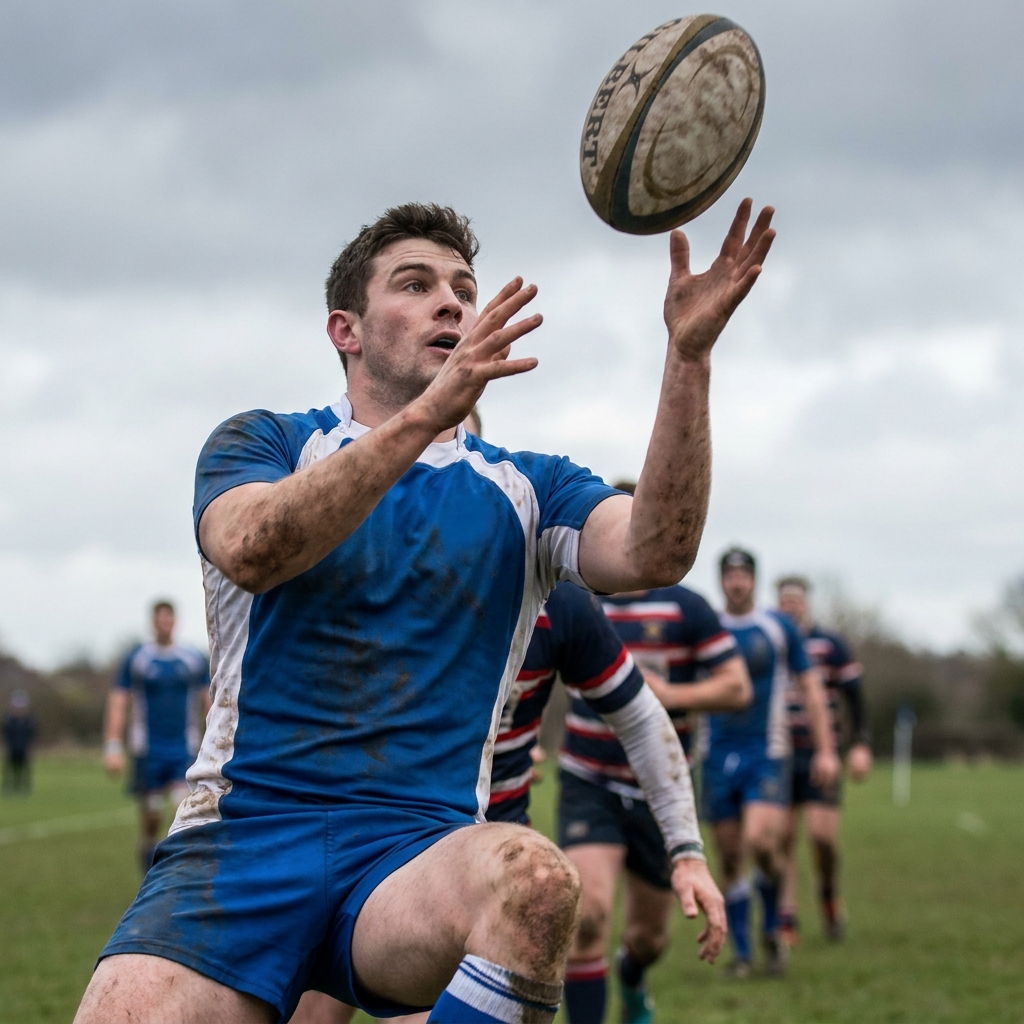
Catching the ball is the easy part. The decision that follows is what separates good counter-attacking teams from poor ones. Train your back three to run through three questions every time they collect a kick.

Decision 1 - Time and space: How close is the nearest chaser? If a chaser is within five metres and closing fast, the answer is almost always to return the kick. If the nearest chaser is ten metres away or more, the carry is on.

Decision 2 - Width on the field: Where are my support runners? A counter-attack needs at least two players in support. If the wingers are still on their wings and the full-back caught it, there is no point trying to run - the carrier will be isolated. Better to step infield to a phase, then launch the next play.

Decision 3 - The defensive picture: Which side is undermanned? Most chase lines come up flat and even, but there is almost always a weakness - usually on the far side of the field where the original kicker stayed back. Counter to that space, not into the strongest chase channel.

How to Build Counter-Attack Habits

Counter-attacking cannot be taught from a whiteboard. It is a reactive skill and must be trained in environments that look like the game. Here is a progression that works at every level from U16 upward.

Stage 1 - Catch and scan: Two minutes of high-ball drills where every catcher must shout the position of the nearest chaser before they hit the ground. This trains the pre-catch scan, which is the foundation of every good counter-attack.

Stage 2 - 3v2 from a kick: Coach kicks the ball into a back three. Two chasers come from 20 metres. The back three must keep the ball alive and beat the chasers using one of three responses: switch infield, hit a support runner on the outside, or counter-kick.

Stage 3 - Full-pitch transition game: Conditioned game where every kick must be returned. No mark allowed, no exit kick allowed. Forces players to find solutions and exposes which units have not learned to support the back three quickly.

The Forwards' Role in Counter-Attack

This is where most teams fail. The back three can be brilliant, but if the forwards are still standing where they were before the kick, the counter dies at the first ruck. Coach your forwards to react to opposition kicks like a fire alarm - the closest three drop into the back-field as immediate support, while the rest fan out across the pitch ready to play.

This habit takes weeks to embed. Start by freezing training every time a kick is fielded and asking each forward to show where they should be running. Repetition turns it from a thought into a reflex.

Key Coaching Points

  • The transition window is six to eight seconds - move the ball before it closes
  • Train the pre-catch scan: who is chasing, how close are they, where is the space?
  • Counter to the weak side of the chase, not into the strongest channel
  • Forwards must react to kicks as quickly as the back three
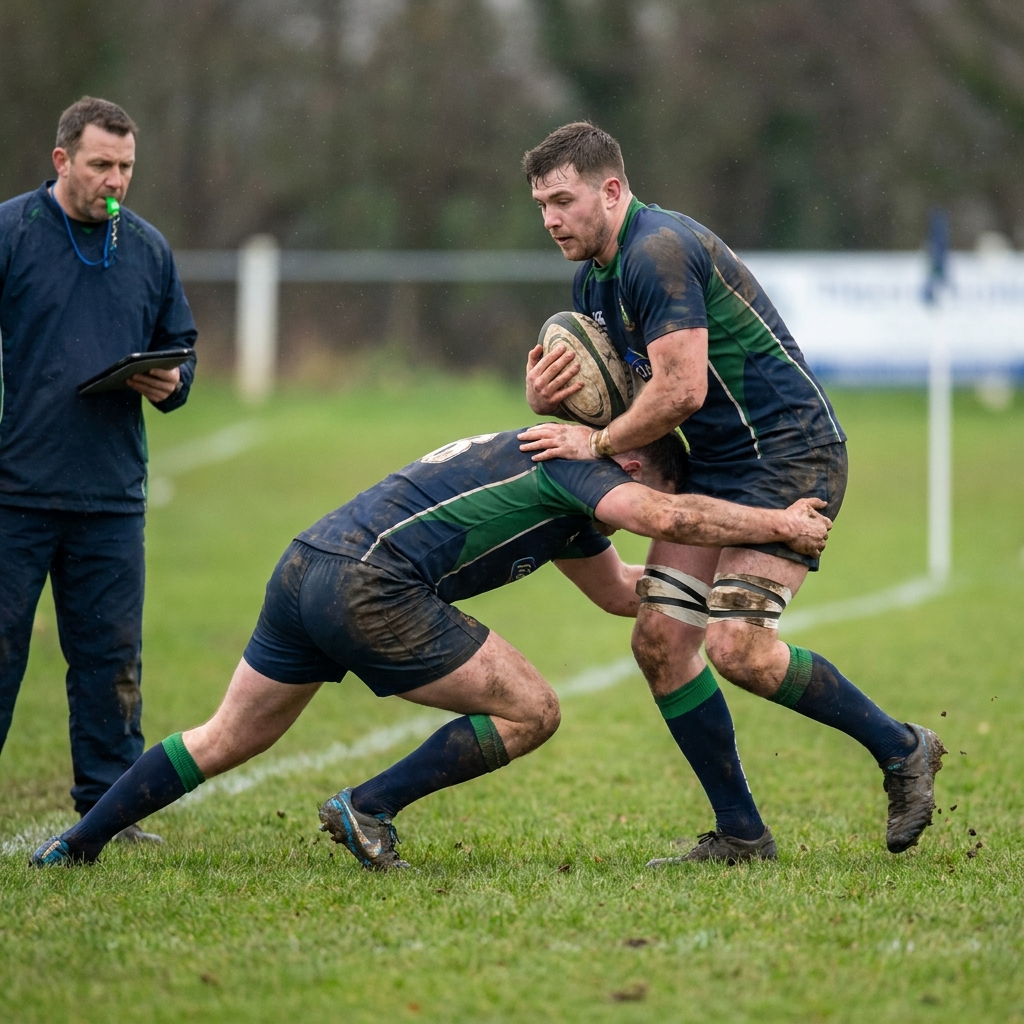
  • Avoid contact in your own 22 - if the counter is not on, return the kick

Recommended Drills

VIEW ALL DECISION-MAKING DRILLS

running with the ball DRILLS
View All

Continuous Passing Square 2 Pa...

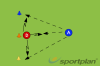
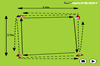
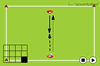
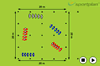
Set up a square of cones, and get the players to form equal lines behind each cone.The ball starts in the hands of a player behind cone 1, who runs (black running line) towards cone 2, passes the ball to the player behind cone 2 who passes the ball back to the first player. The first player then runs towards cone 3 and passes the ball to the player standing behind cone 3.The player who passed the ball from behind cone 2 runs (blue running line) following the run of the first player and receives a pass from the player behind cone 3 before running towards cone 4 and passing the ball to the player behind cone 4.The player who passed the ball from behind cone 3 runs (yellow running line) following the run of the second player and receives a pass from the player behind cone 4 before running towards cone 1 and passing the ball to the player behind cone 1.The player who passed the ball from behind cone 4 runs (red running line) following the run and receives a pass from the player behind cone 1 before running towards cone 2 and passing the ball to the player behind cone 2. The player who passed the ball from behind cone 1 runs (black running line) following the run and receives a pass from the player behind cone 2 before running towards cone 3 and passing the ball to the player behind cone 3, and the drill continues.Change the direction which the ball is going.Progressions:Get the players to change direction on your command (shout/whistle etc)Multiple ballsAs a group must complete 10 successful passes before the session can move on, every time a ball is dropped the whole group does an exercise (e.g. 10 press ups).

General

Unfortunately there were no results for your search! Please try again
running with the ball ANSWERS
View All

My son will not run with the b...

My sons plays for the U9 team, his position is number ten, he was put there due to his kicking power, drop kicking accuracy, etc - I have been teaching him over time to tackle this has helped him build his confidence - what I have been noticing is the fact that when he gets the ball, he wont run - he just refuses to do anything with it...I need to find a way to encourage him the move forward with it, but nothing ever happens, now his own team mates are starting to look down at him, since he has giving the game away far to many time. Help!

john mcqueen Coach, New Zealand

u8s running sideways not forwa...

What drills would anybody reccomend to encourage forward running in an u8s side,whilst keeping it fun?Some players tend to crab along the pitch.

Archived User Coach

Tap penalty - Running onto the...

When taking a tap penalty can a member of the kicking team be running onto the ball before the tap is taken?

Archived User Coach

Tips on breaking through a def...

Hi my name is Mac and i am a 8 man and i struggle to push through a defensive line when i have the ball due to how my coaches make us practice so i wanted to know tips on how to push/break through a defensive line when i have the ball.

Mac Coach, United States of America

switch pass in rugby union

switch pass in rugby union

maria Coach, England

what are simple drills for touch rugby...to get ready?

what are simple drills for touch rugby...to get ready for the season?

Archived User Coach

Successive quick tap penalties - at referee's discretion ??

During a recent U17's league game, the opposing side took two consecutive quick tap penalties. During a break in play shortly after, as the coach attending an injured player, I questioned the referee on the legality of this passage of play, as my understanding was that two consecutive quick taps, used to catch the opposition in an offside position and therefore gain terratorial advantage, was not allowed under current law. The referee responded that this law is at his discretion and when we discussed after the game, he stated there is no such aw and that it is a "gentlemens agreement". I have since reviewed the laws on penalties and there is no specific law preventing a side taking two quick tap penalties. Has anyone else come across this interpretation and how can this be managed consistantly if when watching elite games, such a move is not allowed yet can be allowed at junior level ?

Archived User Coach

Our under tens when they go into a ruck situation often go straight over the ball leaving it in the open. A is this ball then available to be played by any player from both teams and B if this ball is out how can we teach them to secure the ball.

Ask a question and have it answered by Coaches from around the world and Sportplan's team of Experts.

Archived User Coach

what are the rules of tag rugby?

what are the rules of tag rugby?

Chris Mason Coach, England

Our U12 fly half is a talented yet small player but?

Our U12 fly half is a talented yet small player but only seems to tackle when a player has already gone by and he uses his pace to takle from behind/side. Is there a drill to improve his confidence tackling face on.

Archived User Coach

i coach collegiate womens rugby...any suggestions for?

i coach collegiate womens rugby...any suggestions for tackling sessions in practice - my girls are very hesitant to "hurt" each other. we have tackle dummies, but that just isn't the same...

Archived User Coach

Law 12 - the forward pass or throw forward

The law says that a forward pass is one "thrown forward" "in the direction of the opponents' goal line" Does that mean that, if the ball is passed and the receiver catches it NEARER to the opponents goal line than from where the ball was passed that the pass was forward? (Leaving to one side any other touches of the ball that might have taken place.) Maybe an example is better. Player 1 passes the ball sideways - releasing it on the 22 metre line. Player 2 (with no other player having touched the ball), running from well behind the 22 metre line, catches the ball when it has travelled sideways but the ball is now 20 metres from the opponents goal line (2 metres further forward from the place that the ball was passed). Is that a forward pass or throw forward? And if not, why not?

Archived User Coach

Scoring tries - habit?

Why is it important to get players to score the try when completing a handling/running drill?

Archived User Coach

Kickoff Alignment

I am looking for a set up for receiving a kickoff in rugby. We are using the expoloded scrum method and marking their forwards on the kickoff now. But if the forwards move or are split we end up looking like the Keystone Cops trying to match. What is a prefered set up?

Matt Coach, United States of America

Can I and should I coach basic tackle skills to U8s?

Does anyone have a definitive answer to this question%3A can I coach basic tackling skills to U8s now, in preparation for next season, without falling foul of any RFU rules or regulations? Hugo

Hugo Norton-Taylor Coach, England

Looking for drills to improve my U10's defending skills?

We have recently formed a new under 10s team. Out of the team , roughly half have played before, and the other half are new to the game. We played Sunday and were well beaten , although the side we played has a very good reputation for being a good side. I do see promise though in our team, it's just the organisational side that needs attention. Example, keeping our players from bunching, realigning in defence, etc. after doing the coaching course, I am we'll aware of trying not to pigeonhole players into positions, but I think they need this to help them organise themselves easier. Are there any drills to help with the above? Cheers, Chris.

christopher jenkins Coach, Wales

Looking for day 0 skills to teach children?

I am looking for a Day 0 type of session for American children who may have never held a rugby ball. If I move forward with a rugby exhibition/team creation in the neighborhood, I want to make sure I know how/what to teach Day 0. I'm hoping that interest is growing for touch and flag rugby due to the recent in Philadelphia between the USA Eagles and the Maori All Blacks. I was there. It was fantastic. Tickets sold out so fast, I think there will be more of these in the area. Thanks.

Doug Jones Coach, United States of America

How to stop U12s forwards picking the ball up?

My forwards constantly pick and go from the rucks in games and this is starving the backs from any ball. Is there anything I can do, drills etc, which would help them realise there is a time and a place for pick and go, but to do it every time narrows the game and it becomes ineffective and not good teamwork.

Simon Luxton Coach, England

Do U9's have to have both hand...

In relation U9's, I've read about the two hands on the ball ruling in U7 tag, Is there a similar requirement in U9's to have both hands on the ball when running etc (this was flagged up by a learned touchline parent?). Can anyone close the loop on this one for me?

P Naylor Coach, England

Taking the ball into contact -...

Several of my players are taking the ball a yard too far into contact and losing possession as a result.Do you have any suggestions or drills that would help to address this? Dave Knights. Hong Kong

Archived User Coach

JOIN SPORTPLAN FOR FREE

  • search our library of 1100+ rugby drills
  • create your own professional coaching plans
  • or access our tried and tested plans

Sportplan App

Give it a try - it's better in the app

YOUR SESSION IS STARTING SOON... Join the growing community of rugby coaches plus 1100+ drills and pro tools to make coaching easy.
LET'S DO IT