
Watch a try go in from open play and the camera usually follows the wrong player. Everyone sees the runner who takes the final pass, but the try was made two or three phases earlier by someone arriving on the right shoulder, at the right depth, calling for the ball before the defence had reset. Support play is the least glamorous skill in rugby and the one that decides most matches.
This month is a good excuse to put it back on the training plan. The new Nations Championship has Six Nations sides facing the southern hemisphere's major unions throughout November, and those contests are a useful reminder for players of how much modern rugby is won by runners arriving in support rather than by the ball carrier alone. At club and school level the lesson is simpler: a team that organises its support lines well will create more line breaks than a team that only works on the carry.
Why Support Play Breaks Down
Most support errors are not about effort. Players chase hard, but they chase the ball rather than the space, and they arrive flat, square to the try line and too close to the carrier to be any use. A flat, square support runner gives the defender two targets standing next to each other, so the tackler simply shuts down both.
The fix is a slightly curved, or "banana", running line that starts wide and bends back in behind the ball carrier. Done well, it keeps the support runner out of the first tackler's reach, keeps depth so there is time to catch a pass on the move, and keeps the option alive for a second or third runner to do the same thing on the next phase.
Five Habits of a Good Support Line
Step One: Read the picture early. Good support runners decide where to go before first contact, not after. Teach players to scan the defensive line and the space behind it while the ball is still two passes away, not once their teammate is already tackled.
Step Two: Find the right depth. Too flat and a runner is no option at all; too deep and they cannot get to the ball in time. Aim for roughly two to three metres behind and slightly outside the ball carrier, close enough to arrive quickly, deep enough to be running onto the pass rather than standing and waiting for it.
Step Three: Run to space, not to the ball. The habit to break is chasing the carrier directly. Instead, players should run to the space the defence has left, bending their line in only at the last few strides so the final option appears late to the defender.
Step Four: Communicate loud and early. A support runner who calls "inside" or "outside", or their own name, the moment they commit to a line gives the ball carrier a genuine decision to make. Silent support is guesswork for the carrier under pressure.
Step Five: Arrive with intent. Every support run ends in one of two jobs: hands up and ready to take the ball on the move, or body ready to clean out and protect it. Drifting in without deciding which job you are doing is how turnovers happen.
How to Train It: A Simple Session Plan
Warm up with a passing square that always finishes with the passer following their pass into a support line, so the habit starts before the session gets competitive.
Move into technical work: 2 vs 1 shapes where the lone support runner must find the banana-shaped line and communicate before the carrier draws the defender. Correct depth and angle on every rep rather than letting bad habits repeat at pace.
Build decision-making with 3 vs 2 and 2 vs 2 shapes, rewarding players for getting their line right even if the final pass does not come off. The habit matters more than the outcome at this stage.
Finish with a small-sided game and a simple rule: no player may be the first or second support option in the same phase twice in a row. It forces the whole team to organise support, not just your quickest two players.
Key Coaching Points
- Support runners should decide their line before the ball carrier is tackled, not after.
- Aim for a slightly curved running line with depth, never flat and square to the carrier.
- Run to the space the defence has left, bending in late rather than chasing the ball directly.
- Call early and clearly; silent support gives the ball carrier nothing to work with.
- Decide in advance whether you are there to receive the ball or to clean out and protect it.
- Reward good lines in training even when the pass does not come, so the habit sticks under pressure.
Recommended Drills
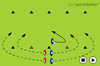 3 vs 2 - Sprint to Support
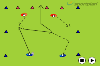 2 vs 2 - Out/In Support Line
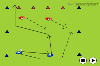 2 vs 2 - Loop and Step Inside
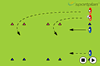 2 vs 1 - Decision Making
VIEW ALL DECISION MAKING DRILLS
Frequently Asked Questions
What is the difference between support play and just backing up?
Backing up is simply following the ball carrier in case something goes wrong. Support play is active: the runner reads the space early, chooses a specific line and depth, and arrives ready either to take the ball or to clean out. It is a planned decision, not an instinct to stay nearby.
How many support runners should a ball carrier have?
Two is a realistic target for most club and school teams, one slightly inside and one slightly outside, at different depths so the carrier has a genuine choice. Trying to coach three or four support options at once usually just causes congestion around the ball.
My players bunch around the ball carrier. How do I fix it?
Bunching almost always comes from support runners chasing the ball instead of reading the space. Use small-sided games with a rule that no two support runners can occupy the same depth or angle, and reward the first player to spot and fill an open line rather than the one who simply arrives first.

 sportplan_rugby