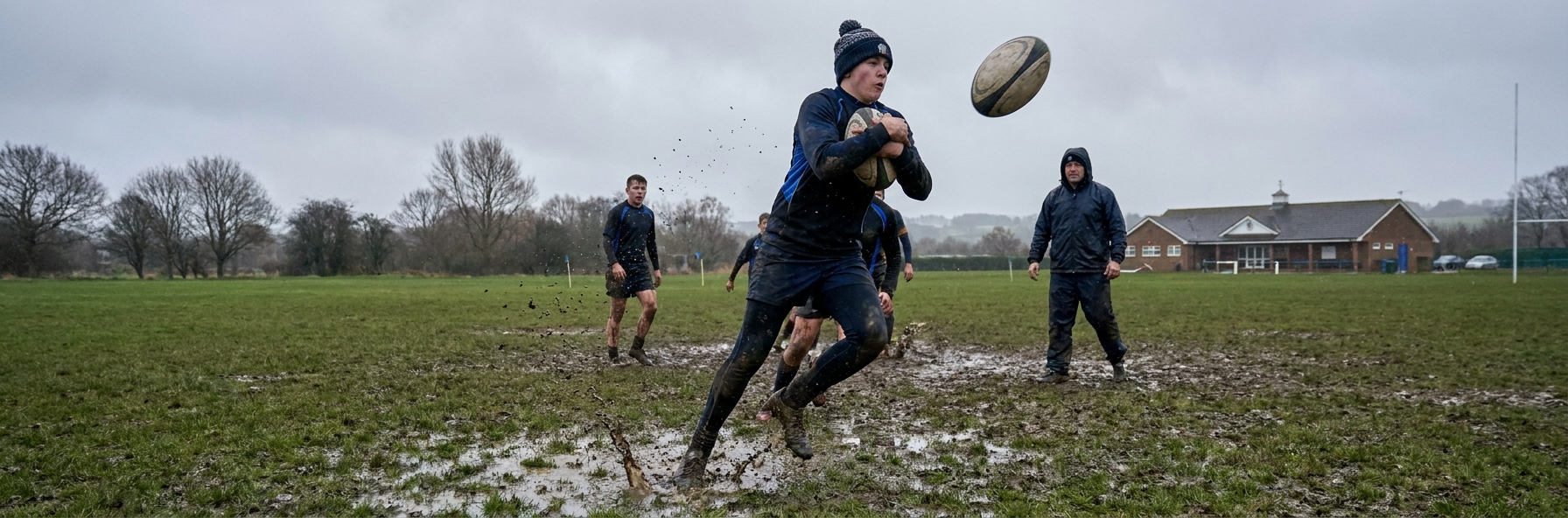
By late November the novelty of a muddy pitch has worn off. The ball is heavier, hands are cold, and a pass that was routine in September now squirms loose under the lightest pressure. Clubs who coached for this lose fewer turnovers than clubs who hope the conditions improve.
The good news is that wet-weather handling is a coachable skill, not a lottery. Small changes to technique, decision-making and session design keep the ball alive long after the pitch has given up being firm and dry.
Why Handling Breaks Down in Winter
Three things combine against you. The ball itself is slicker and often heavier once it has picked up water, so grip has to work harder for the same result. Hands are colder and less sensitive, so players feel contact with the ball later than they do in summer. And underfoot conditions are less stable, so the lower body is working to stay balanced at the exact moment the upper body needs to be soft and precise with a pass or catch.
None of this is fixable by wishing for better weather. It is fixable by training the specific habits that compensate for it.
A Framework for Secure Hands in the Wet
Step One: Slow the catch down. In the dry, players can get away with catching across their body or at full stretch. In the wet, insist on catching with two hands, fingers spread, and the ball brought in to the chest as early as possible. A secure catch close to the body beats a flashy one-handed take every time conditions are poor.
Step Two: Widen the target, not the risk. Ball carriers should present a bigger, calmer target for the pass, hands up early, rather than demanding a flat, fast ball that is harder to control in the wet. Passers should favour a slightly slower, truer pass over a rushed one.
Step Three: Protect the ball after the catch. The moment after taking possession is when most wet-weather turnovers happen, because players relax their grip to look up or change direction. Coach a firm two-handed grip for at least one extra stride after every catch before the head comes up to assess options.
Step Four: Simplify decisions under pressure. Wet conditions punish hesitation and complicated handling patterns alike. Reduce the number of options a player has to process in poor conditions drills, so technique does not collapse under decision load as well as weather.
Step Five: Rehearse the recovery. However good the technique, the ball will still be dropped or knocked on more often in winter. Train players to react instantly, chase hard and compete for the loose ball rather than stopping to blame the conditions.
How to Train It
Warm up with simple catch-and-pass work using a wet or deliberately slippery ball if you have one, so players recalibrate their grip before the session gets competitive. Move into technical blocks on secure catching and controlled passing in pairs and small groups, exaggerating the "two hands, into the chest" habit. Add a decision-making phase with a defender applying pressure on the catch, so players learn to keep the ball under duress rather than in isolation. Finish with a small-sided game where every handling error gives up a scrum or restart to the opposition, so the consequences of loose ball carry into a game-realistic setting.
Key Coaching Points
- Catch with two hands and bring the ball into the chest as early as possible.
- Present a bigger, calmer target for passers rather than demanding speed over control.
- Keep a firm two-handed grip for a stride after every catch before assessing options.
- Simplify the decisions you ask of players in wet-weather drills so technique does not overload.
- Train the reaction to a loose ball as hard as you train keeping hold of it.
- Adjust footwear and pitch-reading early in the session, not after the first slip.
Recommended Drills




Frequently Asked Questions
Should we train differently in the wet, or just do the same drills more carefully?
Both. Keep the same core technical habits, two hands, ball into the chest, firm grip after the catch, but simplify the decision-making you layer on top so players are not trying to solve a complicated pattern and fight the conditions at the same time.
Is it worth training with a deliberately wet ball even on a dry day?
Yes. Wetting the ball for part of a warm-up is a cheap way to force the "two hands, bring it in early" habit before match day, rather than waiting for the first genuinely wet fixture to find out who has not practised it.
Our handling errors go up in winter even though the players have not changed. What is really going on?
Usually it is a mix of colder hands, a heavier ball and less stable footing, not a drop in ability. Treat it as a conditions problem to coach around rather than a form dip, and revisit the basics of grip and presentation rather than more advanced patterns until the habits are solid again.

 sportplan_rugby