









Excellent drills, very detailed videos. Useful site for my U15 boys team.

I'm looking for suggestions on set plays for free hits going into the circle. High school rules in the US now state that all players (attack/defense) must be 7 yards from the ball. What plans will work for drawing corners and goal scoring opportunities?

Can anyone provide me ideas on how to combat a half field press in hockey?
What's a good drill for creating space in the attacking 'D'?
My Girls team I coach get caught a lot between man marking and zonal marking in the 23 yard area and sometimes end up with half the team doing one and the rest the other. Suggestions on the ideal defensive set up inside the 23?
What are the best conditioning skills to practice with a junior high team? (12-14 yrs) We are limited the first few days to indoor practices in a small space. They are not in shape, so we are starting from scratch. Our first game is in 3 1/2 weeks.
how do you stop your team over crowding in the circle? what drills or game situations could i use at training?
Dear colleagues, I am coaching a 1st women team (Argentina) and the system that is working for us very well is 3-1-3-3. Given the quality players we've got in the midfield and attack we try to emphasize our offensive game all the time. The problem I am struggling to resolve is that the forwards do not get involved in chances to score inside the circle very often. The few chances the forwards have they are able to score but it is our midfielders who most of the time get to the circle in possession with the ball. I would like to see a quick transfer of the ball from the midfielders to the forwards who need to be in touch with the ball more often during the game and have the midfielders supporting the attack rather than being the leaders of the attack.Is there any drill or way to improve this aspect of the game? Thanks for your time. Martin
I am a high school coach in the USA. We played a team this past weekend who had a defender who lifted on a free hit 30-40 yards. That was pretty much their only offense. All of their forwards were ready to receive the long balls. How do we defend that? Should I have almost everyone drop back 30-40 yards?
overlapping outside halves ? or drop Midfield in hole?
Hi can you help me setting a defence against a team playing 2 centre halves. My team plays conventional style 5321 . Thanks
Hi,I perhaps naively, expected to have most of our team from last year carry over and only have a few new comers to integrate and get up to speed with the rest. However meeting the team at our first practice last night i find I have five players still at school from last year and the rest all new comers, most of whom had not held a hockey stick at all till practice.This being only my second season coaching (year 9 to year 13 boys) has left me feeling a little blindsided, and feeling quite unsure how to prepare practices that target both groups of boys. Do i lump them both groups together, keep them separate? What drills/exercises to best bring the new comers up to speed.I don't want to neglect either group, keep practice worthwhile for the experienced boys, but also bringing the new comers up to a level were they can mix in with the others and learn organically from them while practicing as a team. David
i often feel like i dont play to the best of my abilities. during practices im almost at the top of my game but come the match my skills, confidence and abilities seem to take quite a tumble. i want to please know how to keep the pace on and off the field.please please, hockey is my life!
How to coach fast attackers to control the pace of the ball as they accelerate? At higher speeds, the players' touch on the ball needs to be "softer" but this requires hands and feet to work at varying intensity. I see a lot of speedsters push the ball too far ahead of themselves, the faster they go. The outcome is often a failed shot at goal because the ball runs out of reach or out over the back line.
I like trying to play every position and find it hard to stop doing that and focus and improve my own position (right wing or center back) but how do I improve them so that I can be confident enough to trust my teammates and stick to my own position ?? Asked using Sportplan Mobile App
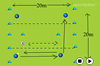
What size space would you use in this exercise?
This applies to both the simple plan and the standard plan. When I save, stop editing, and then print to PDF it creates a lot of white space in very box. I am trying to make a one page plan because I post it on the court board prior to every practice. Can we fix this?

Dear colleagues, I am coaching a 1st women team (Argentina) and the system that is working for us very well is 3-1-3-3. Given the quality players we've got in the midfield and attack we try to emphasize our offensive game all the time. The problem I am struggling to resolve is that the forwards do not get involved in chances to score inside the circle very often. The few chances the forwards have they are able to score but it is our midfielders who most of the time get to the circle in possession with the ball. I would like to see a quick transfer of the ball from the midfielders to the forwards who need to be in touch with the ball more often during the game and have the midfielders supporting the attack rather than being the leaders of the attack.Is there any drill or way to improve this aspect of the game? Thanks for your time. Martin
overlapping outside halves ? or drop Midfield in hole?
Hi,I coach a university team that has a group of mixed abilities, ranging good players with some previous hockey experience to some who are starting from the basics. We've managed to polish on basics and now the team is able to play together. They move the ball well around the pitch using the wider areas, good defence and tackles, but the big problem is creating scoring opportunities. Without goals we can't win matches... The best is draws which we get most times. I was wondering if anyone could share a small sided game or drill that could help create the attack mindset so my team can have that hunger for goas and go for it.

Hi all, thank you for taking the time to read my question. I was hoping for some clarity around 'presses'Pressing oppositions 16- Full press3/4 pressHalf courtWhat are the pro's and cons offensively of each and in what situation would you suggest using each?


in more ways than one
 sportplan_hockey




A few weeks into the league season, poor first touches are costing teams the ball. Coach body shape, scanning and receiving on the move to keep possession.

Pre-season fitness fades fast once the league starts. Build conditioning into ball work and use rolling subs well to keep your squad sharp all season.

The first weeks of the season decide whether a junior or new player sticks with adult hockey. Here is how to keep them safe, give them a clear job and build their confidence from the very first bully.
Coaches from around the world look to Sportplan for coaching confidence.
Excellent drills, very detailed videos. Useful site for my U15 boys team.

I love using Sportplan. It's been a great help for co-ordinating hockey practice and being able to help tweak skills and getting the most out of my players!

Great site. An absolute must for coaches who are willing to change and learn new drills. Superb, simply superb.

Wow what a great website, I have found sportplan an important tool for me when planning my netball sessions with my netball team. There are alot of very helpful tips/ideas/skills that I can learn and teach to my team. Thank you sportplan I hope to continue to use your helpful tips and to learn more about improving my teams netball skills. Thanks again....keep it up....

I have been using Sportplan now for 3 years and can honestly say that I have never repeated the same session twice. My girls are always focused and are improving every year. Thanks Sportplan.
What a fantastic tool. The Chalkboard and session tools make an unbelievable difference in making training plans in both time and organization. I will be instructing all of my assistant coaches that this tool must be used for all sessions during the season, so that we may build a club coaching resource library.
I can't get enough of the Sportplan, It has given me back the enthusiasm i was starting to lose. My girls are so keen and are ready at 14 to take the next up in their game. Sportplan will help no end.



