









Excellent drills, very detailed videos. Useful site for my U15 boys team.

Hello all, im coaching a ladies first team and im trying to motivate them to take it a lot more seriously then they currently do. They want to train hard but are afraid of making mistakes defensively. Instead of getting back behind the ball when they make a mistake they almost seem embarrassed and stand there with their arm up. I give them as much encouragement as possible without following them round with a pillow!! Also only 2/3 of the squad come to training which is frustrating as both forwards never attend training but the captain wont drop them and come saturday, they have no clue as to what we have been working on. So im having to take 15 minutes out of my pre-game warm up with the rest of the ladies to explain whats going to happen. I get paid to coach them on Tuesday nights but i do saturdays for free. It is frustrating to say the least and i would love any help you can give pleeeaaasseee!!! Mike

Hi all just wondering if there are any coach's that have any good tip for a new coach like me. I am coaching under 6/8yr olds and find they get bored very easy. How do you keep them from getting bored and what fun drills do you use? Cheer James first time coach

I have a team of 12 girls, many are new to the game. How do I prepare them to work together as a team and learn their positions when I can't simulate a game in practice?
I have just returned from coaching my first high school hockey tournament. It was great fun but the girls really felt it by the end of the tournament. I want to offer guidance in the form of a fitness build up to the girls for next season but am not sure what my expectations should be. How fit should you be looking to get if you are preparing to play 7 50min games over 5 days? And what types of fitness should I be suggesting? Sprinting and Intervals along with Swimming are things I feel that could be introduced. Ideally it needs to be accessable (not expensive or require special equipment), self managed (to an extent) and let it fit in with their daily rountine as best possible to give them the best chance to commit (i.e. I feel like suggesting they power walk to school rather than get dropped off will work better than asking them to join a gym to do the pelaton classes) Any ideas? Or things that have worked in the past?
I have a team of 14 year old girls who mostly want to run with the ball rather than pass. A lot of them are strong ball carriers and so often achieve success this way but am concerned that this strategy will not work once the other teams get bigger and stronger, and that it is too one dimensional. What are the best ways to change this approach?
My U13 Girls play really well in the first half but drop of badly in the second half - this has caused us too many draws. How do I get consistency for the whole game?

Please can you explain the difference in the full court press press and the half court press

Hi all,I've got my level 2 assessment coming up on Sunday and I just wanted to quickly check whether there's a 'recommended' structure to the session plan.Btw, this is a level 2 practical assessment and is with juniors (U14s).One coach has suggested a 3 part approach:1) techniques and skills required2) unopposed 3) opposedThe theme I'm choosing, which is a bit of a generic one, is defending in a channel (as I'm a defender and it's pretty straight forward).I'm not really looking for info on what exactly to include (i.e. theme specific) but rather general structure or whether E.H. have an approved structure to sessions?My session's on Sunday, so a quick reply would be awesome.Thanks,Gary

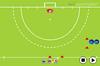
Hi, in this week's session "My players lack the ability to pass accurately", there's a progressive exercise called "shoot and recover". Sorry if this is a dumb question but when a player is 'shooting' at their target goal, is the other player allowed to defend the goal?I ask because the diagram makes it look like you're pushing over around 12m and I'd have thought that unless you make the goals huge, with a player defending the goal, people just aren't going to score.Also, if you make the goals really big, it kinda defeats the person of the accuracy element to the exercise.Hope you can assist. Regards,Gary
overlapping outside halves ? or drop Midfield in hole?
Can someone give me advice on the best was to teach ladies 3d skills while entering the D? I am open to any suggestions. I have tried to get them lifting the ball over sticks but it doesn't seem to transfer to matches.
I've got a team of year 5 and 6s getting together and i want to know what a good drill to use to see who is going to be defenders and attackers
Hi,I perhaps naively, expected to have most of our team from last year carry over and only have a few new comers to integrate and get up to speed with the rest. However meeting the team at our first practice last night i find I have five players still at school from last year and the rest all new comers, most of whom had not held a hockey stick at all till practice.This being only my second season coaching (year 9 to year 13 boys) has left me feeling a little blindsided, and feeling quite unsure how to prepare practices that target both groups of boys. Do i lump them both groups together, keep them separate? What drills/exercises to best bring the new comers up to speed.I don't want to neglect either group, keep practice worthwhile for the experienced boys, but also bringing the new comers up to a level were they can mix in with the others and learn organically from them while practicing as a team. David
Whats the best drill for ladies to attack at pace?
You can use Sportplan to challenge your players to stay busy at home and improve fitness! Looking for a way to improve all round muscle strength? Try this basic circuit routine! Got a different idea or exercise let the community know how you're challenging your players at home!

how can I make practises such as the indian dribble and running with the ball using the correct grip more entertaining for junior players?

in more ways than one
 sportplan_hockey




A few weeks into the league season, poor first touches are costing teams the ball. Coach body shape, scanning and receiving on the move to keep possession.

Pre-season fitness fades fast once the league starts. Build conditioning into ball work and use rolling subs well to keep your squad sharp all season.

The first weeks of the season decide whether a junior or new player sticks with adult hockey. Here is how to keep them safe, give them a clear job and build their confidence from the very first bully.
Coaches from around the world look to Sportplan for coaching confidence.
Excellent drills, very detailed videos. Useful site for my U15 boys team.

I love using Sportplan. It's been a great help for co-ordinating hockey practice and being able to help tweak skills and getting the most out of my players!

Great site. An absolute must for coaches who are willing to change and learn new drills. Superb, simply superb.

Wow what a great website, I have found sportplan an important tool for me when planning my netball sessions with my netball team. There are alot of very helpful tips/ideas/skills that I can learn and teach to my team. Thank you sportplan I hope to continue to use your helpful tips and to learn more about improving my teams netball skills. Thanks again....keep it up....

I have been using Sportplan now for 3 years and can honestly say that I have never repeated the same session twice. My girls are always focused and are improving every year. Thanks Sportplan.
What a fantastic tool. The Chalkboard and session tools make an unbelievable difference in making training plans in both time and organization. I will be instructing all of my assistant coaches that this tool must be used for all sessions during the season, so that we may build a club coaching resource library.
I can't get enough of the Sportplan, It has given me back the enthusiasm i was starting to lose. My girls are so keen and are ready at 14 to take the next up in their game. Sportplan will help no end.



