Rugby: touch rugby
July 2026

July is the month most clubs dust off the running shoes and head for the hills. It feels productive - lads coming back sweaty and sore, the group bonding through shared suffering. But months of steady-state running rarely show up where it matters: in the last ten minutes of a tight match, when the legs are gone and a defender still needs tracking.

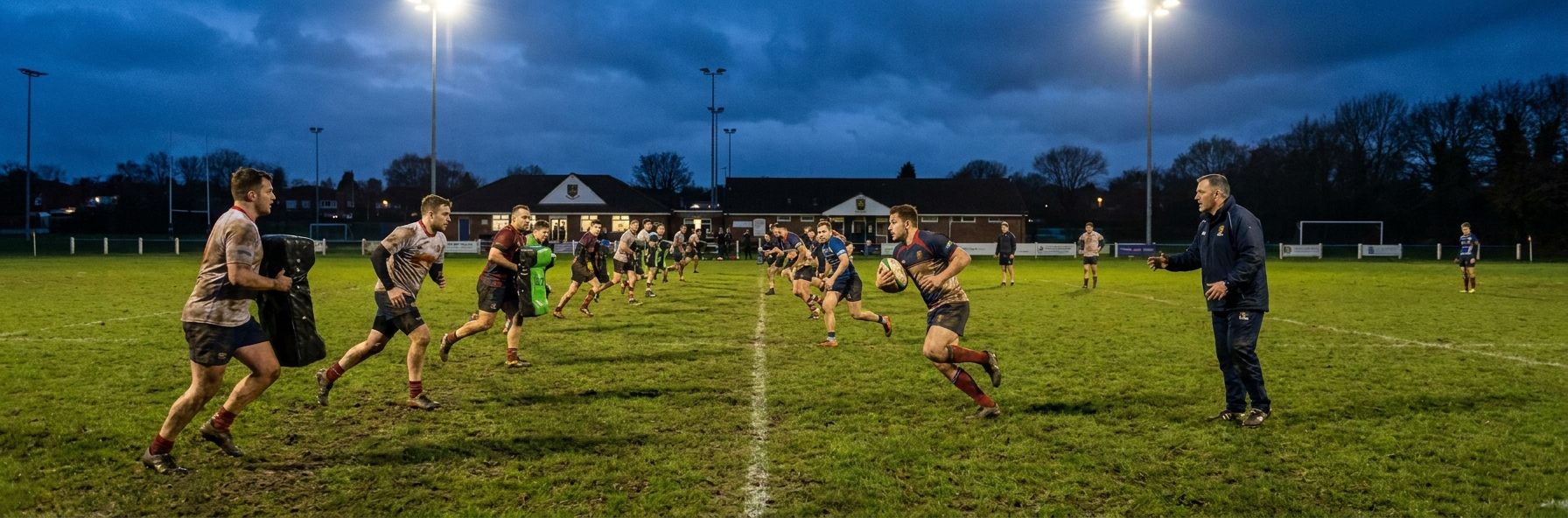
The modern thinking on pre-season is simple. Rugby is a game of repeated high-intensity efforts, collisions and rapid decisions under fatigue. Your conditioning should look like that too. Get the ball into the work as early as you safely can, and build volume gradually rather than front-loading everyone into the ground in week one.
Why Traditional Fitness Falls Short

Rugby is not a steady-state sport. It is a series of short, sharp bursts - a sprint to the breakdown, a collision, a scramble to reset - separated by incomplete recovery. Training your players to jog for forty minutes teaches their bodies to be efficient at jogging. It does very little for the energy system the game actually taxes.
Worse, long slow running done in isolation carries a real cost: it eats into the time you have for skills, and it can leave players flat and heavy-legged rather than sharp. Fitness earned away from the ball tends to stay away from the ball.

Build It Around the Game

The most transferable conditioning happens inside rugby-shaped activity. Small-sided games, handling grids run at pace, and repeat-effort shuttles with a skill on the end all raise the heart rate while rehearsing the movements and decisions of a match. Players get fit and better at rugby at the same time.

Step One: Establish a base. Early pre-season, use games and continuous handling to lift general work capacity. Keep intensity moderate and volume gentle - you are waking bodies up, not testing them.

Step Two: Add repeated high-intensity efforts. Introduce shuttle and interval work with clear work-to-rest ratios. Think 15-30 seconds of maximal effort against short recovery, repeated in blocks. Put a pass, a catch or a decision at the end so fitness and skill develop together.

Step Three: Layer in fatigue. Once the base is there, run your skills sessions when players are tired. Handling under fatigue is where matches are won and lost, so rehearse it deliberately rather than hoping it holds up.

Step Four: Sharpen and taper. In the final weeks before your opener, cut volume and lift intensity. Short, sharp, game-realistic work keeps players fresh and fast rather than flat.

Manage the Load, Not Just the Effort

The point of building gradually is not softness - it is availability. Players who are buried under a huge week-one load pick up soft-tissue injuries and spend the season on the physio bench. Track how hard sessions feel, watch for the group getting heavy-legged, and progress the tough stuff week on week rather than all at once.

Small tweaks make a big difference. Vary the work so it is not all running in straight lines. Give genuine recovery between the hard days. And remember that a fit squad that is fully available in September beats a heroically fit squad that is half-injured.

Don't Forget the Collision Engine

Running fitness alone will not prepare a player for the specific fatigue of repeated contact. Wrestling, bag work and short contact-conditioning circuits build the strength and resilience the tackle and breakdown demand. Weave a little of this into the fitness block so that when full contact returns, bodies are ready for it - but build it up carefully, never full-tilt in the first sessions.

Key Coaching Points

  • Match your conditioning to the game: short, sharp, repeated efforts, not endless steady running
  • Get a ball into the work early so fitness and skills grow together
  • Build volume gradually across pre-season rather than front-loading week one
  • Deliberately train handling and decisions under fatigue
  • Track load and protect recovery to keep players available all season
  • Include contact-conditioning so bodies are ready when full contact returns

Recommended Drills

VIEW ALL FITNESS DRILLS

Frequently Asked Questions

Should we scrap long runs from pre-season altogether?

Not entirely. A little low-intensity aerobic work early on helps build a base and aids recovery. The mistake is making it the centrepiece. Once the base is laid, the bulk of your conditioning should look and feel like rugby - repeated efforts, changes of direction and a ball in the mix.

How early should we introduce ball work in pre-season?

From day one. There is no need to earn the right to touch a ball by grinding through fitness first. Handling grids and small-sided games raise the heart rate just as effectively as running while keeping skills sharp and morale high.

How do I know if I'm loading players too hard?

Watch and listen. Persistent heavy legs, dropping session quality, niggling soft-tissue complaints and low mood are all signs the load is climbing too fast. Ask players how hard sessions felt, progress the demanding work week on week, and always protect a proper recovery day.

touch rugby DRILLS
View All

Tabata Touch Tag Rugby - Rugby...

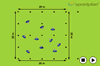
You can play any version of touch you like, I'm going to suggest One Touch Off-Load - but you can change this to suit your training goals for the session ahead. Mark out your training area for the game, but include one or more Tabata training zones for your players (these zones don't have to be very big). If you only have one other person helping you - you might have only one zone, but if you have more assistant coaches or helpers standing around, create more zones - you'll find they will be used. Split your players into two teams, giving them bibs if needed. Keep your law briefing, brief - telling the players the laws of the version of touch you have decided to play. Tell them that as an addition to the normal laws, we now have a sin binning for mistakes e.g. you may decide that all mistakes are sent to the sin bin (The Tabata Zone), you might just focus on forward passes, or penalties. My point is that you can tailor this to suit your coaching goals. Players sent to the sin bin will be there unit sent back by the supervising coach. Don't forget to swap the defense and the attack. Also you can focus the sin binning on the defence for not meeting your defensive goals. Using the Tabata Zones Small areas with one coach/helper. The Tatbata protocol is often 8 periods of intense 20 second activity - with 10 seconds of rest in between (sound simple - try it!). Tell the sin binned player they have 20 seconds to complete as many press-ups as they can, then give them 10 seconds to rest. Repeat 8 times, or reduce to a number of repetitions that work for you and your players. When the player has completed their reps - return them to the game. What you could do in the zones: Press ups, Lunges, Burpees, Sit ups, Etc.

General

Unfortunately there were no results for your search! Please try again
touch rugby DRILL CATEGORIES
View All
touch rugby ANSWERS
View All

what are simple drills for touch rugby...to get ready?

what are simple drills for touch rugby...to get ready for the season?

Archived User Coach

Touch Rugby

I need some drills to attack the zone between the opposing try line to 5m dotted line (in the game of touch rugby?). any advice will be much appreciated.

Archived User Coach

What is the best age to introduce contact?

I'm trying to work out what the best age is to introduce contact to children (tackling, mauling, rucking). I think learning early how to handle contact safely is very important, but at the same time, I want to make sure it is not too early. Are there any universal guidelines, or does it vary from national union to national union?

Dominic Rossi Coach, Canada

what are good drills for touch rugby?

what are good drills for touch rugby?

Archived User Coach

How to begin coaching when the sport is not popular?

How to begin coaching when the sport is not popular and many of player candidates are not familiar with rugby ? What is key of initiation ? How to start from white paper ?

Narek Sargsyan Coach, Armenia

what are the rules of tag rugby?

what are the rules of tag rugby?

Chris Mason Coach, England

Scoring tries - habit?

Why is it important to get players to score the try when completing a handling/running drill?

Archived User Coach

How do I coach women the game of rugby?

I just finished my collegiate rugby career. I feel inspired I would love to coach rugby to women in countries that have a lower popularity of women's rugby. How do I get started?

Archived User Coach

Looking for varations for touch rugby games.

Looking for varations for touch rugby games. Using as a bit of preseason want to freshen the game up.

Jack Redfern Coach, England

rugby tackling under 9s fear

tackling under 9s fear

Archived User Coach

What are some simple drills for touch rugby?

Hi I am a new 19 year old coach, it is my first time coaching and currently am looking after a year 3/4 team for touch rugby. I was wondering if anyone could give me some simple drills to help build the students passing and spreading out skills for touch rugby

Zac Coach, New Zealand

what are the rules of touch rugby

what are the rules of touch rugby

Archived User Coach

I have just started coaching touch at my school and?

I have just started coaching touch at my school and have been trying to find out about field positions. can anyone help me? i have only been doing drils at practice and now want to start having mini matches.

Archived User Coach

Can I and should I coach basic tackle skills to U8s?

Does anyone have a definitive answer to this question%3A can I coach basic tackling skills to U8s now, in preparation for next season, without falling foul of any RFU rules or regulations? Hugo

Hugo Norton-Taylor Coach, England

Teaching Touch Rugby to Beginners - Help

Coaching touch rugby to beginners, what should I do?

Archived User Coach

High School Rugby

We are beginning a high school rugby progrm this spring. Wht is the best way to introduce rugby to students that have never played rugby?

Tony Poti Coach, United States of America

Looking for day 0 skills to te...

I am looking for a Day 0 type of session for American children who may have never held a rugby ball. If I move forward with a rugby exhibition/team creation in the neighborhood, I want to make sure I know how/what to teach Day 0. I'm hoping that interest is growing for touch and flag rugby due to the recent in Philadelphia between the USA Eagles and the Maori All Blacks. I was there. It was fantastic. Tickets sold out so fast, I think there will be more of these in the area. Thanks.

Doug Jones Coach, United States of America

JOIN SPORTPLAN FOR FREE

  • search our library of 1100+ rugby drills
  • create your own professional coaching plans
  • or access our tried and tested plans

Sportplan App

Give it a try - it's better in the app

YOUR SESSION IS STARTING SOON... Join the growing community of rugby coaches plus 1100+ drills and pro tools to make coaching easy.
LET'S DO IT