









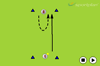
Excellent drills, very detailed videos. Useful site for my U15 boys team.

My team have asked for drills to help them at 16s, can anyone help me

I am looking for a good drill that will explain posting up to maintain possesion? Anyone help?!?!?!?!?!?!?!?
My team are constantly allowing oppositions to score from penalty corners we do 1st runner 2nd runner amp; 2 players on the post, what can I do.
Are there any screen formations set up on sportplan for Hockey? I am after a basic outline for the different screens you can run for 16yd hits, free hits, side line hits etc. Thanks
Hi everyone, I have been hunting for a more detailed explanation on the self pass rule for hockey. My under standing of it is that a self pass must involve the ball moving five meters before it is hit by the player or it must be hit from a dead positon (not moving) I have umpired many games where the players 'tap and hit' the ball, often with another player rushing in to tackle just as the 'tap' is played. This seems dangerous but im not sure if the tackler is playing dangerously or if the 'tap and hit' player is dangerous? I have read the rule book but this rule is not explicit enough. Any interpretaions welcome. Thanks
How should a women team,that cannot use the scoup or an overhead,do when the oposit uses a full press at a 16yd hit??Thank you...
Can you please assist me, I am coaching the 1st school team (0/18). we are playing 3-3-3-1 but there is a big gap between the forwards and links and also between the links and the backs. How can I change that. Is there any excercises that I can do with them or must we rather change the system??
What is the rules for a penalty corner pusher or injector? Must have one leg in or u can have both leg out to use a sweep?

hi there I'm using 4-4-2 and on sometimes 3-1-4-2 with a lower level hockey team.I've chosen this over other formations, simply because the hockey experience and ability of my players is not of a high level (and most people have an approximate understanding of 442). Also, I believe that one must choose a formation based on players traits and what they can deliver. For example, I'd ideally prefer to have 3 forwards, to help with more height and width but then would have to either play 3 in the middle or 3 at the back... and my player strengths don't permit this. In short, I simply don't believe I have a strong enough CH / CM to handle 3 in the middle and I'm not convinced that the off-the-ball support from other players is strong enough to allow 3 in the middle. OFFENSIVE PLAYS Anyway, I'm not 100% where to get my centre mids to stand when we have a 16 yd hit to take (i.e. our possession). Obviously one of the CMs comes deep to offer a potential direct outlet from the centre backs or offer an overload option if the ball goes out to the sides (which is more likely, since I've pretty much banned the high risk play of releasing up the middle - we've had far too many turnovers in our final third or quarter because we tried to play up the middle). My players are 'aware' of posting up and leading runs. However, I'm not sure about the 2nd CM. On the one hand I'd ideally like the 2nd CM to come deep as well, in order to potentially help break up the opposition press but by doing so, I distort the midfield and if we do manage to get the ball to one of the CMs, he won't have the 2nd CM in a higher position to release to, etc. DEFENSIVE POSITIONING Can someone suggest, again, about midfield positioning using 4-4-2 or 3-1-4-2, when we are setting up a general press? I have traditionally encouraged man marking, simply because our general positional awareness is weak (which makes zonal play a no-no IMO) + our tracking and attitude to committed defending (i.e. you donât give up if one tackle fails) could be better! However, looking at suggested presses on Sportplan, some zonal positioning seems a necessity and I think if I can help my players make the step, success will come because they've been forced to become more aware of their pitch positioning, etc. Also, looking at some of the presses, it looks like the midfield can go 'flat' to create a barrier... and as I encourage a diamond shape in midfield, I need to explain to my players what to do and when. Sorry for the wordy question. I hope this all makes sense. Regards, Gary

Hi Im new to coaching hockey want to know what position do I play some of my weaker players without them losing interest and there confidence.
Hi all, I'm looking for drills that assist in getting my team to use both the lower and 25 line T spots. There was a 6 on 5 drill on Sportplan but I can not find it. Does anyone have any I can utilise?
When subbing on a penalty conner, you hold the player out until the ball is inserted, does the player coming in have to be behind mid field or can she be up on the edge of the substitution box?
Does anyone have any good drills to practice or strategies to use for self-starts under the 25? It should be an advantage for the attack, but we seem to give up possession more than we keep it.
What kind of defensive presses do you all run for highshoolers? And is there a resource that will make it easier to teach to them? We play a 4-4-3 with 2 sitters in the midline. Iâm used to a Fall Away Press, but am having a hard time teaching it. Asked using Sportplan Mobile App

Ideas on drills to get defenders to go to the player or the ball not waiting for them to come to them.

When a player is taking a throw in, and they position their first foot at the correct position from the line, can they take a step to the side and lift the first foot before they throw the ball and enter the court?
Dear all, what are best practices for playing long corners? Please advice for playing long corners while attacking and defending long corners.
My Girls team I coach get caught a lot between man marking and zonal marking in the 23 yard area and sometimes end up with half the team doing one and the rest the other. Suggestions on the ideal defensive set up inside the 23?
hi there I'm using 4-4-2 and on sometimes 3-1-4-2 with a lower level hockey team.I've chosen this over other formations, simply because the hockey experience and ability of my players is not of a high level (and most people have an approximate understanding of 442). Also, I believe that one must choose a formation based on players traits and what they can deliver. For example, I'd ideally prefer to have 3 forwards, to help with more height and width but then would have to either play 3 in the middle or 3 at the back... and my player strengths don't permit this. In short, I simply don't believe I have a strong enough CH / CM to handle 3 in the middle and I'm not convinced that the off-the-ball support from other players is strong enough to allow 3 in the middle. OFFENSIVE PLAYS Anyway, I'm not 100% where to get my centre mids to stand when we have a 16 yd hit to take (i.e. our possession). Obviously one of the CMs comes deep to offer a potential direct outlet from the centre backs or offer an overload option if the ball goes out to the sides (which is more likely, since I've pretty much banned the high risk play of releasing up the middle - we've had far too many turnovers in our final third or quarter because we tried to play up the middle). My players are 'aware' of posting up and leading runs. However, I'm not sure about the 2nd CM. On the one hand I'd ideally like the 2nd CM to come deep as well, in order to potentially help break up the opposition press but by doing so, I distort the midfield and if we do manage to get the ball to one of the CMs, he won't have the 2nd CM in a higher position to release to, etc. DEFENSIVE POSITIONING Can someone suggest, again, about midfield positioning using 4-4-2 or 3-1-4-2, when we are setting up a general press? I have traditionally encouraged man marking, simply because our general positional awareness is weak (which makes zonal play a no-no IMO) + our tracking and attitude to committed defending (i.e. you donât give up if one tackle fails) could be better! However, looking at suggested presses on Sportplan, some zonal positioning seems a necessity and I think if I can help my players make the step, success will come because they've been forced to become more aware of their pitch positioning, etc. Also, looking at some of the presses, it looks like the midfield can go 'flat' to create a barrier... and as I encourage a diamond shape in midfield, I need to explain to my players what to do and when. Sorry for the wordy question. I hope this all makes sense. Regards, Gary
I have a ladies team with slow defenders who insist on playing 5-10 yards (sometimes more) off of their attacker. They do this as they say they are much slower and therefore need the space to catch up to them and as a 'buffer'. This is an argument I have heard used by a lot of slower players.I however have been arguing that they'd have more success if they marked closer and tried to prevent them from turning and gathering speed/or being within range to make the interception in the first place. They may get beaten on occasion if the player has the wherewithal to turn with skill and beat their marker, but I feel for a lot of players, the mere pressure of having a defender in close proximity may discourage them from attempting to turn and force them to play the ball backwards.My argument is that if you give a player with speed 10 yards to build up speed against you then it will be harder to stop them/catch them, especially in a wide space. The way I think about it is, if two cars are in a race, but the first one is allowed to get up to 30 mph before the start line AND is the faster vehicle, it's a no-brainer as to who will win. I'm interested to see what everyone else thinks - am I thinking about this incorrectly or does my thinking make sense?


in more ways than one
 sportplan_hockey




A few weeks into the league season, poor first touches are costing teams the ball. Coach body shape, scanning and receiving on the move to keep possession.

Pre-season fitness fades fast once the league starts. Build conditioning into ball work and use rolling subs well to keep your squad sharp all season.

The first weeks of the season decide whether a junior or new player sticks with adult hockey. Here is how to keep them safe, give them a clear job and build their confidence from the very first bully.
Coaches from around the world look to Sportplan for coaching confidence.
Excellent drills, very detailed videos. Useful site for my U15 boys team.

I love using Sportplan. It's been a great help for co-ordinating hockey practice and being able to help tweak skills and getting the most out of my players!

Great site. An absolute must for coaches who are willing to change and learn new drills. Superb, simply superb.

Wow what a great website, I have found sportplan an important tool for me when planning my netball sessions with my netball team. There are alot of very helpful tips/ideas/skills that I can learn and teach to my team. Thank you sportplan I hope to continue to use your helpful tips and to learn more about improving my teams netball skills. Thanks again....keep it up....

I have been using Sportplan now for 3 years and can honestly say that I have never repeated the same session twice. My girls are always focused and are improving every year. Thanks Sportplan.
What a fantastic tool. The Chalkboard and session tools make an unbelievable difference in making training plans in both time and organization. I will be instructing all of my assistant coaches that this tool must be used for all sessions during the season, so that we may build a club coaching resource library.
I can't get enough of the Sportplan, It has given me back the enthusiasm i was starting to lose. My girls are so keen and are ready at 14 to take the next up in their game. Sportplan will help no end.



