






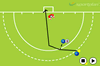
Excellent drills, very detailed videos. Useful site for my U15 boys team.

Can any one help me with the new mandantory rule. If a free hit is taken in the 23mts square and is hit back into the centre square am I correct in coaching that it still must be touched by another stick in the 23mts square before entering the circle

Any tips for the new hockey self pass rules
Ask a question and have it answered by Coaches from around the world and Sportplan's team of Experts.
My Girls team I coach get caught a lot between man marking and zonal marking in the 23 yard area and sometimes end up with half the team doing one and the rest the other. Suggestions on the ideal defensive set up inside the 23?
Please explain the rule about the free hit outside the sirkle.
Are there any drills to force players to stay low
When teaching the self-pass rule to my team, are there any tips in terms of when to hit and when to carry, depending on the situation?
My team's players don't haveãstrong pass. So our pass is hard to arrive for FW. Please tell me way to pass (push, sweep, hit) strong.
How do I get my team to play better as a team and pass more
Does anyone have a simple drill for 7-8yr olds to help with what to do when the whistle blows for a free hit?
player is getting ready to hit free hit. other player on same team is 5 yards away waiting if pass is needed it. defender is right behind her. is tha obstruction?
How should a women team,that cannot use the scoup or an overhead,do when the oposit uses a full press at a 16yd hit??Thank you...
With the new own goal rule it's getting very critical to defend the player who is carrying the ball.The team that I coach had a major problem on this area last season.I've already told them what they sould do in order to make it difficult for the ball carrier to scan for a pass or hit the ball inside our defending circle,or at least make him to drible instead of making a dangerous pass.But,they are not used to doing it and we have conceived a lot of goals that way.We have the same problem at defending a free hit inside our 25 yards,when the attacker dribles with the ball for the neccessary 5 meters and then smashes it into our circle.I am trying to think of a way or an excersise that will make them do it,but I haven't found one.Any ideas for both ways could be very helpful.
could someone comment on the 5 yard rule when entering the scoring area? There always seams to be a lot of wrong information regarding this rule.

My club has a 5s team which is predominantly young lad (15 upwards) but as of next season the juniors team will have 13 year olds who will be joining the mens league. as an older player (Compared to them anyway) myself and another player are going to start a kind of mentoring program to get the youngsters ready for the mens league. what is the best way and any tips what we should be taking note of etc?
rules of free hit
In field hockey, how do you hit a tomahawk flat and accurately?
My team have asked for drills to help them at 16s, can anyone help me
My daughter plays U13 hockey in the position of right wing.She gets different advice from her school coach and her club coach.I want to make sure that she is getting the right advice as she is passionate about her hockey. Firstly, exactly what is the full function of a right wing at this level of hockey (she will be going to U15 club hockey and U14 school hockey next season) She has a good understanding of the game and appears to me to read it well (I only played school level many years ago and things change) When her team is in the offensive position in the âDâ she mostly waits at goal post to deflect ball into goal. She appears to not be involved. Comments from spectators have been made as to why she just stands there. There is a very skilled player in her team who hits the ball EXTREMELY hard. I believe that at this level of hockey these extremely hard hits/passes do not achieve anything, they just keep going out. However, please can you advise on how to stop and control these very hard passes (that is if one can get to them) in order to move on with the game. Lastly, can you send some drills/exercises to get her eye in as well as positioning her body correctly for goal shooting. The âhard hitterâ and my daughter seem to be the main goal shooters of the team. Many thanks Lynne
Hi allI am looking for advice on how to implement processes in my girls school hockey team. processes of setting up presses, defensive structures and counter attacking thinking. I have 14 players in the team from 15 years old to 18. we train twice a week. only a few play club hockey as well. We either play a 3-1-4-2 or a 3-1-3-3.I find it difficult for example, when you want to teach a press on the opposition 16, to simulate gameplay with only 14 players (if they are all at training). I can have my halves setup for taking the 16 and then get my strikers and links to setup, but then I still want defenders to see things from the back but they are taking the 16? Also when taking the 16 they then don't have any support in the drill because everyone else is setting up a press?I know we need to work on our basics in order for the other tactics and skills and game plans to work. However I find it frustrating with this team that on counter attacks for a few reasons which I am struggling to mend;- they only head forward. No one holds up the ball to wait for support.- they run straight and don't use angles- they pass too late and get tackled - they don't have the vision to see an early pass or pass into space- players without the ball do not run into useful positions and angles and get caught out by the person with the ball who then makes a pass to no one and it runs out of play.So suggestions please for;- open, creative but simple counter attacking- teaching processes for presses on free hits and 16s- coaching how to take 16s and work your way out- coaching vision and expecting your players to be in support. RegardsMatt

in more ways than one
 sportplan_hockey




A few weeks into the league season, poor first touches are costing teams the ball. Coach body shape, scanning and receiving on the move to keep possession.

Pre-season fitness fades fast once the league starts. Build conditioning into ball work and use rolling subs well to keep your squad sharp all season.

The first weeks of the season decide whether a junior or new player sticks with adult hockey. Here is how to keep them safe, give them a clear job and build their confidence from the very first bully.
Coaches from around the world look to Sportplan for coaching confidence.
Excellent drills, very detailed videos. Useful site for my U15 boys team.

I love using Sportplan. It's been a great help for co-ordinating hockey practice and being able to help tweak skills and getting the most out of my players!

Great site. An absolute must for coaches who are willing to change and learn new drills. Superb, simply superb.

Wow what a great website, I have found sportplan an important tool for me when planning my netball sessions with my netball team. There are alot of very helpful tips/ideas/skills that I can learn and teach to my team. Thank you sportplan I hope to continue to use your helpful tips and to learn more about improving my teams netball skills. Thanks again....keep it up....

I have been using Sportplan now for 3 years and can honestly say that I have never repeated the same session twice. My girls are always focused and are improving every year. Thanks Sportplan.
What a fantastic tool. The Chalkboard and session tools make an unbelievable difference in making training plans in both time and organization. I will be instructing all of my assistant coaches that this tool must be used for all sessions during the season, so that we may build a club coaching resource library.
I can't get enough of the Sportplan, It has given me back the enthusiasm i was starting to lose. My girls are so keen and are ready at 14 to take the next up in their game. Sportplan will help no end.



