










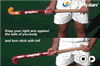

Excellent drills, very detailed videos. Useful site for my U15 boys team.

Does anyone have a link to a few GOOD Hockey Specific fitness tests. And I'm not looking for bleep tests which is somewhat out of date. Many thanks

What is a good fitness programme for hockey?

I'm after a bunch of good drills, not involving a ball, for speed/sprint training? any variations on shuttle runs and sprints would be good
Training 30 Girls as a group before trials. What drills are best to get everyone involved. Take into account ages between 14 and 17.

I'm a junior and really wanna play. Is it too late? Also, how do I get started? Thanks!
As of 1 September, major FIH events such as the Champions Trophy, Hockey World League Final and Rio 2016 Olympic Games will assume a new format that includes moving to four 15-minute quarters and having 40-second time-outs when a penalty corner is awarded and after a goal is scored. Do you think this a positive or negative for the future of hockey?

Im new to female hockey coaching and was just wondering if there is any recommendations someone can give me as to getting setup with a new team for the first night of training, what to look out for etc.
I am a high school coach in the USA. We played a team this past weekend who had a defender who lifted on a free hit 30-40 yards. That was pretty much their only offense. All of their forwards were ready to receive the long balls. How do we defend that? Should I have almost everyone drop back 30-40 yards?
Hi all, I have to do a 30 minute presentation about the attacking principles of the self pass. Will appreciate any help.Thank you
Suggestions on how to play this system. I have very young 1st team so feel i must play defensive hockey. Thanks
I have a ladies team with slow defenders who insist on playing 5-10 yards (sometimes more) off of their attacker. They do this as they say they are much slower and therefore need the space to catch up to them and as a 'buffer'. This is an argument I have heard used by a lot of slower players.I however have been arguing that they'd have more success if they marked closer and tried to prevent them from turning and gathering speed/or being within range to make the interception in the first place. They may get beaten on occasion if the player has the wherewithal to turn with skill and beat their marker, but I feel for a lot of players, the mere pressure of having a defender in close proximity may discourage them from attempting to turn and force them to play the ball backwards.My argument is that if you give a player with speed 10 yards to build up speed against you then it will be harder to stop them/catch them, especially in a wide space. The way I think about it is, if two cars are in a race, but the first one is allowed to get up to 30 mph before the start line AND is the faster vehicle, it's a no-brainer as to who will win. I'm interested to see what everyone else thinks - am I thinking about this incorrectly or does my thinking make sense?

How to keep myself fit through simple workout?some exercises to increase fitness Asked using Sportplan Mobile App
I can;t work out how much the site costs, if I upgrade what do I get
I just had a club preseason session plan for 30 days preeason and now cant seem to find it again

i subsribe to pro and i can not edit or share my animations. can i have my $30 back as i feel you have not provided what you are offering!
Hi, when I go to cancel my subscription, a message pops up telling me I will lose access to certain content and folders.My next payment date is 30-Jul-23, I just want to confirm that if I cancel my subscription now, that I will still have full access to my subscription up to 30-Jul-23 and not lose any access or content until then?Thanks.
I'm a junior and really wanna play. Is it too late? Also, how do I get started? Thanks!
I have a ladies team with slow defenders who insist on playing 5-10 yards (sometimes more) off of their attacker. They do this as they say they are much slower and therefore need the space to catch up to them and as a 'buffer'. This is an argument I have heard used by a lot of slower players.I however have been arguing that they'd have more success if they marked closer and tried to prevent them from turning and gathering speed/or being within range to make the interception in the first place. They may get beaten on occasion if the player has the wherewithal to turn with skill and beat their marker, but I feel for a lot of players, the mere pressure of having a defender in close proximity may discourage them from attempting to turn and force them to play the ball backwards.My argument is that if you give a player with speed 10 yards to build up speed against you then it will be harder to stop them/catch them, especially in a wide space. The way I think about it is, if two cars are in a race, but the first one is allowed to get up to 30 mph before the start line AND is the faster vehicle, it's a no-brainer as to who will win. I'm interested to see what everyone else thinks - am I thinking about this incorrectly or does my thinking make sense?
Why wont this session open for me when i log in its not there ??

Suggestions on how to play this system. I have very young 1st team so feel i must play defensive hockey. Thanks

in more ways than one
 sportplan_hockey




A few weeks into the league season, poor first touches are costing teams the ball. Coach body shape, scanning and receiving on the move to keep possession.

Pre-season fitness fades fast once the league starts. Build conditioning into ball work and use rolling subs well to keep your squad sharp all season.

The first weeks of the season decide whether a junior or new player sticks with adult hockey. Here is how to keep them safe, give them a clear job and build their confidence from the very first bully.
Coaches from around the world look to Sportplan for coaching confidence.
Excellent drills, very detailed videos. Useful site for my U15 boys team.

I love using Sportplan. It's been a great help for co-ordinating hockey practice and being able to help tweak skills and getting the most out of my players!

Great site. An absolute must for coaches who are willing to change and learn new drills. Superb, simply superb.

Wow what a great website, I have found sportplan an important tool for me when planning my netball sessions with my netball team. There are alot of very helpful tips/ideas/skills that I can learn and teach to my team. Thank you sportplan I hope to continue to use your helpful tips and to learn more about improving my teams netball skills. Thanks again....keep it up....

I have been using Sportplan now for 3 years and can honestly say that I have never repeated the same session twice. My girls are always focused and are improving every year. Thanks Sportplan.
What a fantastic tool. The Chalkboard and session tools make an unbelievable difference in making training plans in both time and organization. I will be instructing all of my assistant coaches that this tool must be used for all sessions during the season, so that we may build a club coaching resource library.
I can't get enough of the Sportplan, It has given me back the enthusiasm i was starting to lose. My girls are so keen and are ready at 14 to take the next up in their game. Sportplan will help no end.



