


Field Hockey: 1 touch

May 2026

Watch any FIH Pro League fixture this season and you'll see the same pattern again and again. A team loses the ball, and instead of dropping back to reorganise, three or four players sprint forward to surround the new ball carrier. Within five seconds the ball is back, often closer to the opposition goal than when it was lost. This is counter-pressing, and in 2026 it has become the defining habit of elite hockey.

The principle is borrowed from football's gegenpressing, but hockey suits it better. With no offside line, fewer touch restrictions and a small playing surface, the moment after a turnover is genuinely chaotic for the team that has just won possession. Their shape isn't set, their heads are down on the ball, and the simple outlet pass is rarely available. Five seconds is enough to punish all of that.

Why the First Five Seconds Matter

When you lose possession, the opposition is in their most vulnerable state. Their players are still moving forward in attacking shape, their goalkeeper isn't set, and the ball carrier has barely controlled the tackle. If you can apply pressure before they organise, you create three scoring scenarios: a turnover deep in their half, a hurried clearance that comes straight back, or a foul that hands you a free hit in dangerous territory.

Wait six or seven seconds and the moment is gone. The ball carrier has lifted their head, the support runners have arrived, and an outlet down the line is available. The counter-press has to happen now, by the players nearest the ball, without waiting for instructions from the bench.

The mindset shift: The instant you lose the ball, your closest three players are no longer attackers. They are pressers. Teach this as an automatic reaction, not a tactical decision.

The Two Counter-Pressing Models

There are two ways to organise the counter-press, and most teams use a hybrid of both. Knowing the difference helps you coach it deliberately.

Space-oriented pressing targets the area around the ball rather than specific opponents. The nearest player closes the carrier hard, the next two cut off forward and lateral passing lanes, and the rest of the team squeezes the pitch from behind. The aim is to suffocate the space, force a poor pass, and intercept rather than tackle.

Man-oriented pressing sees each player pick up the nearest opponent the moment possession is lost. With no offside in hockey, this is highly effective because every potential outlet is marked. The risk is that one missed pickup creates a free runner; the reward is that successful counter-presses almost always lead to interceptions in dangerous areas.

For most club teams, start with man-oriented counter-pressing for the first five seconds, then drop into a zonal shape if the ball isn't won. This gives you the upside of intensity without the chaos of pure space-pressing in transition.

How to Train It

Counter-pressing fails when it is taught as a tactic in a team talk. It only sticks when players experience it again and again in training, with feedback in the moment.

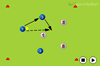
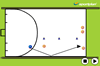
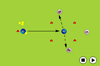
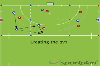
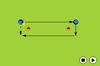
Step one - the rondo with consequence. Play 5v2 in a 12m square. When the two defenders win the ball, they have five seconds to score by stopping it on a target line. The five attackers must counter-press immediately to prevent it. This compresses the whole concept into a 90-second exercise that you can run as a warm-up every session.

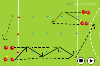
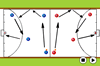
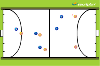
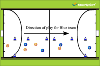
Step two - the transition game. Set up a 7v7 game across half a pitch. Every time possession changes, start a five-second clock. If the team that lost the ball wins it back inside the count, they score double on the next attack. If they fail, the new attacking team gets a free pass forward. Watch the intensity of those first five seconds rise sharply.

Step three - the full-pitch conditioned game. Play 11v11 with one rule: whenever a team loses the ball in the opposition half, they must counter-press for five seconds before retreating. Use a whistle to mark the five-second cut-off in the first few sessions, then let the players self-manage.

What to Coach When You See It Live

Freeze play in training the moment a counter-press starts. Ask three questions: who is pressing the ball, who is closing the forward pass, and who is covering behind? If all three roles aren't filled in the first second, the press will fail. Most counter-presses break down because the player furthest from the ball doesn't move - they assume someone else will cover, and a simple bounce pass releases the carrier.

Communication is the second checkpoint. The presser needs to be told what to take away. A simple call of "force left" or "lock the line" gives the chasing player a job. Without it, they go in flat and the ball carrier finds the gap.

Key Coaching Points

  • The moment of turnover is the trigger, not the bench
  • Three players minimum: presser, cover, screen
  • Five seconds is the limit - then drop into shape
  • Talk constantly to force the carrier into one decision
  • Reward turnovers in training with extra points or bonus possession

Recommended Drills

VIEW ALL PRESSING DRILLS

1 touch DRILLS
View All
Unfortunately there were no results for your search! Please try again
1 touch ANSWERS
View All

Indoor Hockey Situations for Russel Garcia- Solutions to tactical situations

2 Indoor Hockey situations%3A 1.)Could Sportsplan have Russel lay out how to defend a free hit/push into your circle from the left,center and right? More importantly show how the team moves/shifts when a pass is made from that area of the court to another in this situation. 2.) How to play against a 1/2 court system defense. What should the team be looking to do to find space and be successful.

Archived User Coach

New rules, the attacking 5 yard hit outside the D -?

New rules, the attacking 5 yard hit outside the D - has anyone got any great ideas for set plays?

sue shelswell Coach, New Zealand

finishing

I have done numerous exercises on goalscoring but my girls cant seem to finish. Any suggestions?

Archived User Coach

How to speed up the game on indoor hockey?

How to speed up the game on indoor hockey?

Bernardo Picado Coach, Costa Rica

Good drill to get girls to move to the ball faster?

I need a good drill to help the girls move to the ball faster? we arw slow to the ball need a drill thanks

Brenda Strohmer Coach, United States of America

iPad app will not come off update window can't get in?

I pad won't come off hockey up date window

Archived User Coach

How can we overcome a 1-4-4-2 formation?

I coach a women's team wide range in age 16 - 54 , when the stars align we are a very strong team hard to beat and very stingy when it comes to goals against, the games we do lose are usually 1-0 games,The exception comes when we play a team that plays a 1-4-4-2 ,what makes it worse is that we play a 4-4-2 and are very successful with it, but when it comes to defending against it my Defense and Mids become confused. I have not had any luck in figuring out a way to explain to my team how to defend against it. Any ideas on an easy way to fix this? Thanks

William Phillips Coach, Canada

Is there a drill for cutting?

Is there a drill to teach cutting on a free hit? When there is a free hit; how do we get kids to learn how to create space/get open during the hit?

Michelle Coach, United States of America

Drills for 1 or 2 players

hi. i recently started playing hockey again after 7 years and looking for drills me and my brother can do to help get my technique back. like first touch and shooting dribbling etc. i am a striker

owen hankey Coach, United States of America

cancel subscription

hi I would like to cancel my subscription.

Rebecca Page Coach, Australia

junior keepers closing down angles

I'm looking for drills to give junior goalkeepers confidence to step off the goalline and close down play. ideally fun and ideally helping them become more confident and vocal


Sarah Smith Coach, England

JOIN SPORTPLAN FOR FREE

  • search our library of 1000+ hockey drills
  • create your own professional coaching plans
  • or access our tried and tested plans

Sportplan App

Give it a try - it's better in the app

YOUR SESSION IS STARTING SOON... Join the worlds largest hockey coaching resource for 1000+ drills and pro tools to make coaching easy.
LET'S DO IT








