

Field Hockey: select

May 2026

Watch any FIH Pro League fixture this season and you'll see the same pattern again and again. A team loses the ball, and instead of dropping back to reorganise, three or four players sprint forward to surround the new ball carrier. Within five seconds the ball is back, often closer to the opposition goal than when it was lost. This is counter-pressing, and in 2026 it has become the defining habit of elite hockey.

The principle is borrowed from football's gegenpressing, but hockey suits it better. With no offside line, fewer touch restrictions and a small playing surface, the moment after a turnover is genuinely chaotic for the team that has just won possession. Their shape isn't set, their heads are down on the ball, and the simple outlet pass is rarely available. Five seconds is enough to punish all of that.

Why the First Five Seconds Matter

When you lose possession, the opposition is in their most vulnerable state. Their players are still moving forward in attacking shape, their goalkeeper isn't set, and the ball carrier has barely controlled the tackle. If you can apply pressure before they organise, you create three scoring scenarios: a turnover deep in their half, a hurried clearance that comes straight back, or a foul that hands you a free hit in dangerous territory.

Wait six or seven seconds and the moment is gone. The ball carrier has lifted their head, the support runners have arrived, and an outlet down the line is available. The counter-press has to happen now, by the players nearest the ball, without waiting for instructions from the bench.

The mindset shift: The instant you lose the ball, your closest three players are no longer attackers. They are pressers. Teach this as an automatic reaction, not a tactical decision.

The Two Counter-Pressing Models

There are two ways to organise the counter-press, and most teams use a hybrid of both. Knowing the difference helps you coach it deliberately.

Space-oriented pressing targets the area around the ball rather than specific opponents. The nearest player closes the carrier hard, the next two cut off forward and lateral passing lanes, and the rest of the team squeezes the pitch from behind. The aim is to suffocate the space, force a poor pass, and intercept rather than tackle.

Man-oriented pressing sees each player pick up the nearest opponent the moment possession is lost. With no offside in hockey, this is highly effective because every potential outlet is marked. The risk is that one missed pickup creates a free runner; the reward is that successful counter-presses almost always lead to interceptions in dangerous areas.

For most club teams, start with man-oriented counter-pressing for the first five seconds, then drop into a zonal shape if the ball isn't won. This gives you the upside of intensity without the chaos of pure space-pressing in transition.

How to Train It

Counter-pressing fails when it is taught as a tactic in a team talk. It only sticks when players experience it again and again in training, with feedback in the moment.

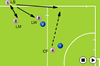
Step one - the rondo with consequence. Play 5v2 in a 12m square. When the two defenders win the ball, they have five seconds to score by stopping it on a target line. The five attackers must counter-press immediately to prevent it. This compresses the whole concept into a 90-second exercise that you can run as a warm-up every session.

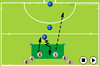
Step two - the transition game. Set up a 7v7 game across half a pitch. Every time possession changes, start a five-second clock. If the team that lost the ball wins it back inside the count, they score double on the next attack. If they fail, the new attacking team gets a free pass forward. Watch the intensity of those first five seconds rise sharply.

Step three - the full-pitch conditioned game. Play 11v11 with one rule: whenever a team loses the ball in the opposition half, they must counter-press for five seconds before retreating. Use a whistle to mark the five-second cut-off in the first few sessions, then let the players self-manage.

What to Coach When You See It Live

Freeze play in training the moment a counter-press starts. Ask three questions: who is pressing the ball, who is closing the forward pass, and who is covering behind? If all three roles aren't filled in the first second, the press will fail. Most counter-presses break down because the player furthest from the ball doesn't move - they assume someone else will cover, and a simple bounce pass releases the carrier.

Communication is the second checkpoint. The presser needs to be told what to take away. A simple call of "force left" or "lock the line" gives the chasing player a job. Without it, they go in flat and the ball carrier finds the gap.

Key Coaching Points

  • The moment of turnover is the trigger, not the bench
  • Three players minimum: presser, cover, screen
  • Five seconds is the limit - then drop into shape
  • Talk constantly to force the carrier into one decision
  • Reward turnovers in training with extra points or bonus possession

Recommended Drills

VIEW ALL PRESSING DRILLS

select DRILLS
View All
Unfortunately there were no results for your search! Please try again
select ANSWERS
View All

Uploading drills to my plans?

How do you upload a drill to a session plan?

Nick Gall-Tomassen Coach, England

How do I upload a Youtube Video to my session plans?

How do I upload a Youtube Video to my session plans?

Nick Gall-Tomassen Coach, England

How to reduce the size of a session planner image

Archived User Coach

Need a copy of an invoice

Need a copy of an invoice for my $64.00 charge to renew my membership. Tess Ellis. College of William & Mary

Tess Ellis Coach, United States of America

cancel subscription

hi there. just wondering how I can cancel my subscription

Koto Bakani Coach, New Zealand

cancel my subscription

I want to cancel my subscription how do I do this

gill bennett Coach, Australia

cancel my membership

Hi can you cancel my membership please

Ross Hutcheson Coach, Scotland

how to add a chalboard drawing

I've tried loads but cant seen to add a chalkboard drawing to a plan that I have created - it is driving me nuts as it should be easy...Any help gratefully received

Dai Rose Coach, Wales

printing

pdf does not print now?

Mark Cronk Coach, England

Cancel Subscribition

Hi,I am needing to cancel my subscription and when I click on my plan and click on the reason, I am unable to click the cancel button.Can I please have this cancelled on my behalf?Thanks

Kym Scarman Coach, Australia

Cancel Membership

How can I cancel my membership? When I go into edit, it only gives me the option to change my membership type!

Simone Ingersoll Coach, Australia

my sportshub

How do I delete items in my sportshub

edward pollock Coach, Scotland

Multiple sports

I would like to know how I can enter more that one sports in my account because it only comes with netball and tried to log out and then when I did it still had only netball.

Leila Davis Coach, United Kingdom

how to print a plan

how do you print out a coaching plan ?

andy burrows Coach, England

cancel subscription, end to join

hi sir. I want to end to subscribe the service.please stop the payment from my side now.thank youLi

Li Coach, Hong Kong

Account

Hi, I would like to change my account from coach to player as I selected the wrong one. How do I do this?

Cecilia Greig Coach, England

cancel my membership - Sportpl...

Hi can you cancel my membership please

Ross Hutcheson Coach, Scotland

what are good penalty corner p...

what are good penalty corner plays?

Archived User Coach

cancel my subscription - Sport...

I want to cancel my subscription how do I do this

gill bennett Coach, Australia

AFL training types and methods...

Hello, can someone please help with this question: Describe two different training types and methods which would have a positive impact on sports performance for AFL players. I need to provide 2 training methods for the 2 training types where the training methods include (examples are the training methods): Aerobic-eg continuous, fartlek, aerobic interval and circuit. Anaerobic- eg anaerobic interval. Flexibility-eg static, ballistic, PNF, dynamic stretching. Strength training- eg free/fixed weights, elastic, hydraulic. So i have information on dynamic stretching but if i am to do that I have to pick another form of stretching from the example methods above such as PNF, static ballistic. Not sure what to say if I had to pick one of those. Also I think aerobic interval seems good, how does it better AFL players performance?

Gee Coach, Australia

JOIN SPORTPLAN FOR FREE

  • search our library of 1000+ hockey drills
  • create your own professional coaching plans
  • or access our tried and tested plans

Sportplan App

Give it a try - it's better in the app

YOUR SESSION IS STARTING SOON... Join the worlds largest hockey coaching resource for 1000+ drills and pro tools to make coaching easy.
LET'S DO IT








