Rugby: rugby defence

July 2026

July is the month most clubs dust off the running shoes and head for the hills. It feels productive - lads coming back sweaty and sore, the group bonding through shared suffering. But months of steady-state running rarely show up where it matters: in the last ten minutes of a tight match, when the legs are gone and a defender still needs tracking.

The modern thinking on pre-season is simple. Rugby is a game of repeated high-intensity efforts, collisions and rapid decisions under fatigue. Your conditioning should look like that too. Get the ball into the work as early as you safely can, and build volume gradually rather than front-loading everyone into the ground in week one.

Why Traditional Fitness Falls Short

Rugby is not a steady-state sport. It is a series of short, sharp bursts - a sprint to the breakdown, a collision, a scramble to reset - separated by incomplete recovery. Training your players to jog for forty minutes teaches their bodies to be efficient at jogging. It does very little for the energy system the game actually taxes.


Worse, long slow running done in isolation carries a real cost: it eats into the time you have for skills, and it can leave players flat and heavy-legged rather than sharp. Fitness earned away from the ball tends to stay away from the ball.

Build It Around the Game

The most transferable conditioning happens inside rugby-shaped activity. Small-sided games, handling grids run at pace, and repeat-effort shuttles with a skill on the end all raise the heart rate while rehearsing the movements and decisions of a match. Players get fit and better at rugby at the same time.

Step One: Establish a base. Early pre-season, use games and continuous handling to lift general work capacity. Keep intensity moderate and volume gentle - you are waking bodies up, not testing them.

Step Two: Add repeated high-intensity efforts. Introduce shuttle and interval work with clear work-to-rest ratios. Think 15-30 seconds of maximal effort against short recovery, repeated in blocks. Put a pass, a catch or a decision at the end so fitness and skill develop together.

Step Three: Layer in fatigue. Once the base is there, run your skills sessions when players are tired. Handling under fatigue is where matches are won and lost, so rehearse it deliberately rather than hoping it holds up.

Step Four: Sharpen and taper. In the final weeks before your opener, cut volume and lift intensity. Short, sharp, game-realistic work keeps players fresh and fast rather than flat.

Manage the Load, Not Just the Effort

The point of building gradually is not softness - it is availability. Players who are buried under a huge week-one load pick up soft-tissue injuries and spend the season on the physio bench. Track how hard sessions feel, watch for the group getting heavy-legged, and progress the tough stuff week on week rather than all at once.

Small tweaks make a big difference. Vary the work so it is not all running in straight lines. Give genuine recovery between the hard days. And remember that a fit squad that is fully available in September beats a heroically fit squad that is half-injured.

Don't Forget the Collision Engine

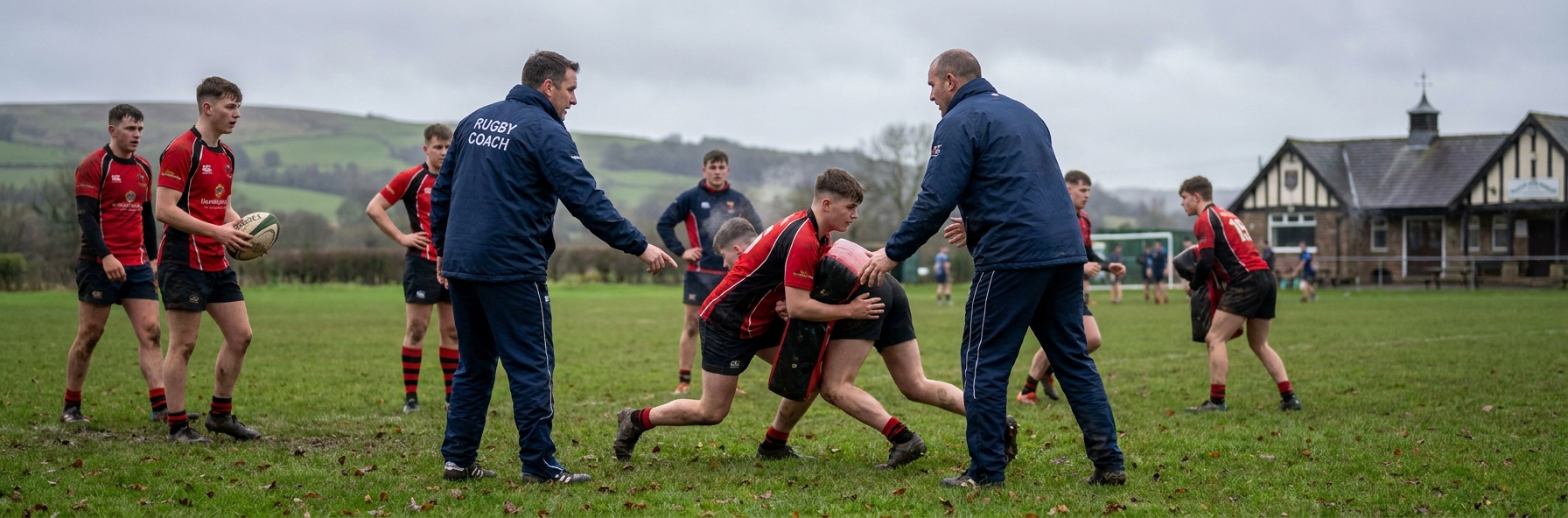
Running fitness alone will not prepare a player for the specific fatigue of repeated contact. Wrestling, bag work and short contact-conditioning circuits build the strength and resilience the tackle and breakdown demand. Weave a little of this into the fitness block so that when full contact returns, bodies are ready for it - but build it up carefully, never full-tilt in the first sessions.

Key Coaching Points

  • Match your conditioning to the game: short, sharp, repeated efforts, not endless steady running
  • Get a ball into the work early so fitness and skills grow together
  • Build volume gradually across pre-season rather than front-loading week one
  • Deliberately train handling and decisions under fatigue
  • Track load and protect recovery to keep players available all season
  • Include contact-conditioning so bodies are ready when full contact returns

Recommended Drills

VIEW ALL FITNESS DRILLS

Frequently Asked Questions

Should we scrap long runs from pre-season altogether?

Not entirely. A little low-intensity aerobic work early on helps build a base and aids recovery. The mistake is making it the centrepiece. Once the base is laid, the bulk of your conditioning should look and feel like rugby - repeated efforts, changes of direction and a ball in the mix.

How early should we introduce ball work in pre-season?

From day one. There is no need to earn the right to touch a ball by grinding through fitness first. Handling grids and small-sided games raise the heart rate just as effectively as running while keeping skills sharp and morale high.

How do I know if I'm loading players too hard?

Watch and listen. Persistent heavy legs, dropping session quality, niggling soft-tissue complaints and low mood are all signs the load is climbing too fast. Ask players how hard sessions felt, progress the demanding work week on week, and always protect a proper recovery day.

rugby defence DRILLS
View All

Attack Vs Defence Continuous D...

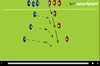
<span style=&quot;background-color: transparent;&quot;>Set a cone 2 meters from the defensive line. This will mark where the ball will passed from (feed) preferably from a scrum half.<span style=&quot;background-color: transparent;&quot;>Set a cone 0.5 meters each side from the mid point of the passing cone to simulate the sides of the ruck.<span style=&quot;background-color: transparent;&quot;>Set a cone a cone 5 meters from the ruck on the defensive line. 4 players start as attackers3 defenders start on their stomaches on the other side of the defensive cone (ruck) and 1 player on the defensive cone 5 metres from the ruck<span style=&quot;background-color: transparent;&quot;>The player on the 5 meter cone (defence) starts the drill by shouting ‘FOLD’ (or whatever call your team may use).<span style=&quot;background-color: transparent;&quot;>Defenders on their stomachs get up and fold around the ruck to take up a defence position. Players fold wide first, and ensure that 2 players are close to the ruck (Guard and Body Guard). <span style=&quot;background-color: transparent;&quot;>The player on the defensive cone bounces out (takes space in the defence line), the first player who folds takes up a position on the 5 meter defence cone (or inside the first attacking player)<span style=&quot;background-color: transparent;&quot;>Once the defence line is set the scrum half can pass the ball.<span style=&quot;background-color: transparent;&quot;>The attackers work to beat the defence, setting up a 'tip' (running a hard line) and 'pull back' option. They should read the defensive movements and make a decision to hit the tip option or pull out the back<br><br>

General

Unfortunately there were no results for your search! Please try again
rugby defence ANSWERS
View All

switch pass in rugby union

switch pass in rugby union

maria Coach, England

Which defence system is the most effective?

Which defence system is the most effective for 15-man rugby and what drills can I use for the rush/sliding defence...especially to get the guys in the inside to slide with and close up the inside gap from the 2nd phase onwards.

Rossi Marx Coach, South Africa

Translation Please

I recently received this in my "inbox"%3A Building a Flat Line Defence System Dear Rugby Coach, Whether your in the northern hemisphere and winding down for this season, or maybe already planning for next, or your in the southern hemisphere and the new season has just begun, this week we are pleased to present the workings of a Flat Line Defensive System. The following is the principles of how the system is implemented, Full Members can download the training drills to coach the system with their team. Upgrade to full access today. When teaching any defensive formation, you must always consider, how it works both in open play / set-pieces and from the breakdown, and that all players understand the roles they play. Priniciples for Open Play Key pointsThe make sure you choose the system to fit playing strength%3A Either IN-2-OUT or OUT-2-IN. Considering using INSIDE-2-OUT Midfield Gain-Line never broken. Surrender very wide attack to cover defence. Offensive 2m tackles. Pendulum wide cover. Huge communication requirements. Step-in System. Up and Drift. Forgive me but I haven't got a scooby do (clue) what the above means - please could the technobabble be explained (maybe we should start a dictionary of coaching terms?)

Gary D Coach, Northern Ireland

Big Hit or Step Up tackle

Describe a 'step-up' or 'big hit' tackle. How would you coach it, what is the technique and what are the key factors technically?

Archived User Coach

any suggestions on getting u 13s to communicate

any suggestions on getting u 13s to communicate

Archived User Coach

Scoring tries - habit?

Why is it important to get players to score the try when completing a handling/running drill?

Archived User Coach

problem- slow start at 7s games

I coach a womans 7s team. Every two weeks we have a two game tournament. The problem is that for the whole first game the girls play like they haven't woken up yet, and only in the second game their real rugby comes out. How do I help them play strong from the start?

eli Coach, Israel

Blindside position - I'm new to the game and I'm not sure what to do?

This is my first year playing on a rugby team for my school, grade 9, im much smaller than everyone else but i run fast and can be strong. my position is the blind side wing, and i dont understand what im supposed to do. it seems like i just jog and stay far away, but i dont know what im supposed to do if someone from the opposite team comes near me and noone else is one them, am i supposed to tackle? i also have trouble tackling cause my arms dont rap fast enough when they run into me, any advice?

Archived User Coach

U10s organisation in defence. How to improve?

I have started an under 10s team up, and I would say about 8 from the 13 children I have , did not play rugby until about 6 months ago. Of these players, there seems to be a lot of potential, as we are scoring tries against teams, that very rarely concede tries.the problem I got with them, is that we are very poor at organising our selves in defense when the opposition has the ball, which does result in us conceding quite a few tries. We have some very good tacklers in the team. Can anyone offer some ideas on how I can get them to organise themselves? Thanks . Chris.

christopher jenkins Coach, Wales

1v1 side defence - need advice for planning

I need to start planning a 1v1 side defence for my level 2 rugby coaching course..BUT what is 'side defence'? I've tried online to find the best 1v1 side defence but to no avail.

Archived User Coach

Organisation drills for 11s

I am looking for ideas on how my under 11s team can re organise after the breakdowns etc. they are a good bunch of players, but I am finding it difficult to get them to spread the field after breakdowns . I am wondering if there any drills here to do this? Thanks all

christopher jenkins Coach, Wales

Looking for easy tag rugby defence drills (for U7s)

What defence drills exist for tag rugby that are easy enough to explain to a 7 year old?

Archived User Coach

Staying onside games/drills for under 8s tag rugby

Looking for some drills or games to help my under 8s stay on side and not stand in the way during tag rugby.Any suggestions??

Pete Evans Coach, England

Rugby sessions plan?

HiAny ideas about technical/tactical drills for a Rugby session?Attacking?Defence?passing?Teaching points?

Archived User Coach

what are the tens rugby basics you need to learn

what are basics to playing tens rugby,attacking,defence and set piece

Archived User Coach

Tag Rugby Defence drills for kids

Hi, I'm coaching Tag rugby in Japan for ages 8-9yrs. Tryingto help kids stay in a defensive line and not group towards ball. Looking for drill ideas

James Hickling Coach, Japan

U10s organisation in defence. ...

I have started an under 10s team up, and I would say about 8 from the 13 children I have , did not play rugby until about 6 months ago. Of these players, there seems to be a lot of potential, as we are scoring tries against teams, that very rarely concede tries.the problem I got with them, is that we are very poor at organising our selves in defense when the opposition has the ball, which does result in us conceding quite a few tries. We have some very good tacklers in the team. Can anyone offer some ideas on how I can get them to organise themselves? Thanks . Chris.

christopher jenkins Coach, Wales

Tips on breaking through a def...

Hi my name is Mac and i am a 8 man and i struggle to push through a defensive line when i have the ball due to how my coaches make us practice so i wanted to know tips on how to push/break through a defensive line when i have the ball.

Mac Coach, United States of America

how to keep a defensive line f...

i currently help out with the coaching of the u7+u8 tag rugby but we are struggling to keep a defensive line can have anybody got any drills

jason halse Coach, Wales

Drills and attack moves to cou...

I am looking for some drills and moves to coach a counter offensive against a rushed defence or a blitzing defence. I've had ideas of short kicks over the top.

tom burkett Coach, England

JOIN SPORTPLAN FOR FREE

  • search our library of 1100+ rugby drills
  • create your own professional coaching plans
  • or access our tried and tested plans

Sportplan App

Give it a try - it's better in the app

YOUR SESSION IS STARTING SOON... Join the growing community of rugby coaches plus 1100+ drills and pro tools to make coaching easy.
LET'S DO IT