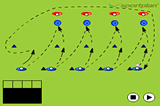
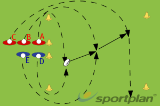
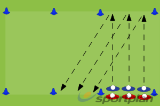
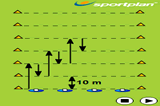
2 defenders work together to force 5 players to pass and work them towards touch.
The golden rule is for them to keep their spacing even, ensure that the inside defender covers the outside defenders inside, and that they do not rush up to commit to the tackle, but hover across and "swim" past the passer to reach the next and the next attacker.
If an attacker draws and passes so well that he then tries to block the defender, he needs to work hard and swim across that blocker to return to his defending role.
The last player must ensure that he can reach the last attacker, even though he is very far away.
This distance and the speed at which the attacking line moves will determine the defenders line of run.

in more ways than one
 sportplan_netball


in more ways than one
sportplan_rugby

Tacklers are aiming lower, so carriers who dip late put heads at risk. Teach footwork, a strong early body height and leg drive to win the collision safely.

The hooker's brake foot moved from trial into full law in July 2026. Here is how to coach it so your front row stays stable, legal and safe.

Your players can pass beautifully in a warm-up grid. Then a defender closes, their lungs are burning, and the ball goes to ground. Here is how to build catch-pass skills that hold up when it matters.