1. Defensive Organisation
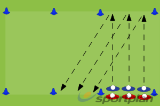
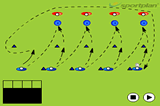
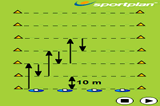
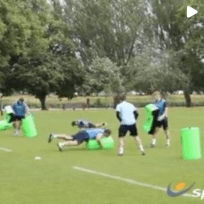
4 Defenders line up on the the cones.
When coach goes to pass the ball, when hands are on the defenders get line speed, making lots of noise and staying connected.
After each rep the players move along the cones back trackign until the reach the end, this is continuous.
2. 3 v 2
In a 5mx5m grid, 3 attackers attack 2 defenders.
Same focus on the defence on when to drift or make the takle on attackers.
Lots of communcitaion and line speed is key.
3. Kick out touch- Reduced Defence.
A defending player kicks the ball from the back of the pithc to attacking team.
Attacking team has more players than defensive system to induce a counter attack situation.
Players will learn to fill space with fewer numbers aswell as being a good attacking practice identifying space and overlaps.
1. Defensive organisation
Scanning - defenders 2m apart - eyes up on the ball and players infront.
Defenders 1, 2 , 3 know there role. (1- ball back inside form 9, 2 - 9 sniping or runnign across, 3 - lines up opposite first attacker 10.
Lines speed - off the line agressive and fast
Connections - Imagine players are on a pece of string - no dog legs.
Communication - lots of noise.
2. 3 v 2
Similar coachign points.
Drift or Blitz defensive decisions.
3. Kick out touch.
Work on all coaching points above in match situation.

in more ways than one
 sportplan_netball

in more ways than one
sportplan_rugby

Tacklers are aiming lower, so carriers who dip late put heads at risk. Teach footwork, a strong early body height and leg drive to win the collision safely.

The hooker's brake foot moved from trial into full law in July 2026. Here is how to coach it so your front row stays stable, legal and safe.

Your players can pass beautifully in a warm-up grid. Then a defender closes, their lungs are burning, and the ball goes to ground. Here is how to build catch-pass skills that hold up when it matters.