










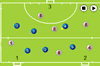
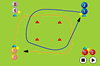

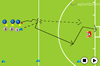
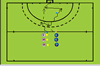



Excellent drills, very detailed videos. Useful site for my U15 boys team.

The new rules - what will UK coaches be focussing on most? (Living in NZ, we're playing them now!)

Hello all, I would like to have some reflection on following please%3A As a coach of a 8 team of juniors age 9-10 years old i tend to rotated the positions of players every other game.The reasons for this is that I believe it helps them understand the importance and difficulties from each separate position in the field and so creating a better understanding of the game. Furthermore it gives a positive influence on their learning curve from a technical point of few. Of course I am taking care that everyone stays happy in playing hockey. What are your opinions?
is there any skill that can help me attack my opponent?
I have done numerous exercises on goalscoring but my girls cant seem to finish. Any suggestions?
What are the best things to get your players to do when you come up against a full press / 3/4 press, anything that's putting a lot of pressure on high up the pitch?

I have a team of 12 girls, many are new to the game. How do I prepare them to work together as a team and learn their positions when I can't simulate a game in practice?
This is my first year coaching field hockey and I am coaching beginners, a U8 team. Any drills geared towards beginners?
What are the key skills in individual defending and what are the best ways to practise them?
Hi all,I've got my level 2 assessment coming up on Sunday and I just wanted to quickly check whether there's a 'recommended' structure to the session plan.Btw, this is a level 2 practical assessment and is with juniors (U14s).One coach has suggested a 3 part approach:1) techniques and skills required2) unopposed 3) opposedThe theme I'm choosing, which is a bit of a generic one, is defending in a channel (as I'm a defender and it's pretty straight forward).I'm not really looking for info on what exactly to include (i.e. theme specific) but rather general structure or whether E.H. have an approved structure to sessions?My session's on Sunday, so a quick reply would be awesome.Thanks,Gary

As of 1 September, major FIH events such as the Champions Trophy, Hockey World League Final and Rio 2016 Olympic Games will assume a new format that includes moving to four 15-minute quarters and having 40-second time-outs when a penalty corner is awarded and after a goal is scored. Do you think this a positive or negative for the future of hockey?

tackle how to approach the person in control of the ball

how do we defend counter

easy drill ideas that are fun

in more ways than one
 sportplan_hockey




A few weeks into the league season, poor first touches are costing teams the ball. Coach body shape, scanning and receiving on the move to keep possession.

Pre-season fitness fades fast once the league starts. Build conditioning into ball work and use rolling subs well to keep your squad sharp all season.

The first weeks of the season decide whether a junior or new player sticks with adult hockey. Here is how to keep them safe, give them a clear job and build their confidence from the very first bully.
Coaches from around the world look to Sportplan for coaching confidence.
Excellent drills, very detailed videos. Useful site for my U15 boys team.

I love using Sportplan. It's been a great help for co-ordinating hockey practice and being able to help tweak skills and getting the most out of my players!

Great site. An absolute must for coaches who are willing to change and learn new drills. Superb, simply superb.

Wow what a great website, I have found sportplan an important tool for me when planning my netball sessions with my netball team. There are alot of very helpful tips/ideas/skills that I can learn and teach to my team. Thank you sportplan I hope to continue to use your helpful tips and to learn more about improving my teams netball skills. Thanks again....keep it up....

I have been using Sportplan now for 3 years and can honestly say that I have never repeated the same session twice. My girls are always focused and are improving every year. Thanks Sportplan.
What a fantastic tool. The Chalkboard and session tools make an unbelievable difference in making training plans in both time and organization. I will be instructing all of my assistant coaches that this tool must be used for all sessions during the season, so that we may build a club coaching resource library.
I can't get enough of the Sportplan, It has given me back the enthusiasm i was starting to lose. My girls are so keen and are ready at 14 to take the next up in their game. Sportplan will help no end.



