







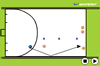
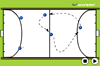
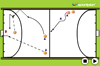
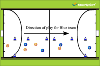

Excellent drills, very detailed videos. Useful site for my U15 boys team.

What are the best drills to get players to release the ball quickly?

Where do I find the "add to clip board" button?
when using the chalk board is it possible to design a drill and view it in motion, like the drills used on sportplan?
hi allI'm currently coaching 12 and 13 yr olds and the team has a massive problem with shape and being disciplined positionally.Any tips, ideas, drills etc for helping with / teaching this?many thanks,Gary

Who can help me to develop a tool to manage the substitutional players during a match? I manage a team of 15 girls of 12-14 years old with different levels of hockey experience. To arrange the substitutes is quite complicated and I am searching for a helpful tool.
I can't find numbered counters so I can refer to player 1, 2 etc. they are on the sessions I receive by email, but on the sketch board, I can only find A, D, F or coloured player counters - it's getting very frustrating as I'm sure they are somewhere! Please help.

At home, inside my small basement, I don't have a huge space to practice field hockey. I have cones, an equipment ladder (for agility), and a rebounding board. I have basically been practicing dribbling, passing against the rebounding board, and dodging "defenders" (cones). After a little while, I run out of creativity for drills, and I feel that I may not be getting the most out of practicing. Do you have any drills that will improve my ball skills greatly that are okay for one person?
any ideas on what to cover in a white board session for adults and junior during a wet night when training is postponed thanks

when an attacker comes to you is it best to have your stick right at the ground or in an angle ?
Need help with planning a rolling subs with 11 players and 5 subs.Keeper,4 backs, 4 midfied, 2 strikers.Any ideas please
Hello, I am a parent of my daughter's U/9 team and have been asked to coach. I have very little experience coaching (I did some in Vanuatu but that's about it). Could anyone recommend some drills to help spread them out on the field so they're not all running around in one big group after the ball? Thanks!
how can i make a drill in clipboard and then copy paste it in the same clip board many times
how to create a new clipboard
I have searched all over YouTube with no success. Does anyone have any video footage I can share with my players showing a successful high/full press? It is one thing moving counters on a board whilst drawing arrows, and another my players actually seeing it in action so they can relate and recognise situations and how they force turnovers. Thank you in advance.
How do I show my board on full screen?

This applies to both the simple plan and the standard plan. When I save, stop editing, and then print to PDF it creates a lot of white space in very box. I am trying to make a one page plan because I post it on the court board prior to every practice. Can we fix this?

any ideas on what to cover in a white board session for adults and junior during a wet night when training is postponed thanks
hi allI'm currently coaching 12 and 13 yr olds and the team has a massive problem with shape and being disciplined positionally.Any tips, ideas, drills etc for helping with / teaching this?many thanks,Gary
At home, inside my small basement, I don't have a huge space to practice field hockey. I have cones, an equipment ladder (for agility), and a rebounding board. I have basically been practicing dribbling, passing against the rebounding board, and dodging "defenders" (cones). After a little while, I run out of creativity for drills, and I feel that I may not be getting the most out of practicing. Do you have any drills that will improve my ball skills greatly that are okay for one person?

in more ways than one
 sportplan_hockey




A few weeks into the league season, poor first touches are costing teams the ball. Coach body shape, scanning and receiving on the move to keep possession.

Pre-season fitness fades fast once the league starts. Build conditioning into ball work and use rolling subs well to keep your squad sharp all season.

The first weeks of the season decide whether a junior or new player sticks with adult hockey. Here is how to keep them safe, give them a clear job and build their confidence from the very first bully.
Coaches from around the world look to Sportplan for coaching confidence.
Excellent drills, very detailed videos. Useful site for my U15 boys team.

I love using Sportplan. It's been a great help for co-ordinating hockey practice and being able to help tweak skills and getting the most out of my players!

Great site. An absolute must for coaches who are willing to change and learn new drills. Superb, simply superb.

Wow what a great website, I have found sportplan an important tool for me when planning my netball sessions with my netball team. There are alot of very helpful tips/ideas/skills that I can learn and teach to my team. Thank you sportplan I hope to continue to use your helpful tips and to learn more about improving my teams netball skills. Thanks again....keep it up....

I have been using Sportplan now for 3 years and can honestly say that I have never repeated the same session twice. My girls are always focused and are improving every year. Thanks Sportplan.
What a fantastic tool. The Chalkboard and session tools make an unbelievable difference in making training plans in both time and organization. I will be instructing all of my assistant coaches that this tool must be used for all sessions during the season, so that we may build a club coaching resource library.
I can't get enough of the Sportplan, It has given me back the enthusiasm i was starting to lose. My girls are so keen and are ready at 14 to take the next up in their game. Sportplan will help no end.



