











Excellent drills, very detailed videos. Useful site for my U15 boys team.

How do you disguise the slap hit?

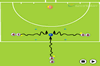
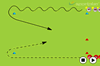
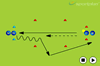
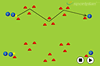
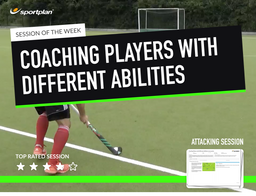
Here is one example I use.I put out this slalom as the test whenever confronted with a large group of mixed ability players that need to be put into equal ability groups to play a game or to be coached. The slalom incorporates lots of the aspects of the techniques required by the individual players to play the game of hockey. I.e. running with the ball, fast and controlled, changing direction with the ball pivoting, stopping the ball etc.I normally set up 2 - 4 identical slaloms, see attachment, and have 4 coaches or helpers with a stopwatch (mobile phones are great for this).To record the score I normally put a label on the stick of each player so they can write down their time. Once all players have recorded a time, ask the players to stand in time order on the sideline. Once the players are in order you can put the 10 fastest times to play a 5 aside game across 23 meter area and the next 10 in the next 23 meter area and so on up to 40 players playing on one full pitch. The last few changes you might now need to make are the players that perform better or weaker on any particular pitch (should not be to many).

Currently coaching years six to eight. 40 young lads - all keen as mustard but with different skill levels and experience.It would seem best to stream. But I am concerned this creates an elite divide...At this age is it enough to power through core skills e.g passing using slaps, pushes and clip hit exercises or should we be - in spite of numbers trying to coach technique one to one... The enthusiasm is great but so many youngsters need a broader brush approach which is concerning me...

Does anyone know any drills to practice marking? Players are familiar with marking theory and need to implement it including front marking and goal side marking. I have found a good half court practice which emphasises the importance of marking. Wandered if anyone had any other ideas?
hi allI'm currently coaching 12 and 13 yr olds and the team has a massive problem with shape and being disciplined positionally.Any tips, ideas, drills etc for helping with / teaching this?many thanks,Gary

Hi all,I've got my level 2 assessment coming up on Sunday and I just wanted to quickly check whether there's a 'recommended' structure to the session plan.Btw, this is a level 2 practical assessment and is with juniors (U14s).One coach has suggested a 3 part approach:1) techniques and skills required2) unopposed 3) opposedThe theme I'm choosing, which is a bit of a generic one, is defending in a channel (as I'm a defender and it's pretty straight forward).I'm not really looking for info on what exactly to include (i.e. theme specific) but rather general structure or whether E.H. have an approved structure to sessions?My session's on Sunday, so a quick reply would be awesome.Thanks,Gary
How can I help my u/12 girls to attack? At the moment they are running beside the opponent but not attacking the players.
So I'm having trouble getting my young and inexperienced group of midfielders to flip the switch from defense to offense, and back, as we move up and down the field. They will often hang back and leave my forwards stranded rather than rush in to attack. Naturally, we are not scoring. Advice and drill ideas would be most welcome! J.G. Coach, Maryland USA
Does anyone have any ideas for developing players understanding of creating angles of attack during a 1V1?

How do I teach kids to get body around to tackle from correct position? Asked using Sportplan Mobile App
Looking gro theory or practicals on defending help side vs ball side.Any help?
What is your best suggestions for how to improve the back players skills to defend the goal?
How do I defend two High hanging strikers?
Hi all,I am wondering, what do you think about formation 3-5-2? I watch football a lot and i think that our sport is very similar tactically. With this formation you could get 5 defenders when you are defending and in the offense these wide backs could join attack and the you have 5 - 6 players in the finish and easier way to get out of the press. I dont know this is just a thought. Let me know what do you think. Thank you
hi allI'm currently coaching 12 and 13 yr olds and the team has a massive problem with shape and being disciplined positionally.Any tips, ideas, drills etc for helping with / teaching this?many thanks,Gary
So I'm having trouble getting my young and inexperienced group of midfielders to flip the switch from defense to offense, and back, as we move up and down the field. They will often hang back and leave my forwards stranded rather than rush in to attack. Naturally, we are not scoring. Advice and drill ideas would be most welcome! J.G. Coach, Maryland USA
How do I teach kids to get body around to tackle from correct position? Asked using Sportplan Mobile App

in more ways than one
 sportplan_hockey




A few weeks into the league season, poor first touches are costing teams the ball. Coach body shape, scanning and receiving on the move to keep possession.

Pre-season fitness fades fast once the league starts. Build conditioning into ball work and use rolling subs well to keep your squad sharp all season.

The first weeks of the season decide whether a junior or new player sticks with adult hockey. Here is how to keep them safe, give them a clear job and build their confidence from the very first bully.
Coaches from around the world look to Sportplan for coaching confidence.
Excellent drills, very detailed videos. Useful site for my U15 boys team.

I love using Sportplan. It's been a great help for co-ordinating hockey practice and being able to help tweak skills and getting the most out of my players!

Great site. An absolute must for coaches who are willing to change and learn new drills. Superb, simply superb.

Wow what a great website, I have found sportplan an important tool for me when planning my netball sessions with my netball team. There are alot of very helpful tips/ideas/skills that I can learn and teach to my team. Thank you sportplan I hope to continue to use your helpful tips and to learn more about improving my teams netball skills. Thanks again....keep it up....

I have been using Sportplan now for 3 years and can honestly say that I have never repeated the same session twice. My girls are always focused and are improving every year. Thanks Sportplan.
What a fantastic tool. The Chalkboard and session tools make an unbelievable difference in making training plans in both time and organization. I will be instructing all of my assistant coaches that this tool must be used for all sessions during the season, so that we may build a club coaching resource library.
I can't get enough of the Sportplan, It has given me back the enthusiasm i was starting to lose. My girls are so keen and are ready at 14 to take the next up in their game. Sportplan will help no end.



