Tennis: grip

February 2026 Sportplan Coaching

Tennis is one of the most physically demanding sports. Matches can last five hours. Players cover 3-5 kilometres per match in explosive sprints. They rotate their bodies hundreds of times, generating forces that stress muscles, tendons, and joints. The best technique in the world fails without the physical foundation to support it.

Modern tennis preparation addresses all components of athletic performance - not just "getting fit."

Physical Demands of Tennis

Understanding what tennis requires:

Intermittent power: Tennis is repeated bursts of high-intensity activity with brief recovery. Average points last 6-10 seconds with 15-20 seconds between points.

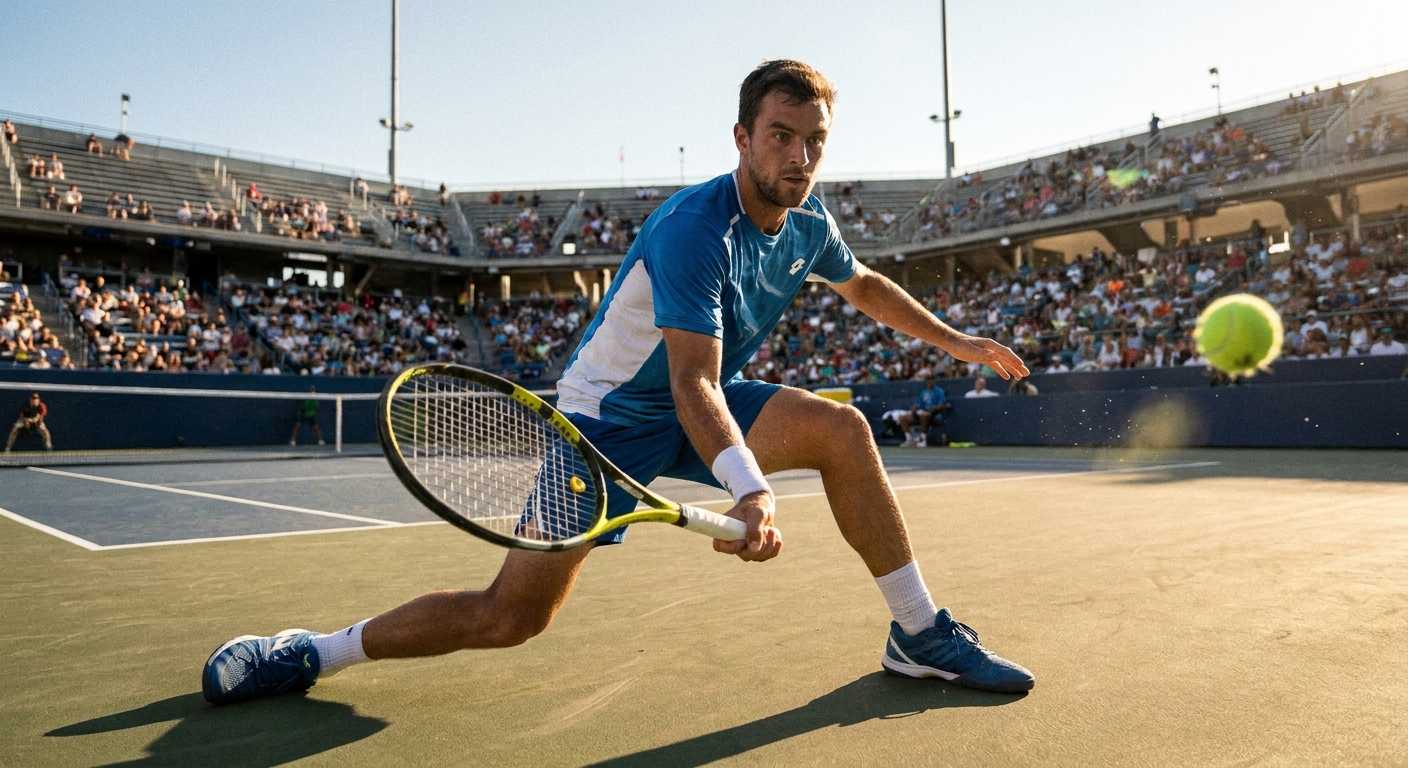
Multi-directional movement: Forward, backward, lateral, diagonal - often in the same point. Change of direction is as important as straight-line speed.

Unilateral loading: Dominant arm and leg do more work, creating imbalances that need addressing.

Duration: Matches can last hours. Maintaining quality in the fifth set requires aerobic fitness most players underestimate.

Strength Training

Strength provides the foundation:

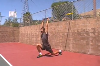
Lower body: Squats, lunges, and deadlifts build the leg strength for explosive movement and stable bases.

Core: Rotational power comes from the core. Medicine ball throws, cable rotations, and plank variations are essential.

Upper body: Balanced development prevents shoulder injuries. Push and pull movements in equal measure.

Unilateral work: Single-leg and single-arm exercises address the asymmetries tennis creates.

Power Development

Strength without speed is incomplete:

Plyometrics: Jump training develops explosive power - box jumps, bounds, depth jumps.

Medicine ball throws: Sport-specific power development. Rotational throws mimic the power generation in strokes.

Speed training: Short sprints with full recovery. Quality over quantity.

Agility work: Ladder drills, cone patterns, reactive movement training.

Endurance Training

The aerobic base enables everything else:

Aerobic capacity: Long, steady-state training builds the cardiovascular foundation. Essential for match-long performance and recovery between points.

Interval training: More tennis-specific than steady state. Work/rest ratios that mimic match demands.

On-court conditioning: Drills that combine technical work with physical demand. Efficient use of training time.

Heat adaptation: For players competing in hot conditions, progressive heat exposure builds tolerance.

Flexibility and Mobility

Range of motion affects performance and injury risk:

Dynamic stretching: Pre-training movement preparation. Leg swings, arm circles, trunk rotations.

Static stretching: Post-training and maintenance work. Hold positions for 30+ seconds.

Targeted areas: Hip flexors, shoulders, thoracic spine, and hamstrings typically need most attention.

Foam rolling: Self-myofascial release maintains tissue quality.

Recovery

Training creates adaptation only if recovery is adequate:

Sleep: The most important recovery tool. 8-10 hours for developing athletes.

Nutrition: Adequate protein, carbohydrates to fuel training, hydration. Match nutrition is specific science.

Active recovery: Light movement promotes blood flow without adding training stress.

Recovery modalities: Massage, cold water immersion, compression - all have roles in tournament settings.

Injury Prevention

Training should reduce injury risk:

Shoulder health: Rotator cuff strengthening and scapular stability work protect against overuse injuries.

Ankle stability: Balance work and ankle strengthening prevent sprains.

Gradual progression: Training load increases gradually. Large spikes in volume or intensity cause injuries.

Movement quality: Proper technique in training exercises prevents compensation patterns.

Periodisation

Training must be planned across the year:

Off-season: Higher volumes, building foundations. Less tennis, more physical training.

Pre-competition: Transition to sport-specific work. Intensity increases, volume decreases.

In-season: Maintenance focus. Enough to sustain fitness without compromising match performance.

Tournament blocks: Minimal physical training during competitions. Focus on recovery.

Key Coaching Points

  • Tennis demands a unique combination of power, endurance, agility, and flexibility
  • Strength training provides the foundation for all other physical qualities
  • Recovery is training - sleep, nutrition, and rest days are not optional
  • Injury prevention must be built into every training programme
  • Training periodisation matches physical preparation to the competition calendar

Drills for Athletic Development

VIEW ALL FITNESS DRILLS

JOIN SPORTPLAN FOR FREE

  • search our library of 1200+ tennis drills
  • create your own professional coaching plans
  • or access our tried and tested plans
grip DRILLS
View All
Unfortunately there were no results for your search! Please try again
grip ANSWERS
View All

Backhand grip

In Nick Saviano's book, Maximum Tennis, Andre Agassi is said to have a very 'soft' left hand on his backhand, and yet often I hear and read many tips suggesting a very dominant, or active, supporting hand for the two handed backhand. Especially now, with the more semi-open stanced players, what should I suggest when teaching the backhand to developing players?

Archived User Coach

how do you teach topspin? what grip to you use?

how do you teach topspin? what grip to you use?

becky farmer Coach, United States of America

I'm having trouble teaching the backhand volley. The?

I'm having trouble teaching the backhand volley. The girls don't seem to have enough arm/wrist strength and/or they don't get the correct angle on their racquet. Suggestions?

Archived User Coach

What can you do to help a player with their serve?

What can you do to help a player with their serve, when they say they want to get more power on it?

Archived User Coach

Hi Guys, How best to teach a return of serve

Hi Guys, Just wondering if anyone has a suggestion on how to teach a block return from serve and a slice return from serve to 13y.o juniors who are playing against big servers Cheers

Ciaran Cahill Coach, Ireland

What is my fault? Difficulty coaching some of the older players - advice?

Helo, my name is Fernando, I am a Spanish tennis teacher who started teaching six months ago. I am working in a public sportcenter and I am having some problems with adults. When I started I realiced that the students were used to playing tennis without any control. Young students told me that the other teacher only used to leave them play - he rarely explained them how to hit the ball. Consequently the do enjoy my clases and they are learning a lot and impoving their level of tennis. So far so good, but the problem is that with the adults I have the impression that they don´t like my clases. In fact some of them left the group at the begining. I try to mix different kinds of drills during the class and I usually finish it with a game like for example 21, winner........ But it seems that they don´t enjoy it. During the exercises most of them don´t try to do what I tell them. As a result, they don´t have a good level of tennis. But as far as I know, the other teacher was a tennis player who uses to play against them during the clases. As this is my first time teaching tennis, I don´t fell confidence and that is the reason whay I do´t like to play against them. Appart from that I think that this is not my role as a teacher. So I would like you to tell me how to deal with that situation. I don´t care if they leave me because this is not going to affect my job, but i wouldn´t like them to leave just because I like tennis and I like teaching tennis. Thank you very much for your help. I am sorry for my English. Best wishes!!!!

Fernando Coach, Spain

Forehand groundstroke. contact point?

Forehand groundstroke. Coach A teaches a classic FH with the C loop and says that the modern FH (western Grip) contact point is at the side. I understood that the Eastern FH was hit at the side but the Semi western was hit 6 to 8" in front when the racket face is vertical to the ground. Which is correct?

Norman Frey Coach, United States of America

forehand

On my forehand I like to play a multi segmented forehand and have a extreeme westrn grip. ,Hitting a multi segment forehand with a semi-western grip particularly off serve does not feel natural for me. What can I do? With thanks, Stephen

stephen Coach, Australia

How to teach single and double-handed backhands to U10s?

teaching single and doublehanded backhands to under 10s

Archived User Coach

How do I improve my backhand in tennis?

how do i improve my handback in tennis?

Maria Paola Molteni Coach, Argentina

How do I teach my non-tennis playing friend to feed me practice balls?

I'm a 4.5 player (recovered competitive junior player) ... my parents used to take me out and feed balls to me to work on my strokes ... now that I'm an adult - and living on the opposite coast - I need someone to feed balls to me. How do I teach a non-tennis player to feed balls to me? What grip should I have them use? Where should they feed the ball?

Archived User Coach

What is the best way to share playing vocab at this site...

...where it will list and describe playing terminology such as shave, tackle-back, steal, forehand.

Ejaz Syed Coach, United States of America

TopSpin Forehand

How should I put more topspin and depth and height on my forehand shots, I want to get it more consistent and practice putting more power on them.

stefo Coach, United States of America

high ball

hi what is the best drill to improve high ball contact point and footwork.

samala ashok Coach, India

Private tennis lesson

Hi, I am going to teach a first private lesson for a woman age 30 . She is a beginner. I would love to hear some tips for our first one on one interaction and what to focus on. Thanks

Moran Cohen Coach, Israel

group coaching

I want to design an 8 sessions for 2 beginners players

Asim 0 Coach, Qatar

how do you teach topspin? what...

how do you teach topspin? what grip to you use?

becky farmer Coach, United States of America

Backhand grip | Sportplan

In Nick Saviano's book, Maximum Tennis, Andre Agassi is said to have a very 'soft' left hand on his backhand, and yet often I hear and read many tips suggesting a very dominant, or active, supporting hand for the two handed backhand. Especially now, with the more semi-open stanced players, what should I suggest when teaching the backhand to developing players?

Archived User Coach

What can you do to help a play...

What can you do to help a player with their serve, when they say they want to get more power on it?

Archived User Coach

Forehand groundstroke. contact...

Forehand groundstroke. Coach A teaches a classic FH with the C loop and says that the modern FH (western Grip) contact point is at the side. I understood that the Eastern FH was hit at the side but the Semi western was hit 6 to 8" in front when the racket face is vertical to the ground. Which is correct?

Norman Frey Coach, United States of America

JOIN SPORTPLAN FOR FREE

  • search our library of 1200+ tennis drills
  • create your own professional coaching plans
  • or access our tried and tested plans

Sportplan App

Give it a try - it's better in the app

YOUR SESSION IS STARTING SOON... Join the growing community of tennis coaches plus 1200+ drills and pro tools to make coaching easy.
LET'S DO IT