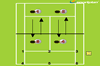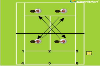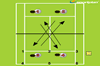
Tennis: mini tennis

The 50:22 law, introduced as a trial and now a permanent fixture, has fundamentally changed how teams approach tactical kicking. A kick from your own half that bounces in-field, crosses the 22, and finds touch rewards the kicking team with the lineout throw-in. This single law change has altered both attacking and defensive strategies across the game.

Understanding the Law

The requirements:

  • Kick must originate from behind your own 10-metre line
  • Ball must bounce in the field of play (not direct to touch)
  • Ball must cross the opposition's 22-metre line
  • Ball must then go into touch
  • Kicking team retains the throw at the lineout

These requirements create specific technical demands. The kick must be long enough to reach the 22, accurate enough to hit the corner, and struck correctly to bounce in-field first.

Why 50:22 Matters

Before the 50:22, kicking from your own half that went to touch gave the throw to the opposition. The only benefit was territorial gain. Now, an accurate 50:22 delivers both territory AND possession - a game-changing combination.

The tactical impact:

  • Lineout attacking platform in the opposition 22
  • Defensive scramble if full-back fails to cover
  • Forces back three to position wider, creating space elsewhere
  • Punishes lazy defensive positioning

Executing the 50:22

The Grubber Option

A well-struck grubber can beat the full-back to the corner. The low trajectory keeps the ball in play, and end-over-end rotation makes the bounce predictable.

Grubber technique:

  • Strike through the middle of the ball, toe down
  • Generate end-over-end spin for predictable bounce
  • Aim for the gap between full-back and touchline
  • Follow up - if it doesn't reach touch, contest the chase

The Chip and Chase

A chip kick over the defensive line that bounces in the 22 and reaches touch. Higher risk - defenders can field it before it reaches touch - but effective against narrow defences.

Chip technique:

  • Get under the ball with angled foot
  • Enough height to clear defenders, not so much that chase time is lost
  • Backspin for controlled bounce toward touchline

The Cross-Field Kick

Against a defence shifted to one side, the cross-field kick to the far corner can find space. This is a longer kick requiring more accuracy but exploits defensive imbalance.

Defensive Adjustments

The 50:22 has forced defensive positioning changes. Full-backs can no longer sit narrow - they must cover the width. Wings must be aware of their touchline responsibilities.

Defending against 50:22:

  • Full-back positions wider to cover both corners
  • Wings drop deeper to provide secondary cover
  • Communication about kick threats: "Watch grubber!"
  • Quick identification and reaction to kicks

These defensive adjustments create space elsewhere. If the full-back is wide, the central channel opens. If wings drop deep, the defensive line loses numbers.

When to Attempt 50:22

Good opportunities:

  • Full-back positioned narrow or deep
  • Wide channel space visible
  • Defence rushed up, leaving back field exposed
  • Slow ball where running attack is risky

Poor opportunities:

  • Full-back already covering the corner
  • Quick ball with attacking momentum
  • Wind against making accurate kicking difficult
  • Kicker not in optimal position

Training 50:22 Execution

Individual kicking practice:

  • Set targets at the corner - grubber to specific zones
  • Practice both feet (advantage when on either side)
  • Vary distances - not every 50:22 opportunity is from the same position

Team practice:

  • Live scenarios with defence - read the full-back position
  • Decision-making: kick, run, or pass?
  • Chase organisation when the kick doesn't reach touch

Alternative Outcomes

Not every 50:22 attempt succeeds. But the threat creates secondary benefits:

If fielded before touch: You've still gained territory and forced the opposition to start from deep. Apply chase pressure and compete for their exit kick.

If it bounces out before 22: Opposition throw, but you've gained significant ground. Reset defensive line.

If full-back covers: Your threat has pulled them wide. Subsequent attacks may find more space centrally.

The Mental Game

The 50:22 threat changes how oppositions defend, even when you don't kick. Simply having players capable of executing the kick forces wider positioning and changes defensive dynamics.

Make sure your opposition knows you have this weapon. Execute it successfully early in matches, and they'll respect the threat throughout.

Key Coaching Points

  • The 50:22 rewards accurate kicking with possession AND territory
  • Grubbers are highest percentage - practise them
  • Read the full-back position before deciding
  • Even unsuccessful attempts gain territory
  • The threat changes defensive positioning

Drills to Master the 50:22

VIEW ALL KICKING DRILLS

JOIN SPORTPLAN FOR FREE

  • search our library of 1200+ tennis drills
  • create your own professional coaching plans
  • or access our tried and tested plans
mini tennis DRILLS
View All
Unfortunately there were no results for your search! Please try again
mini tennis ANSWERS
View All

Permanent lines for U10 tennis?

I would like to add permanent lines for Under 10 tennis and am wondering if anyone has any experience doing this and can help me avoid problems with adult members?

Archived User Coach

How to train kids with different abilities?

I train a group of six children on a mini tennis court aged 4-5. They have all different abilities. How do I give all of them the needed training without making it too complicated for some or too easy for others?

Mari Milos Coach, Sweden

Keeping Score For Beginners

What is easiest way to teach beginners how to keep score?

Archived User Coach

Best player - bad attitude/determination?

I have a learner that is super talented, he gets the game, he handles pace, power and depth well. He is aggressive and tennis just comes naturally when it comes to this kid but he lacks determination. I am really struggling to keep him motivated not to loose focus or to let one mistake make his shoulders hang for the rest of the lesson. Footwork is unfortunately a big problem and when he loses a point it's even worse, this kid is just draining me mentally every session, its a mental thing but i'm having trouble defeating it. If i'm too hard on him, he closes down and might as well stop and if i play too much and don't push him, he plays with no effort and just hit very sloppy shots. I do know that his situation at home is not good and i think it has a lot to do with his bad attitude on the court but i really need some advise, this is my hardest lesson to plan, what is most important about my lesson with a student with a bad attitude, no temper but just unmotivated and i don't want to give up because this kid really has the talent...he really can be the next junior champion in Africa if he really wants to. Would really appreciate some tips from the professionals that dealt with this before.

Archived User Coach

First time Coaching

It's my first time coaching I need some advice?

steven chiriboga Coach, United Kingdom

group coaching

I want to design an 8 sessions for 2 beginners players

Asim 0 Coach, Qatar

Best player - bad attitude/det...

I have a learner that is super talented, he gets the game, he handles pace, power and depth well. He is aggressive and tennis just comes naturally when it comes to this kid but he lacks determination. I am really struggling to keep him motivated not to loose focus or to let one mistake make his shoulders hang for the rest of the lesson. Footwork is unfortunately a big problem and when he loses a point it's even worse, this kid is just draining me mentally every session, its a mental thing but i'm having trouble defeating it. If i'm too hard on him, he closes down and might as well stop and if i play too much and don't push him, he plays with no effort and just hit very sloppy shots. I do know that his situation at home is not good and i think it has a lot to do with his bad attitude on the court but i really need some advise, this is my hardest lesson to plan, what is most important about my lesson with a student with a bad attitude, no temper but just unmotivated and i don't want to give up because this kid really has the talent...he really can be the next junior champion in Africa if he really wants to. Would really appreciate some tips from the professionals that dealt with this before.

Archived User Coach

What is my fault? Difficulty c...

Helo, my name is Fernando, I am a Spanish tennis teacher who started teaching six months ago. I am working in a public sportcenter and I am having some problems with adults. When I started I realiced that the students were used to playing tennis without any control. Young students told me that the other teacher only used to leave them play - he rarely explained them how to hit the ball. Consequently the do enjoy my clases and they are learning a lot and impoving their level of tennis. So far so good, but the problem is that with the adults I have the impression that they don´t like my clases. In fact some of them left the group at the begining. I try to mix different kinds of drills during the class and I usually finish it with a game like for example 21, winner........ But it seems that they don´t enjoy it. During the exercises most of them don´t try to do what I tell them. As a result, they don´t have a good level of tennis. But as far as I know, the other teacher was a tennis player who uses to play against them during the clases. As this is my first time teaching tennis, I don´t fell confidence and that is the reason whay I do´t like to play against them. Appart from that I think that this is not my role as a teacher. So I would like you to tell me how to deal with that situation. I don´t care if they leave me because this is not going to affect my job, but i wouldn´t like them to leave just because I like tennis and I like teaching tennis. Thank you very much for your help. I am sorry for my English. Best wishes!!!!

Fernando Coach, Spain

How to Improve Error Detection...

HI there,I am an assistant coach for a small tennis academy. It has been 2.5 years since I’ve started. I do not have any certification of being a coach but I was a state player(representing my state) back when I was a player in high school. The only knowledge/experience I have as a tennis player was from when I had training back then and even so it was limited. A big issue/challenge I am facing right now is error detection and correction. I realized I am unable to identify the problems of my players which is beyond the obvious and I tend to correct the effect of the problem instead of the root cause of it. i believe what I don’t have is a coach eye, I was wondering if you have some kind of materials or course or even guidance on that matter. I am really keen on improve that part of me. I feel like that part is holding me back as I can give an accurate correction to my players which then hinders my player’s improvement. Hope to hear from you soon. Thank you

sesagi153 Coach, Malaysia

Permanent lines for U10 tennis...

I would like to add permanent lines for Under 10 tennis and am wondering if anyone has any experience doing this and can help me avoid problems with adult members?

Archived User Coach

How to beat a heavy top spin p...

can anyone suggest a tennis tactics on defeating a player who uses looping topspin?this type of player loves to rally, uses high bouncing topspin, and loves long rallies . however his opponent hates long rallies and ends up losing the point. any suggestions ?

Archived User Coach

Psychology in tennis HELP! My ...

Psychology in tennis HELP!!! I have a daughter who is an excellent player who only started playing tennis seriously last yr at the age of 13. She is a much better player than all the people she has completed against in matches but always loses due to over hitting and getting upset if the wrong call is made (which happens frequently due to how fast she hits and serves) do we need some sort of psychological help for this. what is the best way to get this... books, councilling ??? any help would be most appreciated thanks

Archived User Coach

First time Coaching | Sportpla...

It's my first time coaching I need some advice?

steven chiriboga Coach, United Kingdom

How do I coach 14 girls (varyi...

How do I coach 14 girls, all of varying levels from beginner to advanced on just two courts?

Archived User Coach

JOIN SPORTPLAN FOR FREE

  • search our library of 1200+ tennis drills
  • create your own professional coaching plans
  • or access our tried and tested plans

Sportplan App

Give it a try - it's better in the app

YOUR SESSION IS STARTING SOON... Join the growing community of tennis coaches plus 1200+ drills and pro tools to make coaching easy.
LET'S DO IT