Every May, the tennis world turns to Paris. Roland Garros remains the most physically and tactically demanding of the four majors, and the surface itself is the reason. Clay slows the ball, takes the spin, and lengthens rallies. Power alone is rarely enough. The players who win on clay combine athletic movement, mental patience, and a deep understanding of how to construct points one ball at a time.
For coaches working with juniors or club players in the British spring and summer, clay is also a unique teaching surface. It rewards habits that translate to every other court - footwork, shot tolerance, and tactical discipline. Even if your players will mostly compete on hard courts or grass, a few weeks on clay can transform their development.
The Three Pillars of Clay Court Tennis
Top coaches who specialise in clay development talk about three non-negotiable qualities. Without these, a player cannot compete on the surface for long.
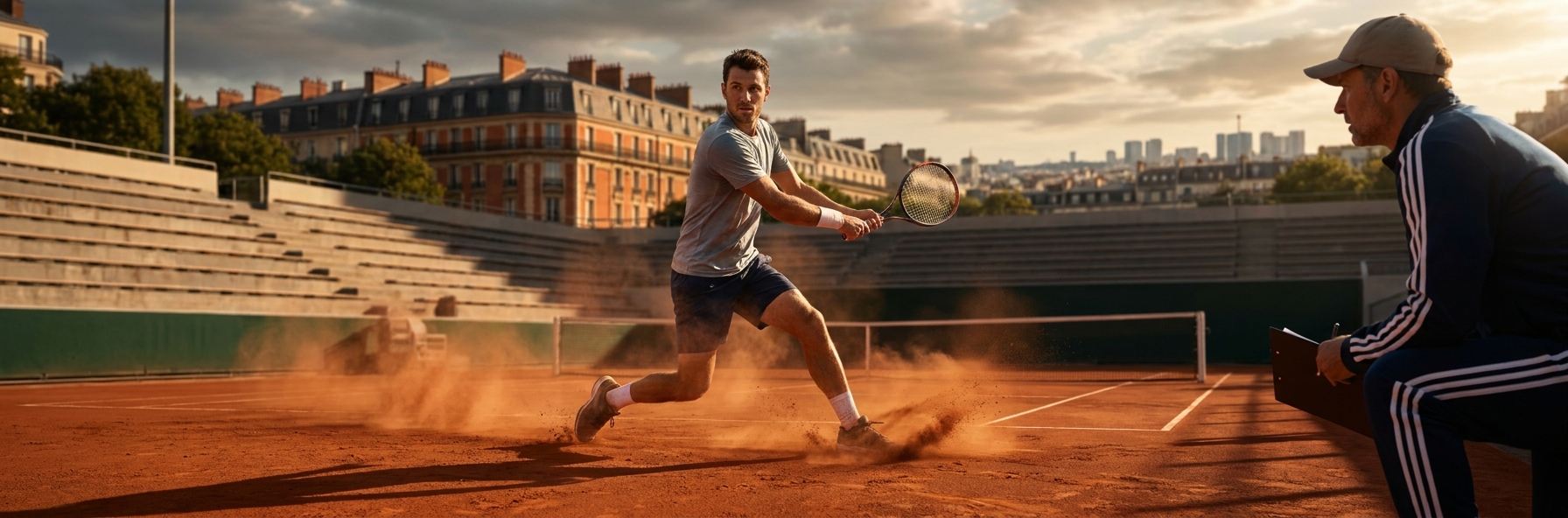
Sliding: Clay players do not stop, they slide. The ability to slide into a shot, plant the inside foot, and recover smoothly is the defining athletic skill of the surface.
Consistency: Average rally length on clay is significantly longer than on hard or grass. Players who go for outright winners early lose to opponents who simply make one more ball.
Endurance: Matches stretch out. Three-set contests can run beyond two hours. Aerobic conditioning, mental stamina, and the ability to recover between points all separate winners from also-rans.
Coaching the Slide
The slide is the single most distinctive technique on clay, and it is one of the few things you genuinely cannot learn well on any other surface. The key coaching point is that players should slide into the shot, not after it. The slide is the recovery footwork, not the celebration.
Stance and shape: Approach the ball with a wide, open stance. The outside leg drives across the body while the inside leg becomes the anchor. The ankle of the inside foot rotates inward, the entire side of the shoe collects clay, and the player stays low through contact.
Inside-foot recovery: Once contact is made, the inside leg pushes off to launch the recovery step. Coaches should drill this rhythm - slide, plant, push, recover - until it becomes automatic.
Don't slide everything: Beginners often try to slide every ball. Teach players that the slide is a tool for wide balls and emergency defence. On a comfortable ball in the middle of the court, a stable open stance is far better.
Patience and Point Construction
Clay punishes impatience. A flat winner attempted from neutral position is intercepted, hung up in the heavy air, and returned with interest. Players need to learn to set up the winning shot before going for it.
Build the rally: Use heavy topspin to push the opponent behind the baseline. Three or four deep, high-bouncing balls force most players into defensive positions before the attacking opportunity appears.
Move the opponent first: Width creates depth on clay. A wide ball that drags the opponent off court opens the entire court for the next shot. Direct attacks rarely succeed; sequential attacks usually do.
Recognise the short ball: The moment to attack is when the opponent's reply lands inside the service line. Drill this recognition: short ball means step in, take the ball on the rise, and finish the point at the net or with a clean drive into the open court.
Surface-Specific Shot Selection
Certain shots gain enormous value on clay, and others lose it.
Heavy topspin: The high-bouncing topspin forehand becomes a true weapon. Balls that would land in the strike zone on hard courts climb above shoulder height on clay, making them very difficult to attack.
Drop shot: Clay is the natural home of the drop shot. The ball dies on the surface and the opponent must cover a long distance to reach it. Teach the drop shot deliberately as part of a clay-court repertoire.
Slice for variation: A low slice that stays beneath the strike zone changes rhythm and forces the opponent to generate their own power. It is also the perfect approach shot on clay.
Flat winners less so: The big flat ball that finishes points on hard courts often becomes just another rally ball on clay. Teach players that aggression on clay looks different - it is about taking time away, not about pure power.
Physical Preparation
Clay tennis is a different physical challenge. Focus your conditioning work on:
Adductor and hip strength: The sliding action loads the inside leg heavily. Side lunges, Copenhagen planks, and lateral band walks build the muscles that protect against injury and produce stable slides.
Core stability: Hitting from extreme positions requires a strong, stable trunk. Anti-rotation work such as Pallof presses transfers directly to court.
Aerobic base: Long rallies and long matches require the engine to match. Two longer aerobic sessions per week underpin everything else.
Key Coaching Points
- Slide into the shot, not after it - the slide is footwork, not flourish
- Average rally length on clay is roughly double that on hard court - plan for it
- Build points with width and depth before attempting the finishing shot
- Heavy topspin, drop shots, and low slices all gain value on the surface
- Adductor strength and aerobic conditioning are non-negotiable