

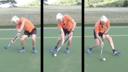
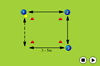
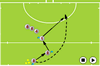

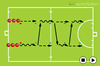

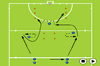
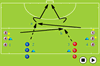
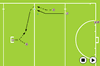

Field Hockey: receiving high ball

June 2026

Until recently, video analysis in hockey meant Hudl Sportscode, a paid analyst and an elite budget. That world still exists at international level - Belgium's Red Lions and Red Panthers run sophisticated tagging workflows that feed directly into their tactical reviews. But in 2026 the same fundamental approach has trickled down to club hockey, and it doesn't need any of that infrastructure.

A phone on a tripod, a free cloud folder and a thirty-minute weekly review meeting is now enough to give your club team a meaningful edge. The teams using it well aren't doing complex statistical analysis; they are simply showing players what happened, what was good, and what could be different. That is enough.

Why Most Clubs Get Video Wrong

The classic failure mode is the recorded match that nobody ever watches. The phone goes on the tripod, the game gets filmed in one long take, and the file sits in a Google Drive folder for the rest of the season. Nothing changes because nothing is reviewed.

The second failure mode is the marathon team meeting where the coach plays forty minutes of footage and gives a monologue. Players switch off after five minutes, the message is lost, and the habit doesn't survive past the third week of the season.

The teams that benefit do two things differently. They edit ruthlessly, and they involve the players. Three minutes of clips that the players themselves help select is worth ten meetings of unedited match footage.

The 3-Clip Rule

Pick a single theme for each weekly review - press triggers, circle entries, set piece execution, whatever the previous match exposed. Then find three clips that show it: one that worked, one that didn't, and one ambiguous moment that prompts discussion.

Three clips is the magic number for club hockey. It is short enough to hold attention, long enough to make a point, and small enough that you can actually edit it in twenty minutes on a Sunday evening. The temptation is always to show ten clips; resist it. The brain only retains the first two or three anyway, so make those count.

Pro tip: Let players nominate one clip each week. The clip they choose tells you what they care about, and they pay attention to footage they have selected themselves.

A Practical Weekly Workflow

Here is the rhythm that works for a typical club coach with a full-time day job.

Saturday match day. Phone on a tripod at the halfway line, slightly elevated if possible. Wide angle covers most of the pitch. Hit record at the warm-up, hit stop at full time. Upload the raw file to a shared cloud folder before you leave the venue. Total time investment: thirty seconds either side of the game.

Sunday clip selection. Open the recording on your laptop. Use a free tool like Clipchamp, iMovie or DaVinci Resolve. Pick your theme based on the match - if the press fell apart, pick press; if you couldn't break the defensive line, pick circle entries. Find three moments, trim them to 10-15 seconds each, save the clip pack. Total time: 30 minutes.

Tuesday training. Show the clips on a tablet or laptop in the changing room before the warm-up. Spend ten minutes - no more - on three questions: what did you see, what should have happened, what will we work on tonight? Then walk straight onto the pitch and train that exact thing.

Wednesday or Thursday follow-up. Share the clip pack to a private team channel with a short text caption. Players who couldn't attend Tuesday can catch up. Players who were there get the reinforcement.

What to Look For

If you don't know what to film for, default to these four categories that almost always reward closer inspection.

The first ten seconds after every turnover. Counter-pressing only succeeds or fails in this window, and it is the most coachable moment in modern hockey.

Every entry into the attacking 25. Did the team build it, did they run it down the wing, did they cross it in? Patterns become visible after three or four matches of footage.

Every conceded goal and shot on target. Painful to watch and uncomfortable to share, but the most direct route to defensive improvement.

Every penalty corner you defended. Run them back at half speed. The body position of the first runner alone will tell you whether your defensive structure is working.

Key Coaching Points

  • Film every match, even with a single phone on a tripod
  • Pick one theme per week, not ten
  • Three clips, three minutes - never more
  • Players nominate one clip each week
  • Train the theme the same day you review it

Recommended Drills

VIEW ALL TACTICS DRILLS

receiving high ball DRILLS
View All
Unfortunately there were no results for your search! Please try again
receiving high ball ANSWERS
View All

Right-Wing Position

My daughter plays U13 hockey in the position of right wing.She gets different advice from her school coach and her club coach.I want to make sure that she is getting the right advice as she is passionate about her hockey. Firstly, exactly what is the full function of a right wing at this level of hockey (she will be going to U15 club hockey and U14 school hockey next season) She has a good understanding of the game and appears to me to read it well (I only played school level many years ago and things change) When her team is in the offensive position in the “D” she mostly waits at goal post to deflect ball into goal.  She appears to not be involved.  Comments from spectators have been made as to why she just stands there. There is a very skilled player in her team who hits the ball EXTREMELY hard.  I believe that at this level of hockey these extremely hard hits/passes do not achieve anything, they just keep going out. However, please can you advise on how to stop and control these very hard passes (that is if one can get to them) in order to move on with the game. Lastly, can you send some drills/exercises to get her eye in as well as positioning her body correctly for goal shooting.  The “hard hitter” and my daughter seem to be the main goal shooters of the team. Many thanks Lynne

Archived User Coach

Typical session for Juniors

Why wont this session open for me when i log in its not there ??

Onny Gajadhar Coach, New Zealand

adding goal keepers to club training

Whats the best way to use keepers in a 2 hour club night .? Core skills of out field players needs more work to get them up to speed . Any ideas would be great ta Dave .

Dave Brierley Coach, England

Receiving the ball forward facing

Anybody any ideas on a conditioned game to encourage receiving the ball in a forward facing position?

Mark Stuart-Thompson Coach, England

Drills for 1 or 2 players

hi. i recently started playing hockey again after 7 years and looking for drills me and my brother can do to help get my technique back. like first touch and shooting dribbling etc. i am a striker

owen hankey Coach, United States of America

Right-Wing Position | Sportpla...

My daughter plays U13 hockey in the position of right wing.She gets different advice from her school coach and her club coach.I want to make sure that she is getting the right advice as she is passionate about her hockey. Firstly, exactly what is the full function of a right wing at this level of hockey (she will be going to U15 club hockey and U14 school hockey next season) She has a good understanding of the game and appears to me to read it well (I only played school level many years ago and things change) When her team is in the offensive position in the “D” she mostly waits at goal post to deflect ball into goal.  She appears to not be involved.  Comments from spectators have been made as to why she just stands there. There is a very skilled player in her team who hits the ball EXTREMELY hard.  I believe that at this level of hockey these extremely hard hits/passes do not achieve anything, they just keep going out. However, please can you advise on how to stop and control these very hard passes (that is if one can get to them) in order to move on with the game. Lastly, can you send some drills/exercises to get her eye in as well as positioning her body correctly for goal shooting.  The “hard hitter” and my daughter seem to be the main goal shooters of the team. Many thanks Lynne

Archived User Coach

Midfield positioning on 16yd h...

hi there I'm using 4-4-2 and on sometimes 3-1-4-2 with a lower level hockey team.I've chosen this over other formations, simply because the hockey experience and ability of my players is not of a high level (and most people have an approximate understanding of 442). Also, I believe that one must choose a formation based on players traits and what they can deliver. For example, I'd ideally prefer to have 3 forwards, to help with more height and width but then would have to either play 3 in the middle or 3 at the back... and my player strengths don't permit this. In short, I simply don't believe I have a strong enough CH / CM to handle 3 in the middle and I'm not convinced that the off-the-ball support from other players is strong enough to allow 3 in the middle. OFFENSIVE PLAYS Anyway, I'm not 100% where to get my centre mids to stand when we have a 16 yd hit to take (i.e. our possession). Obviously one of the CMs comes deep to offer a potential direct outlet from the centre backs or offer an overload option if the ball goes out to the sides (which is more likely, since I've pretty much banned the high risk play of releasing up the middle - we've had far too many turnovers in our final third or quarter because we tried to play up the middle). My players are 'aware' of posting up and leading runs. However, I'm not sure about the 2nd CM. On the one hand I'd ideally like the 2nd CM to come deep as well, in order to potentially help break up the opposition press but by doing so, I distort the midfield and if we do manage to get the ball to one of the CMs, he won't have the 2nd CM in a higher position to release to, etc. DEFENSIVE POSITIONING Can someone suggest, again, about midfield positioning using 4-4-2 or 3-1-4-2, when we are setting up a general press? I have traditionally encouraged man marking, simply because our general positional awareness is weak (which makes zonal play a no-no IMO) + our tracking and attitude to committed defending (i.e. you don’t give up if one tackle fails) could be better! However, looking at suggested presses on Sportplan, some zonal positioning seems a necessity and I think if I can help my players make the step, success will come because they've been forced to become more aware of their pitch positioning, etc. Also, looking at some of the presses, it looks like the midfield can go 'flat' to create a barrier... and as I encourage a diamond shape in midfield, I need to explain to my players what to do and when. Sorry for the wordy question. I hope this all makes sense. Regards, Gary

Gary Thompson Coach, England

How to improve the ball transf...

Dear colleagues, I am coaching a 1st women team (Argentina) and the system that is working for us very well is 3-1-3-3. Given the quality players we've got in the midfield and attack we try to emphasize our offensive game all the time. The problem I am struggling to resolve is that the forwards do not get involved in chances to score inside the circle very often. The few chances the forwards have they are able to score but it is our midfielders who most of the time get to the circle in possession with the ball. I would like to see a quick transfer of the ball from the midfielders to the forwards who need to be in touch with the ball more often during the game and have the midfielders supporting the attack rather than being the leaders of the attack.Is there any drill or way to improve this aspect of the game? Thanks for your time. Martin

Martin Vila-Aiub Coach, Argentina

Tournament prep -building fitn...

I have just returned from coaching my first high school hockey tournament. It was great fun but the girls really felt it by the end of the tournament. I want to offer guidance in the form of a fitness build up to the girls for next season but am not sure what my expectations should be. How fit should you be looking to get if you are preparing to play 7 50min games over 5 days? And what types of fitness should I be suggesting? Sprinting and Intervals along with Swimming are things I feel that could be introduced. Ideally it needs to be accessable (not expensive or require special equipment), self managed (to an extent) and let it fit in with their daily rountine as best possible to give them the best chance to commit (i.e. I feel like suggesting they power walk to school rather than get dropped off will work better than asking them to join a gym to do the pelaton classes) Any ideas? Or things that have worked in the past?

Archived User Coach

how to tackle - Sportplan

tackle how to approach the person in control of the ball

Shirley Perkins Coach, United Kingdom

How to coach school team with ...

Hi,I perhaps naively, expected to have most of our team from last year carry over and only have a few new comers to integrate and get up to speed with the rest. However meeting the team at our first practice last night i find I have five players still at school from last year and the rest all new comers, most of whom had not held a hockey stick at all till practice.This being only my second season coaching (year 9 to year 13 boys) has left me feeling a little blindsided, and feeling quite unsure how to prepare practices that target both groups of boys. Do i lump them both groups together, keep them separate? What drills/exercises to best bring the new comers up to speed.I don't want to neglect either group, keep practice worthwhile for the experienced boys, but also bringing the new comers up to a level were they can mix in with the others and learn organically from them while practicing as a team. David

David Smith Coach, New Zealand

JOIN SPORTPLAN FOR FREE

  • search our library of 1000+ hockey drills
  • create your own professional coaching plans
  • or access our tried and tested plans

Sportplan App

Give it a try - it's better in the app

YOUR SESSION IS STARTING SOON... Join the worlds largest hockey coaching resource for 1000+ drills and pro tools to make coaching easy.
LET'S DO IT









