Tennis: techniques

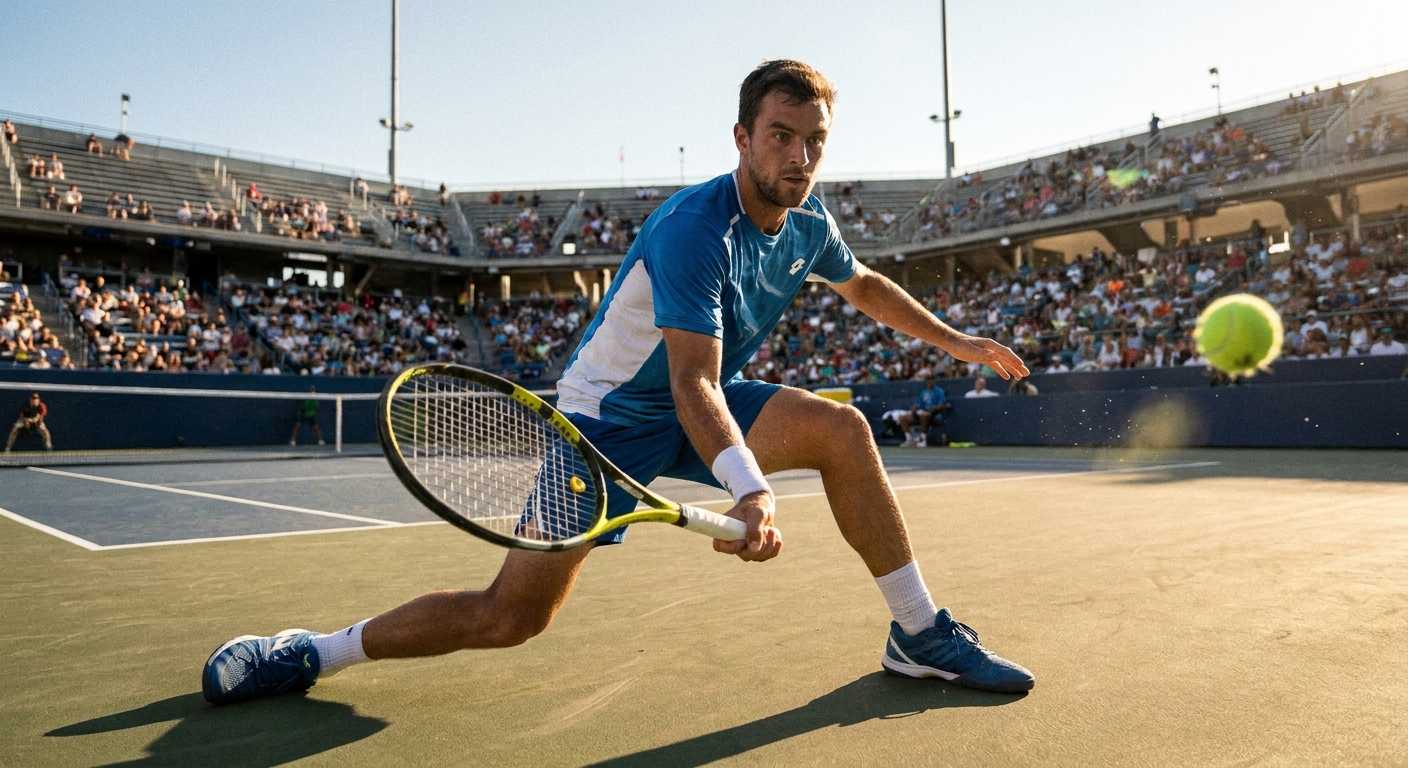
The one-handed backhand is increasingly rare on professional tours. Junior academies default to teaching two-handers. Yet Federer's backhand won 20 Grand Slams. Wawrinka's won three. Dimitrov and Tsitsipas have built careers around theirs.

Is the one-hander an anachronism or a secret weapon?

The Debate: One vs Two Hands

Arguments for the two-handed backhand:

Easier to learn: Two hands provide more stability and control, especially for younger players.

Return advantage: Compact preparation helps handle fast serves.

High ball handling: Two hands manage shoulder-height balls more easily.

Arguments for the one-handed backhand:

Greater reach: One hand extends further, especially on wide balls.

Natural slice: The one-hander naturally incorporates slice, adding variety.

Net play advantage: One-handed players typically transition more smoothly to volleys.

Tactical unpredictability: The disguise between topspin and slice creates uncertainty.

Technical Foundations

The one-handed backhand requires specific technique:

Grip: Eastern backhand or slightly more extreme. The grip position enables a vertical racket face at contact.

Shoulder turn: More pronounced than a two-hander. The hitting shoulder turns back fully, loading rotation.

Non-hitting arm: Extends back for balance and helps initiate rotation. Critical for timing and power.

Contact point: Further in front than a two-hander. Early preparation is essential.

Follow through: Over the shoulder for topspin, across the body for slice.

The Topspin One-Hander

Generating topspin with one hand:

Racket drop: The racket drops below the ball during preparation, creating an upward swing path.

Wrist action: The wrist rolls over through contact, brushing up the back of the ball.

Leg drive: Power comes from the legs driving upward. The arm alone produces weak shots.

Full finish: The follow-through goes up and over the opposite shoulder.

The Slice Backhand

Every one-hander needs a reliable slice:

Preparation: Racket high, roughly ear height. Different from topspin preparation.

Swing path: High to low, carving under the ball.

Contact: Slightly later than topspin, with an open racket face.

Uses: Approach shots, defensive retrievals, changing pace, staying in points.

Handling High Balls

The traditional weakness of one-handers:

Early recognition: Identify high balls early and take them on the rise when possible.

Position adjustment: Move further back to let high balls drop to comfortable height.

Slice option: A high backhand slice, while defensive, is safer than a struggling drive.

Run around: When possible, move to hit a forehand instead.

Development Pathway

Should you teach the one-hander?

Physical requirements: One-handers require more core strength and timing. Very young players often lack both.

Natural preference: Some players naturally gravitate to one hand. Forcing a two-hander on a natural one-hander can backfire.

Long-term view: One-handers take longer to develop but may have higher ceilings for certain player profiles.

Playing style: If a player naturally gravitates to net play and variety, the one-hander fits better than for a pure baseliner.

Practice Priorities

Timing drills: The one-hander is unforgiving of timing errors. Repetition builds the precise timing required.

Footwork emphasis: Good preparation position is even more critical for one-handers.

Slice development: The slice should be as reliable as the drive. Practice both equally.

High ball work: Specifically practice handling high bounces - the known vulnerability.

Key Coaching Points

  • The one-handed backhand remains viable at all levels when well-executed
  • Technical foundations - grip, shoulder turn, contact point - are critical
  • A reliable slice backhand is essential, not optional
  • High balls require specific strategies and practice
  • Player profile and natural preference should guide the choice

Drills for Backhand Development

VIEW ALL BACKHAND DRILLS

JOIN SPORTPLAN FOR FREE

  • search our library of 1200+ tennis drills
  • create your own professional coaching plans
  • or access our tried and tested plans
techniques DRILLS
View All

Tennis: Over and In. 'Budge It...

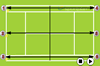
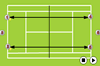
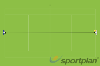
Intention: Assess forehand technique whilst developing the principles of rallying.Players start on their various courts. Each of which has a designated score that is progressive (eg 5, 7, 9) and at the discretion of the coach.Where space is limited, courts can be divided in half or thirds to create stations.One player ('The Sender') starts each rally with an underarm throw to a target area on their partners side of the court, which is situated half way between their partner ("The receiver") and the net.The 'receiver', who is positioned roughly two racket lengths behind the target area, with a racket, attempts to hit the ball after one bounce to a target area on their partner's side of the court, which is positioned roughly half way between their partner and the net.The pair must then continue to throw and hit the ball (after one bounce) until they achieve the score for their designated court/station.If the rally breaks down in any way, the pair must start the rally again from zero on the court/ station they are on.If the players successfully achieve the score for their designated court (or station), they progress upwards (one station) and 'Budge' the pair on the higher station down.If either of the pair lands the ball directly on the target area they automatically progress upwards (one station) and 'Budge' the pair on the higher station down.When a pair achieves the designated score on the highest (top) court they are awarded 1 'golden' point.When a pair successfully achieves a 'golden' point, they attempt another one until they are 'budged'.The game ends when a pair reaches a pre-set number of 'golden' points. Alternatively, the pair with the most 'golden' points at the end of a pre allocated period of time is the winner.

General

Unfortunately there were no results for your search! Please try again
techniques SESSIONS
View All
techniques ANSWERS
View All

I am about to do my level 1 coaching course and just?

I am about to do my level 1 coaching course and just recieved an email about the structure of the course and came across techniques of ABC.<br /><br />My guess is that is stands for, Agility, Balance, Co-ordiantion but im not 100% sure, could someone please let me know.<br /><br />D

Archived User Coach

What is my fault? Difficulty coaching some of the older players - advice?

Helo, my name is Fernando, I am a Spanish tennis teacher who started teaching six months ago. I am working in a public sportcenter and I am having some problems with adults. When I started I realiced that the students were used to playing tennis without any control. Young students told me that the other teacher only used to leave them play - he rarely explained them how to hit the ball. Consequently the do enjoy my clases and they are learning a lot and impoving their level of tennis. So far so good, but the problem is that with the adults I have the impression that they don´t like my clases. In fact some of them left the group at the begining. I try to mix different kinds of drills during the class and I usually finish it with a game like for example 21, winner........ But it seems that they don´t enjoy it. During the exercises most of them don´t try to do what I tell them. As a result, they don´t have a good level of tennis. But as far as I know, the other teacher was a tennis player who uses to play against them during the clases. As this is my first time teaching tennis, I don´t fell confidence and that is the reason whay I do´t like to play against them. Appart from that I think that this is not my role as a teacher. So I would like you to tell me how to deal with that situation. I don´t care if they leave me because this is not going to affect my job, but i wouldn´t like them to leave just because I like tennis and I like teaching tennis. Thank you very much for your help. I am sorry for my English. Best wishes!!!!

Fernando Coach, Spain

Any suggestions for some bad weather drills I can run indoors with my players?

How can I run drills inside before the weather is okay to go out?

Archived User Coach

How do I coach 14 girls (varying abilities) on just 2 courts?

How do I coach 14 girls, all of varying levels from beginner to advanced on just two courts?

Archived User Coach

How to plan 4 progressive lessons?

Hi, I'm on Level 2 Tennis Assistant Coach course, and have a task to plan 4 progressive lessons, explaining the objectives,overall aims and what the players should be able to do before they move onto the next lesson. I did my Level 1 11 years ago, so I'm a bit out of touch. Can any one help please?

Archived User Coach

Coaching players with language-based l.d. /dyslexia

We have some players on a girls high school team who hit well, have good form and serve well but do run into confusion sometimes with remembering scores, hearing instruction when playing matches and processing speed can be a challenge as well because these players have language-based learning disabilities. They are strong players but I need some advice about best practices for lessons/coaching that will bring them the most success on the court. Are there specific drills/coaching techniques that are helpful? Also, I'm going to purchase some wrist score keeper bracelets unless someone knows of a better way for them to keep track of the score discreetly and quickly. (wrist or racket)

Archived User Coach

begginer tennis lesson age 5years

Please provide a structured 5 year old begginner lesson

Florence Madzimbamuto Coach, South Africa

How to Improve Error Detection...

HI there,I am an assistant coach for a small tennis academy. It has been 2.5 years since I’ve started. I do not have any certification of being a coach but I was a state player(representing my state) back when I was a player in high school. The only knowledge/experience I have as a tennis player was from when I had training back then and even so it was limited. A big issue/challenge I am facing right now is error detection and correction. I realized I am unable to identify the problems of my players which is beyond the obvious and I tend to correct the effect of the problem instead of the root cause of it. i believe what I don’t have is a coach eye, I was wondering if you have some kind of materials or course or even guidance on that matter. I am really keen on improve that part of me. I feel like that part is holding me back as I can give an accurate correction to my players which then hinders my player’s improvement. Hope to hear from you soon. Thank you

sesagi153 Coach, Malaysia

How do I coach 14 girls (varyi...

How do I coach 14 girls, all of varying levels from beginner to advanced on just two courts?

Archived User Coach

What is my fault? Difficulty c...

Helo, my name is Fernando, I am a Spanish tennis teacher who started teaching six months ago. I am working in a public sportcenter and I am having some problems with adults. When I started I realiced that the students were used to playing tennis without any control. Young students told me that the other teacher only used to leave them play - he rarely explained them how to hit the ball. Consequently the do enjoy my clases and they are learning a lot and impoving their level of tennis. So far so good, but the problem is that with the adults I have the impression that they don´t like my clases. In fact some of them left the group at the begining. I try to mix different kinds of drills during the class and I usually finish it with a game like for example 21, winner........ But it seems that they don´t enjoy it. During the exercises most of them don´t try to do what I tell them. As a result, they don´t have a good level of tennis. But as far as I know, the other teacher was a tennis player who uses to play against them during the clases. As this is my first time teaching tennis, I don´t fell confidence and that is the reason whay I do´t like to play against them. Appart from that I think that this is not my role as a teacher. So I would like you to tell me how to deal with that situation. I don´t care if they leave me because this is not going to affect my job, but i wouldn´t like them to leave just because I like tennis and I like teaching tennis. Thank you very much for your help. I am sorry for my English. Best wishes!!!!

Fernando Coach, Spain

Coaching players with language...

We have some players on a girls high school team who hit well, have good form and serve well but do run into confusion sometimes with remembering scores, hearing instruction when playing matches and processing speed can be a challenge as well because these players have language-based learning disabilities. They are strong players but I need some advice about best practices for lessons/coaching that will bring them the most success on the court. Are there specific drills/coaching techniques that are helpful? Also, I'm going to purchase some wrist score keeper bracelets unless someone knows of a better way for them to keep track of the score discreetly and quickly. (wrist or racket)

Archived User Coach

Psychology in tennis HELP! My ...

Psychology in tennis HELP!!! I have a daughter who is an excellent player who only started playing tennis seriously last yr at the age of 13. She is a much better player than all the people she has completed against in matches but always loses due to over hitting and getting upset if the wrong call is made (which happens frequently due to how fast she hits and serves) do we need some sort of psychological help for this. what is the best way to get this... books, councilling ??? any help would be most appreciated thanks

Archived User Coach

Catapult serve is a good learn...

I coach 4-7 year olds, and when I'm teaching serves I usually start with the throwing technique without a racket, before introducing the ball toss. Someone has suggested I teach a catapult serve as a part of the learning process. I personally think this would teach bad habits as there is no toss up. Any opinions on this? Thx

Mike Childs Coach, England

JOIN SPORTPLAN FOR FREE

  • search our library of 1200+ tennis drills
  • create your own professional coaching plans
  • or access our tried and tested plans

Sportplan App

Give it a try - it's better in the app

YOUR SESSION IS STARTING SOON... Join the growing community of tennis coaches plus 1200+ drills and pro tools to make coaching easy.
LET'S DO IT