Rugby: maul defence

June 2026

If you watch the data, restart kicks happen more often than any other set-piece in a modern rugby match. A Six Nations game produces around twelve to sixteen restarts, more than the average lineout count and far more than scrums. Yet most teams - especially below elite level - still treat them as an afterthought. That is the gap top coaches are now closing.

The phrase "restart is the third set-piece" has become a coaching slogan in 2026 for good reason. The team that wins the restart battle controls field position, momentum and the opening sixty seconds of every passage of play. Conceding a try and then conceding the restart immediately afterwards is one of the most common ways to lose a match.

Why Restarts Are Suddenly Critical

Two things have changed. First, kickers have become more accurate. Restarts now land precisely on the 10-metre line and in the 15-metre channel, contested by tall, athletic chasers who jump for the ball. The days of a 22-metre dollop into the middle of the pitch are gone.

Second, the reward for retention has grown. With modern attacking shapes, a team that retains its own restart is straight into structured phase play in the opposition half. A team that loses the restart is defending in their own 22 with a disorganised line. The swing between those two outcomes is enormous.

Building a Reception Pod

Top teams now train a dedicated restart reception pod, exactly as they train a lineout pod. The pod typically has four roles, and every player must know which role they have before the kick is taken.

The catcher: Usually a lock or back-rower, chosen for height and timing. They call early - "mine" or the channel number - and commit to the catch.

The lifter: A prop or hooker who arrives at the catcher's side, hands ready, to give a lift on the contested ball. Lifting is legal at restarts and dramatically improves your win rate against good chasers.

The protector: A second forward who stands between the catcher and the chase, taking the contact if it comes and forming the first ruck cleanly.

The exit option: A back, usually the fly-half or full-back, in position to receive the next pass and either kick to touch or launch a counter.

How to Coach Restart Reception

Restart skills are perishable. Train them every week, even if only for ten minutes. Build the session in three blocks.

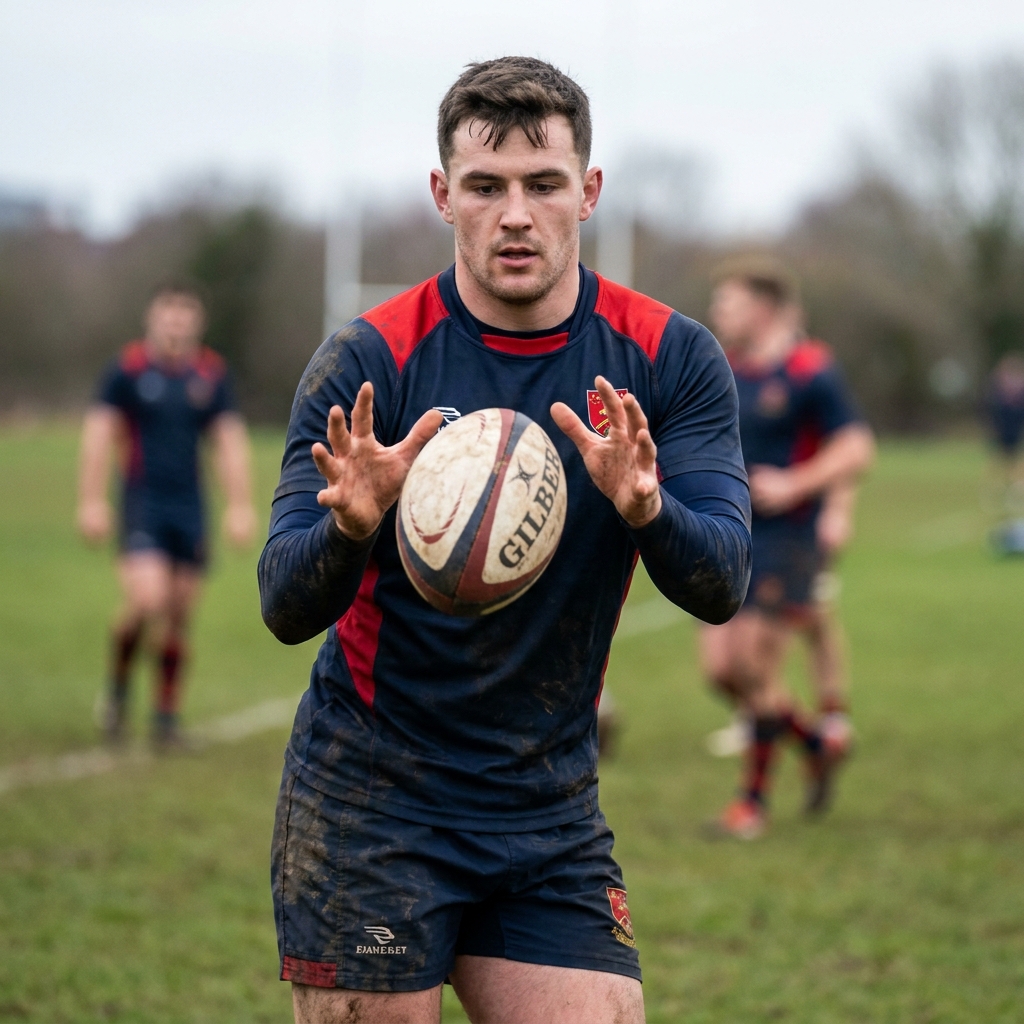
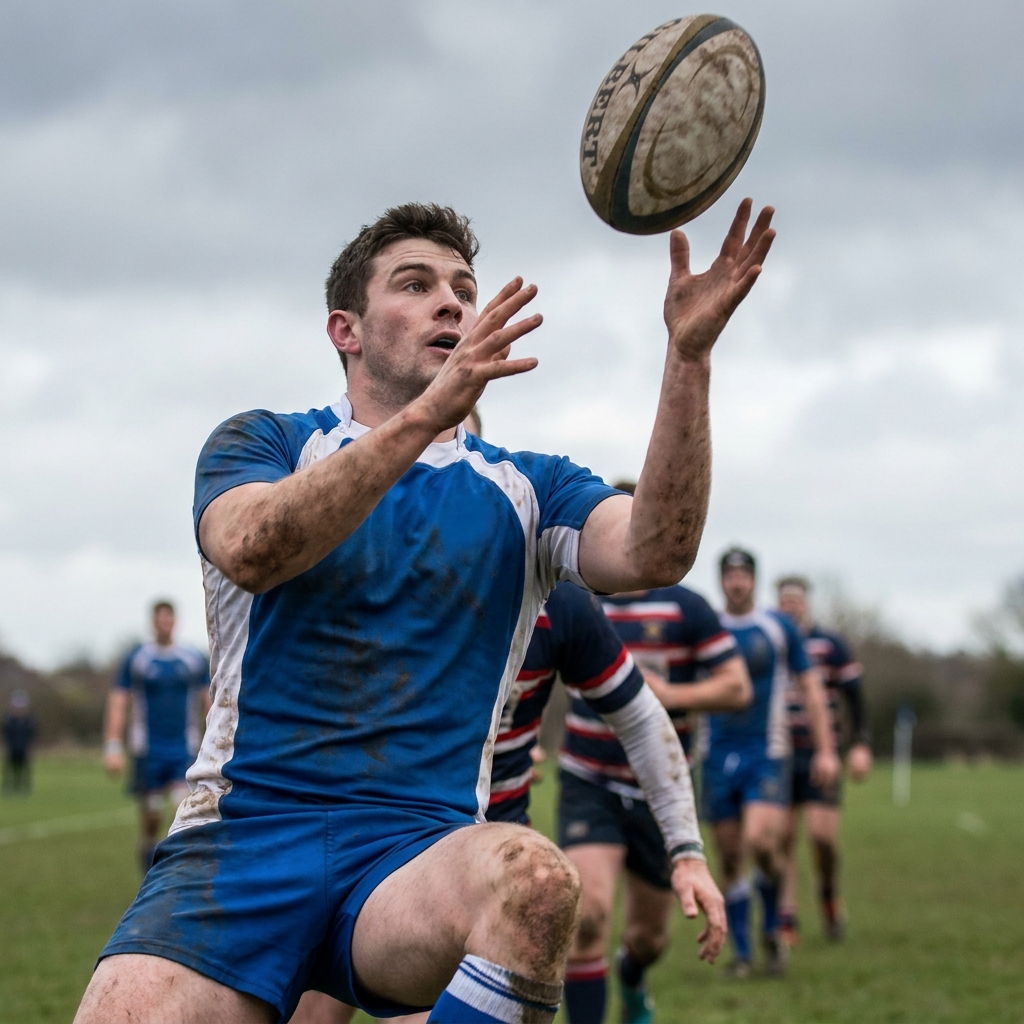
Block 1 - Catching under contest (5 minutes): One coach kicks high balls from the halfway line. Your designated catchers work in pairs - one catches, one acts as a chaser jumping to contest. Rotate every two reps. The focus is timing the jump, not winning every ball.

Block 2 - Receiving as a unit (10 minutes): Full pod of four sets up. Coach kicks restarts. Pod must catch, secure, ruck and recycle clean ball to a back. Add an opposition chase line of three after five reps.

Block 3 - Restart-to-exit scenarios (10 minutes): 12v12 or 10v10 game starting from a restart. After receiving, the team in possession has one rule: get out of their own half within three phases. This trains the link between reception and territorial exit.

Attacking Restarts - The Other Half

Receiving is half the picture. The other half is recovering your own restart. Modern restart kicks are aimed at one of three landing zones: short on the 10 (5-7 metres beyond the kick mark), mid-deep at the 15-metre line, or long into the far corner. Each option requires a different chase pattern.

The short restart is the highest-percentage recovery option but the hardest to execute accurately. Reserve it for moments when you genuinely need the ball back - after conceding a try, with time running out, or to disrupt a stronger opponent. Drill the kicker until they can land a restart in a one-metre window on demand.

Key Coaching Points

  • Restarts are the most frequent set-piece - train them weekly
  • Build a named reception pod with four clear roles: catcher, lifter, protector, exit
  • Lifting is legal at restarts - use it
  • The exit kick after a clean catch is as important as the catch itself
  • Reserve the short restart for moments when winning it really matters

Recommended Drills

VIEW ALL KICKING DRILLS

maul defence DRILLS
View All

Maul Touch Warm Up - Rugby Dri...

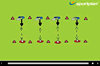
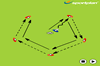
Be brief when telling the players the laws of this game, it's important to get them moving quickly. This is not a contact game, but there will be some light contact. Break your players into two teams, giving each team their own colour of bibs if necessary. One team goes to attack, and one to defence. Nominate a Scrum Half for each team, it will be their job to move the ball from the back of the maul and out to an attacking line. There is no kicking in this game. Normal laws of rugby apply e.g. a forward pass will result in the ball being turned over to the opposition. If an attacking player is touched: they must stop and turn, a maul is then built based on how you have trained your players to Maul. Only four players should be in the maul - but every player should be able to maul - including the backs! When you start playing this game make sure that the defence is employing your defensive pattern around the maul. They will commit 4 players, but will not do anything more than provide light resistance. Once formed the maul can take four steps before moving the ball. If there is a delay in creating the maul, or the quality of the maul is poor - the ball can be turned over. Depending on your goals decide on the number of touches you wish to allow e.g. unlimited is not a bad option as mistakes will be made! If a team has been in possession for a long time, don't forget to turn the ball over to give the opposition a run. Don't hesitate to shape the game to focus on your session goals, and let us and other coaches know what worked for you.

General

Living On The Edge Warm Up - R...

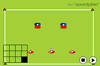
Split the players into two teams, giving each team their own set of bibs. Two different colours that clearly define the teams. Keep your player briefing, brief. It's important that you get your players moving as quickly as possible. Tell the players that we will be playing One Touch Ruck, see the laws surrounding this game in the Warm-Ups section of the SportPlan site. Briefly - when an attacking player is touched while carrying the ball: they go to ground and either pop or present the ball for a minimum of two supporting players to ruck over. The defence should behave as they normally would at the ruck, committing two players who will not compete for the ball or go into contact. The defence should employ their normal patterns around the ruck. The attacking team can have three touches in a row between the 15 meter lines, if they move the ball to the either of the 15 meter channels they can have another four touches in that channel before having to move the ball back out. If the attacking team moves quickly from one 15 meter channel to the other (exploiting space), they get a bonus of 4 touches in that zone. If any attacking team exceeds the number of touches they can sustain inside a channel, the ball is turned over. Play with these laws a bit - keeping an eye on what you want to achieve in this session. The normal laws of rugby apply, any law infringements result in a turn over. There is no kicking in this game. Don't forget to give the defence a turn in attack, if for any reason the attacking team is particularly good at retaining the ball. If they are, well done you as a coach!

General

Unfortunately there were no results for your search! Please try again
maul defence ANSWERS
View All

switch pass in rugby union

switch pass in rugby union

maria Coach, England

Please supply me with the positional play for a No8 at the maul,defence,and attack

Ask a question and have it answered by Coaches from around the world and Sportplan's team of Experts.

Buddy Walker Coach, New Zealand

Post lineout rules. Defending maul.

Hi, I have an enquiry about the post lineout rules. A lineout jumper successfully catches the ball, returns to the ground and precceds to maul. The defending team has three options to put (1)leverage against with defending maul, to (2) attack the main front men of the maul but also I heard on this weekends commentary there is a (3)dragging down. When the lineout jumper is returning to the ground it seems the defending team can hold the jumper as long as no pressure is excerted and when they hit the floor the defending team can tackle him (drag him to the ground) stopping the maul. Is this right and if so are there further rules governing this that i cannot yet find? I have read the IRB 2009 laws but still i have no answer. Many Thanks

Archived User Coach

I am looking for drills / ideas on how to teach U6/U7?

I am looking for drills / ideas on how to teach U6/U7 about how to stay "onside" during a game.

Archived User Coach

positional skill - how can i improve a props defence?

positional skill - how can i improve a props defence / decision making off the side of a ruck / maul?

david clark Coach, South Africa

U10s organisation in defence. How to improve?

I have started an under 10s team up, and I would say about 8 from the 13 children I have , did not play rugby until about 6 months ago. Of these players, there seems to be a lot of potential, as we are scoring tries against teams, that very rarely concede tries.the problem I got with them, is that we are very poor at organising our selves in defense when the opposition has the ball, which does result in us conceding quite a few tries. We have some very good tacklers in the team. Can anyone offer some ideas on how I can get them to organise themselves? Thanks . Chris.

christopher jenkins Coach, Wales

Interpretation of the maul - for U10s?

I will be coaching under 10 next season and need some guidance on how to interpret the rules for the maul?

Ezra rushen Coach, England

(U11 Rugby) - How to referee the 'big lad'

I'm coaching and reffing U11 rugby and one of my players is the definitive 'big lad'. His 'strength' is his size and his power, but last weekend he didn't seem to get reffed fairly. The opposition couldn't tackle him down, one on one and when another two joined in to make a mini maul, that didn't slow him down much either. The ref then let other people join in the (one sided) struggle to tackle him down, which seemed very unfair as A) it's outside the laws of U11 rugby,, B) it makes it nigh on impossible for him to offload, C) when he is brought to ground, he has 4-5 players all over him and he got pinged for 'holding on'. He is a recent arrival to rugby and it was our first game for a couple of months, so the situation hadn't reared his head before. We are keen that he learns all of the core skills of rugby and doesn't get used as a battering ram, but after seeing a pack of hyenas trying to pull down the big fella, something just didn't seem right to me.I'd be grateful for any thoughts and opinions.

Archived User Coach

When a scrum is awarded following an unsuccessful end to a maul

When a scrum is awarded following an unsuccessful end to a maul, which team throws the ball in?

Arthur Johannes Coach, South Africa

Interpretation of the maul - f...

I will be coaching under 10 next season and need some guidance on how to interpret the rules for the maul?

Ezra rushen Coach, England

(U11 Rugby) - How to referee t...

I'm coaching and reffing U11 rugby and one of my players is the definitive 'big lad'. His 'strength' is his size and his power, but last weekend he didn't seem to get reffed fairly. The opposition couldn't tackle him down, one on one and when another two joined in to make a mini maul, that didn't slow him down much either. The ref then let other people join in the (one sided) struggle to tackle him down, which seemed very unfair as A) it's outside the laws of U11 rugby,, B) it makes it nigh on impossible for him to offload, C) when he is brought to ground, he has 4-5 players all over him and he got pinged for 'holding on'. He is a recent arrival to rugby and it was our first game for a couple of months, so the situation hadn't reared his head before. We are keen that he learns all of the core skills of rugby and doesn't get used as a battering ram, but after seeing a pack of hyenas trying to pull down the big fella, something just didn't seem right to me.I'd be grateful for any thoughts and opinions.

Archived User Coach

When a scrum is awarded follow...

When a scrum is awarded following an unsuccessful end to a maul, which team throws the ball in?

Arthur Johannes Coach, South Africa

U10s organisation in defence. ...

I have started an under 10s team up, and I would say about 8 from the 13 children I have , did not play rugby until about 6 months ago. Of these players, there seems to be a lot of potential, as we are scoring tries against teams, that very rarely concede tries.the problem I got with them, is that we are very poor at organising our selves in defense when the opposition has the ball, which does result in us conceding quite a few tries. We have some very good tacklers in the team. Can anyone offer some ideas on how I can get them to organise themselves? Thanks . Chris.

christopher jenkins Coach, Wales

Law no. 16 Maul - Sportplan

When a scrum is awarded following an unsuccessful end to a maul, which team throws the ball in?

Paula Peniasi Coach, Fiji

Unsuccessful end to a maul whe...

Following the TV explanation of a referee's decision on an unsuccessful maul from a kick-off, I looked up the following rule (the latest version on the IRB site).----------------------------------------------------------------------------17.6 UNSUCCESSFUL END TO A MAUL (h) Scrum after a maul when catcher is held. If a player catches the ball direct from an opponent’s kick, except from a kick-off or a drop-out, and the player is immediately held by an opponent, a maul may form. Then if the maul remains stationary, stops moving forward for longer than 5 seconds, or if the ball becomes unplayable, and a scrum is ordered, the team of the ball catcher throws in the ball.---------------------------------------------------------------------------- It states "except from a kick-off or a drop-out", but then nowhere can I find what happens IN the case of a kick-off or a drop-out. Does anyone know the answer?  The referee's decision and the explanation given on Sky was as though the exception above were not there.

Philip Ratcliffe Coach, Italy

How many tacklers are allowed ...

At under 10s I was under the impression that it is 1v1 tackling. Can someone clarify the laws on this please?

Aaron Lee Newson Coach, Wales

Tips on breaking through a def...

Hi my name is Mac and i am a 8 man and i struggle to push through a defensive line when i have the ball due to how my coaches make us practice so i wanted to know tips on how to push/break through a defensive line when i have the ball.

Mac Coach, United States of America

Vision and Anticipation??!!! -...

Hi guys, Thanks for everyone that answered my question on Stats!!! I am in the process of drawing up a sheet and sharing it with those that want. Next Question%3A I have come up with a few drills that I think will improve my players Vision, anticipation and decision making. I am wondering if anyone will share their ideas and process to improve these aspects of players especially VISION? I know the 2v1 and 3v2 drills ext for decision making but I want to focus more on VISION and ANTICIPATION. Any ideas??? Thanks again. Shaun

Archived User Coach

JOIN SPORTPLAN FOR FREE

  • search our library of 1100+ rugby drills
  • create your own professional coaching plans
  • or access our tried and tested plans

Sportplan App

Give it a try - it's better in the app

YOUR SESSION IS STARTING SOON... Join the growing community of rugby coaches plus 1100+ drills and pro tools to make coaching easy.
LET'S DO IT