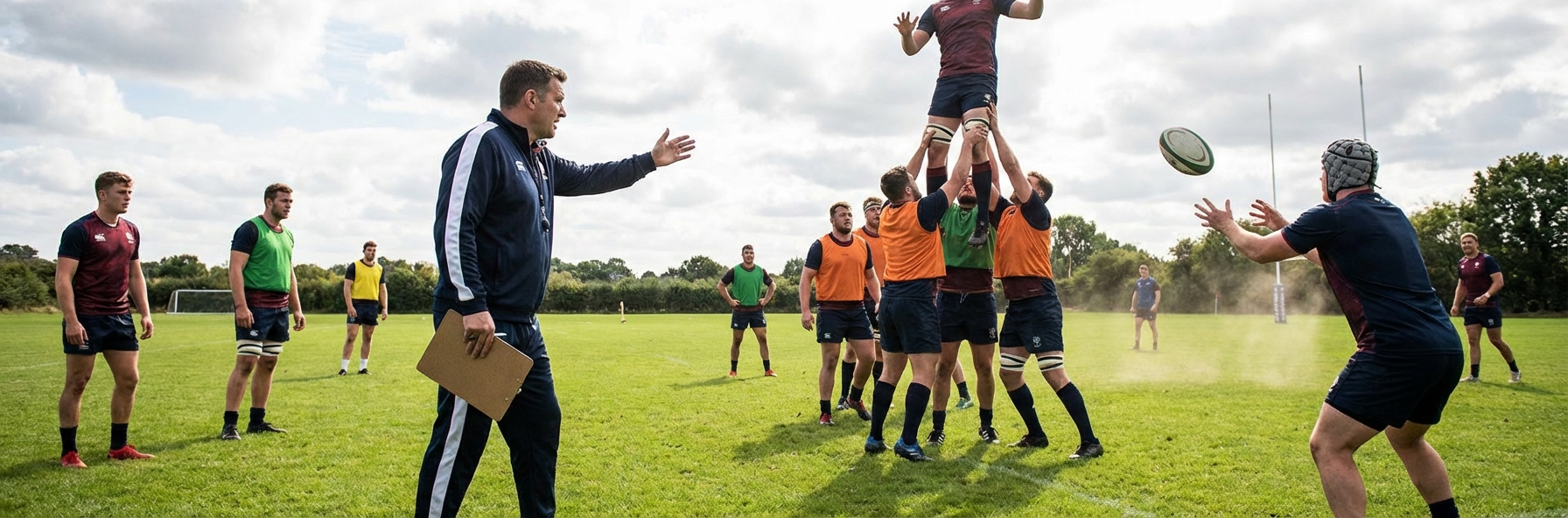
The Rule Change Explained
World Rugby's 2026 law amendment removes the "not-straight" penalty on uncontested lineouts. If the defending team chooses not to contest the throw, marginal accuracy is no longer penalised.
The change aims to speed up play and reduce stoppages for minor technical infringements. But for coaches, it opens significant tactical opportunities that weren't available before.

Why This Matters for Coaches
Less Pressure on Hookers
At grassroots level, inconsistent throwing often costs possession. Under the new rule, when opposition doesn't contest, your hooker can focus on speed and delivery rather than worrying about marginal straightness. This is huge for developing players.
More Variation Possible
Previously, unconventional throws risked "not-straight" calls. Now, if the defence isn't contesting, you can throw to unusual positions without fear of losing possession. This expands your attacking playbook significantly.
Quicker Attacking Ball
When you know a throw won't be penalised for marginally missing the line, you can prioritise speed over precision. Quick ball from lineouts is valuable ball.
New Tactical Opportunities
1. The Quick Tap Lineout
With no contest, your jumper can catch and immediately give to the 9 who's already running a pre-planned move. The defence has no time to set. Practice this until it's automatic - the speed advantage is enormous.
2. Throwing to Unusual Positions
Traditionally, lineouts go to the front or middle. But if there's no contest, you can throw to the back lifter, to a player at the tail who peels around, or even flat to a runner. The defence can't anticipate what isn't contestable.
3. Attacking Width Immediately
Use a short lineout of 2-3 players, catch quickly, and move the ball wide before the defence organises. The uncontested throw is your trigger to attack space, not just win possession.
4. The Dummy Lineout
Set up as if for a lineout, but tap quickly before formation. The defence expects the throw; you're already playing. It's risky but effective when referees allow it.

Training Implications
Prioritise Speed Drills
Run lineout races where teams compete to catch and pass to the 9 fastest. Award bonus points for ball reaching the outside backs within 5 seconds of the throw.
Develop Multiple Throwing Options
Your hooker should be comfortable throwing to any position in the lineout. Practice throws to front, middle, back, and unusual positions. Versatility beats perfection.
Train Recognition
Players must recognise instantly when a lineout is uncontested. Build signals and automatic plays that trigger when the defence stands off.
Practice Transition
The value is in what happens after the catch. Connect lineout work to attacking plays so the transition from set piece to attack is seamless.
Recommended Drills


Defensive Considerations
The flip side: should you contest opposition lineouts?
- Contest when: You have capable lifters, the throw is predictable, or you need possession urgently
- Don't contest when: You're setting for a specific defensive alignment, their lineout is dominant, or you want them to throw quickly into your set defence
- The trap: Standing off invites quick ball. Make sure your defence is organised if you choose not to contest.
Frequently Asked Questions
Does this rule apply at all levels?
Check with your league or union. World Rugby's law variations allow different applications at different levels. Most adult competitions have adopted the change; youth rugby may vary.
Can I still be penalised for a crooked throw?
Yes, if the opposition contests and your throw is not straight, it's still a penalty. The change only applies when the lineout is uncontested.
Should I contest opposition lineouts more or less now?
Consider contesting more often to deny them the speed advantage. But if you can't compete in the air, a well-organised defence might be more effective than a lost contest.
How do we signal an uncontested throw?
Develop simple signals - a call word, a hand gesture from the hooker, or a formation that tells everyone "this is uncontested, execute fast". Clarity is essential.

 sportplan_rugby