Rugby: rugby strength

May 2026

Kicking from hand is at record levels in elite rugby. Six Nations 2026 was the most kicked-from-hand championship since stats began, and the same trend is showing across the URC, Champions Cup and Super Rugby. Coaches have realised that good kicks force opponents into pressured returns - and pressured returns are the easiest scoring opportunities in the game.

The flip side is just as important. If your side is on the receiving end of all those kicks, your counter-attack is no longer a luxury skill - it is a core part of your attacking game plan. The most exciting tries in 2026 are not coming from set-piece strike moves. They are coming from broken-field returns.

Why the Counter-Attack Has Become Central

When a team kicks, three things happen at once. Their forwards are spread across the field as chasers rather than packed around the ball. Their defensive line is in motion, not set. And the receiving team has the ball with space in front of them. Combined, those three factors mean the defence is at its most vulnerable in the seconds immediately after a kick.

Modern attacking analysts call this the "transition window". It typically lasts six to eight seconds. If the receiving team can move the ball into space inside that window, they create a numerical or positional advantage that no structured attack could engineer in open play.

The Three Decisions Every Receiver Must Make

Catching the ball is the easy part. The decision that follows is what separates good counter-attacking teams from poor ones. Train your back three to run through three questions every time they collect a kick.

Decision 1 - Time and space: How close is the nearest chaser? If a chaser is within five metres and closing fast, the answer is almost always to return the kick. If the nearest chaser is ten metres away or more, the carry is on.

Decision 2 - Width on the field: Where are my support runners? A counter-attack needs at least two players in support. If the wingers are still on their wings and the full-back caught it, there is no point trying to run - the carrier will be isolated. Better to step infield to a phase, then launch the next play.

Decision 3 - The defensive picture: Which side is undermanned? Most chase lines come up flat and even, but there is almost always a weakness - usually on the far side of the field where the original kicker stayed back. Counter to that space, not into the strongest chase channel.

How to Build Counter-Attack Habits

Counter-attacking cannot be taught from a whiteboard. It is a reactive skill and must be trained in environments that look like the game. Here is a progression that works at every level from U16 upward.

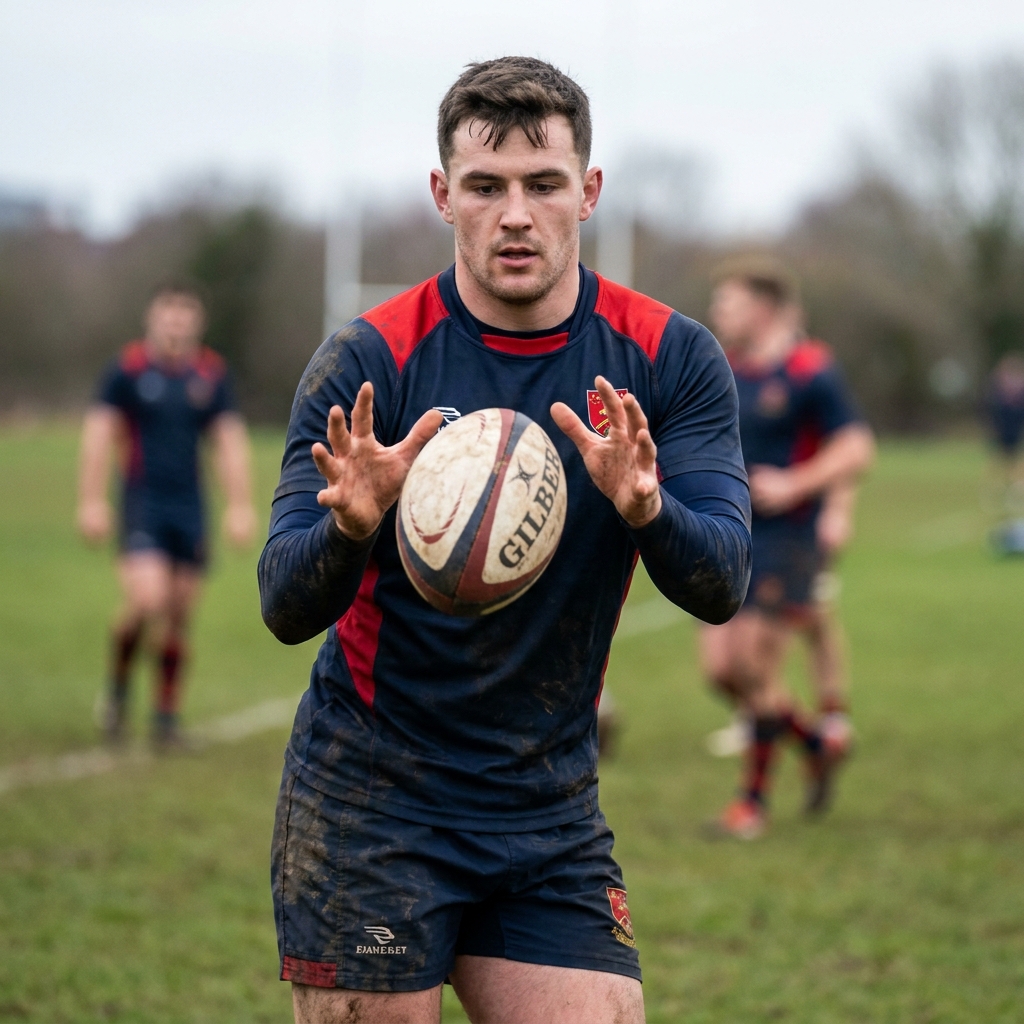
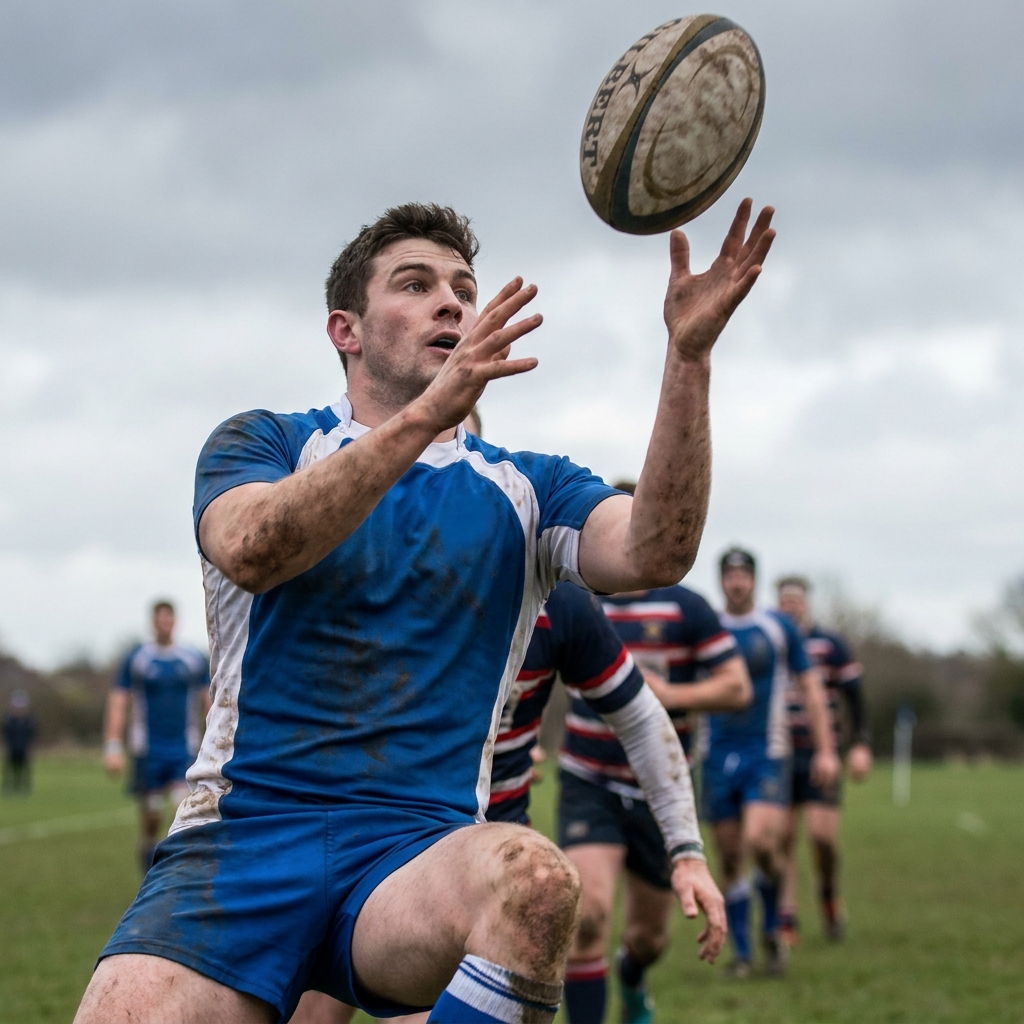
Stage 1 - Catch and scan: Two minutes of high-ball drills where every catcher must shout the position of the nearest chaser before they hit the ground. This trains the pre-catch scan, which is the foundation of every good counter-attack.

Stage 2 - 3v2 from a kick: Coach kicks the ball into a back three. Two chasers come from 20 metres. The back three must keep the ball alive and beat the chasers using one of three responses: switch infield, hit a support runner on the outside, or counter-kick.

Stage 3 - Full-pitch transition game: Conditioned game where every kick must be returned. No mark allowed, no exit kick allowed. Forces players to find solutions and exposes which units have not learned to support the back three quickly.

The Forwards' Role in Counter-Attack

This is where most teams fail. The back three can be brilliant, but if the forwards are still standing where they were before the kick, the counter dies at the first ruck. Coach your forwards to react to opposition kicks like a fire alarm - the closest three drop into the back-field as immediate support, while the rest fan out across the pitch ready to play.

This habit takes weeks to embed. Start by freezing training every time a kick is fielded and asking each forward to show where they should be running. Repetition turns it from a thought into a reflex.

Key Coaching Points

  • The transition window is six to eight seconds - move the ball before it closes
  • Train the pre-catch scan: who is chasing, how close are they, where is the space?
  • Counter to the weak side of the chase, not into the strongest channel
  • Forwards must react to kicks as quickly as the back three
  • Avoid contact in your own 22 - if the counter is not on, return the kick

Recommended Drills

VIEW ALL DECISION-MAKING DRILLS

rugby strength DRILLS
View All
Unfortunately there were no results for your search! Please try again
rugby strength ANSWERS
View All

What is the best age to introduce contact?

I'm trying to work out what the best age is to introduce contact to children (tackling, mauling, rucking). I think learning early how to handle contact safely is very important, but at the same time, I want to make sure it is not too early. Are there any universal guidelines, or does it vary from national union to national union?

Dominic Rossi Coach, Canada

Rugby gym help!

Hi IRBcoaching. im a 21 year of male playing lock for a midland 2 rugby team. im after some gym training tips? want to kno how many times i should be training per week in the gym and how to train in the gym.

Archived User Coach

Basic workout for teenagers.

I coach a 15s team and the players are asking about a basic gym workout, any ideas.

Paul cromack Coach, England

Translation Please

I recently received this in my "inbox"%3A Building a Flat Line Defence System Dear Rugby Coach, Whether your in the northern hemisphere and winding down for this season, or maybe already planning for next, or your in the southern hemisphere and the new season has just begun, this week we are pleased to present the workings of a Flat Line Defensive System. The following is the principles of how the system is implemented, Full Members can download the training drills to coach the system with their team. Upgrade to full access today. When teaching any defensive formation, you must always consider, how it works both in open play / set-pieces and from the breakdown, and that all players understand the roles they play. Priniciples for Open Play Key pointsThe make sure you choose the system to fit playing strength%3A Either IN-2-OUT or OUT-2-IN. Considering using INSIDE-2-OUT Midfield Gain-Line never broken. Surrender very wide attack to cover defence. Offensive 2m tackles. Pendulum wide cover. Huge communication requirements. Step-in System. Up and Drift. Forgive me but I haven't got a scooby do (clue) what the above means - please could the technobabble be explained (maybe we should start a dictionary of coaching terms?)

Gary D Coach, Northern Ireland

What drills would you suggest to get players to focus on poaching the ball in rugby?

Ask a question and have it answered by Coaches from around the world and Sportplan's team of Experts.

John Coach, United States of America

I need ideas for fun team building activities and any?

I need ideas for fun team building activities and any fun games to help towards team building. Has anyone got any ideas on what to do? Anything to spice up rugby training sessions in the dark, cold winter nights.

Archived User Coach

RFU - proposed Mini's rule changes

RFU - proposed Mini's rule changes%3A All - just a quick straw poll%3A Have any CLUBS that you are aware of officially come out in SUPPORT of these changes? If not, have they come out officially rejecting the proposed changes, or are they adopting a "wait and see" attitude? Regards Stephe

Archived User Coach

I have a junior Colt (u17) 6'3" plays 2nd row.?

I have a junior Colt (u17) 6'3" plays 2nd row. He has good skills but want to `bulk-up' to make bigger hits when tackling. Anyone suggest a suitable weight-training routine to help him put on muscle.

Archived User Coach

Comments- Dear sir, I played for 35 yr.s mostly hooker,?

I was asked a question  by email recently and I thought it would be good to put it here as a question for anyone else to comment on%3A Dear sir, I played for 35 yr.s mostly hooker, some back line play. I was tutored in 1972 by former US Eagle hooker Jessie Lopez. We need to stabilize modern era scrums, specifically the front row. The way it's been done forever is wrong. Currently two pressure points come together head to head; and ofcourse the front rows twist amp; turn, left and right, up and down. Thus we are having more injuries with increased focus on scrum strength. FRONT ROWS SHOULD COME TOGETHER CONCAVE AS OPPOSED TO CONVEX. The hookers need to take the under bind on the props instead of the traditional over the top.This technique works much better by dispersing/spreading the impact.Also the hooker being set back about 6 inches is less at risk. If you don't think I know what I am talking about then ask some professionals who serve as the battering ram to try it. Their is a thin line separating safety from serious injury my friend. The way it's done now is time proven to be dangerous. You sir are probably not a hooker or tight head, so go inquire. It might not seem like a noticeable difference, but if it saves a couple people from getting thier necks broke next year - THEN IT BECOMES A BIG DIFFERENCE !! Thanks, Tim Nicodemus Fort Wayne Rugby Club

Simon Jones Coach, England

(U11 Rugby) - How to referee the 'big lad'

I'm coaching and reffing U11 rugby and one of my players is the definitive 'big lad'. His 'strength' is his size and his power, but last weekend he didn't seem to get reffed fairly. The opposition couldn't tackle him down, one on one and when another two joined in to make a mini maul, that didn't slow him down much either. The ref then let other people join in the (one sided) struggle to tackle him down, which seemed very unfair as A) it's outside the laws of U11 rugby,, B) it makes it nigh on impossible for him to offload, C) when he is brought to ground, he has 4-5 players all over him and he got pinged for 'holding on'. He is a recent arrival to rugby and it was our first game for a couple of months, so the situation hadn't reared his head before. We are keen that he learns all of the core skills of rugby and doesn't get used as a battering ram, but after seeing a pack of hyenas trying to pull down the big fella, something just didn't seem right to me.I'd be grateful for any thoughts and opinions.

Archived User Coach

Player development - is there a template for Profiling

Are there any templates I can use for a rugby player development programme. I want to 'profile' players ability strength development areas etc

Archived User Coach

Upper and lower body workouts

Hi I was just wondering what the best upper and lower body workouts would be for rugby. It would be great if you know some good ones and get back to me. Cheers Asked using Sportplan Mobile App

Liam Manley Coach, England

Preseason

What's the recommended periodisation for introducing each element during preseason in a 12 week block?

Nela Tuipulotu Coach, Australia

(U11 Rugby) - How to referee t...

I'm coaching and reffing U11 rugby and one of my players is the definitive 'big lad'. His 'strength' is his size and his power, but last weekend he didn't seem to get reffed fairly. The opposition couldn't tackle him down, one on one and when another two joined in to make a mini maul, that didn't slow him down much either. The ref then let other people join in the (one sided) struggle to tackle him down, which seemed very unfair as A) it's outside the laws of U11 rugby,, B) it makes it nigh on impossible for him to offload, C) when he is brought to ground, he has 4-5 players all over him and he got pinged for 'holding on'. He is a recent arrival to rugby and it was our first game for a couple of months, so the situation hadn't reared his head before. We are keen that he learns all of the core skills of rugby and doesn't get used as a battering ram, but after seeing a pack of hyenas trying to pull down the big fella, something just didn't seem right to me.I'd be grateful for any thoughts and opinions.

Archived User Coach

Resistance Training for U14 - ...

I am curently helping coach an U14 team, my focus being on forward play and conditioning. As a general rule, for conditioning I only get the lads to work against body weight for resistance training. Some players (and parent?)are eager to get into the gym and start to use weights as means of resistance. Obviously at this age the level of physical maturity of players is vast, boys to men, hence each individual must be assessed. I have done some reseaech which would indicate that the use of weights for 14-15 year old is to be encouraged (Irish RFU), but I am keen not to get the lads into the gym to early. Does any one have and ideas on this subject or can point me to any research to support either idea.

Archived User Coach

Forwards fitness U12's - Sport...

Hi, I have a large pack, some new to rugby, and they are really passionate and impactful, but some are really struggling with helping get them on top of their fitness and aerobic exercise. One prop in particular is only 11 yrs old, but deperate to convert osme weight to focus on fitness. Any tips or exercise routines that I can use to get a heavy forward pack to work on their fitness training outside of the once a week rugby training session we have as a team?

Mark Zimmermann Coach, Australia

how can I improve the strengh ...

how can I improve the strengh of players legs to kicking?

Archived User Coach

U10s organisation in defence. ...

I have started an under 10s team up, and I would say about 8 from the 13 children I have , did not play rugby until about 6 months ago. Of these players, there seems to be a lot of potential, as we are scoring tries against teams, that very rarely concede tries.the problem I got with them, is that we are very poor at organising our selves in defense when the opposition has the ball, which does result in us conceding quite a few tries. We have some very good tacklers in the team. Can anyone offer some ideas on how I can get them to organise themselves? Thanks . Chris.

christopher jenkins Coach, Wales

I need ideas for fun team buil...

I need ideas for fun team building activities and any fun games to help towards team building. Has anyone got any ideas on what to do? Anything to spice up rugby training sessions in the dark, cold winter nights.

Archived User Coach

Under 9`s rugby, fear of tackl...

I coach under 9`s rugby and a lot of the kids have a bad fear of tackling, they lack the confidence to get stuck in. What is the best thing to help them overcome this?

Archived User Coach

JOIN SPORTPLAN FOR FREE

  • search our library of 1100+ rugby drills
  • create your own professional coaching plans
  • or access our tried and tested plans

Sportplan App

Give it a try - it's better in the app

YOUR SESSION IS STARTING SOON... Join the growing community of rugby coaches plus 1100+ drills and pro tools to make coaching easy.
LET'S DO IT