








Excellent drills, very detailed videos. Useful site for my U15 boys team.

What are the main principles of pressing to gain possession?

What is playmaker role? and what position does playmaker play?
Hi. I need to coach the following in a session%3A Attacking unit play using right hand side of the pitch. Emphasis on âPosting up.â Use of lead runs and receiving the ball on the move. Any ideas?

would like to set up a rota programme for subs with a squad of 16 so everyone gets pitch time and maximise fitness

What are the best things to get your players to do when you come up against a full press / 3/4 press, anything that's putting a lot of pressure on high up the pitch?

How should a women team,that cannot use the scoup or an overhead,do when the oposit uses a full press at a 16yd hit??Thank you...
What are the key skills in individual defending and what are the best ways to practise them?
the opposition is now playing with 1 goalie, 2 d, 4 mid and 4 forwards it just seems they are everywhere and my mid field can not deal with the extra player. I was going to counter with a 1-4-4-2 but the girls are not used to it. we play a 1-4-3-3.

Hi,I need to play 4 linked hockey sessions to a specific theme I don't know which one to chose such as I can't say attack because there can be so much to cover . So any help?
Hi,I perhaps naively, expected to have most of our team from last year carry over and only have a few new comers to integrate and get up to speed with the rest. However meeting the team at our first practice last night i find I have five players still at school from last year and the rest all new comers, most of whom had not held a hockey stick at all till practice.This being only my second season coaching (year 9 to year 13 boys) has left me feeling a little blindsided, and feeling quite unsure how to prepare practices that target both groups of boys. Do i lump them both groups together, keep them separate? What drills/exercises to best bring the new comers up to speed.I don't want to neglect either group, keep practice worthwhile for the experienced boys, but also bringing the new comers up to a level were they can mix in with the others and learn organically from them while practicing as a team. David
Hey guys how long should you spend on warm ups, dyamic stretches and specific hockey drills. First time coach of XI girls. I have played before at Prem level snd Representative 17 years ago back then 10-15m warm up etc . Your thoughts anyone Thanks Ann Asked using Sportplan Mobile App
I'm looking for a simple and basic way to teach and encourage children to press. Asked using Sportplan Mobile App
What are the best things to get your players to do when you come up against a full press / 3/4 press, anything that's putting a lot of pressure on high up the pitch?
Hi all, after "volunteering" at the last minute to coach last season, I'm looking forward to coaching again this season but would like to be a bit more organised starting the season. Last season I used drills from here (thank you contributors) and put together a practice plan each week addressing what I thought were our weakness from the game just played. This got us through the season, we were promoted after grading and finished the season in the top 4 playoffs for our grade.I wonder if there is some kind of guide to putting a more coherent training plan together for the season.I'm coaching a boys secondary school team, aged 12-18. What kind of skills should they have mastered?What should they be attempting, working towards mastering (individually and as a team)?I last played as a collage boy on grass fields, the change to turf pitches has obviously obsoleted (along with age) much of what I knew as a player.Any pointers appreciated.David
Hi allI am looking for advice on how to implement processes in my girls school hockey team. processes of setting up presses, defensive structures and counter attacking thinking. I have 14 players in the team from 15 years old to 18. we train twice a week. only a few play club hockey as well. We either play a 3-1-4-2 or a 3-1-3-3.I find it difficult for example, when you want to teach a press on the opposition 16, to simulate gameplay with only 14 players (if they are all at training). I can have my halves setup for taking the 16 and then get my strikers and links to setup, but then I still want defenders to see things from the back but they are taking the 16? Also when taking the 16 they then don't have any support in the drill because everyone else is setting up a press?I know we need to work on our basics in order for the other tactics and skills and game plans to work. However I find it frustrating with this team that on counter attacks for a few reasons which I am struggling to mend;- they only head forward. No one holds up the ball to wait for support.- they run straight and don't use angles- they pass too late and get tackled - they don't have the vision to see an early pass or pass into space- players without the ball do not run into useful positions and angles and get caught out by the person with the ball who then makes a pass to no one and it runs out of play.So suggestions please for;- open, creative but simple counter attacking- teaching processes for presses on free hits and 16s- coaching how to take 16s and work your way out- coaching vision and expecting your players to be in support. RegardsMatt
the opposition is now playing with 1 goalie, 2 d, 4 mid and 4 forwards it just seems they are everywhere and my mid field can not deal with the extra player. I was going to counter with a 1-4-4-2 but the girls are not used to it. we play a 1-4-3-3.
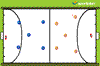
diagram of hockey pitch
Hi,I perhaps naively, expected to have most of our team from last year carry over and only have a few new comers to integrate and get up to speed with the rest. However meeting the team at our first practice last night i find I have five players still at school from last year and the rest all new comers, most of whom had not held a hockey stick at all till practice.This being only my second season coaching (year 9 to year 13 boys) has left me feeling a little blindsided, and feeling quite unsure how to prepare practices that target both groups of boys. Do i lump them both groups together, keep them separate? What drills/exercises to best bring the new comers up to speed.I don't want to neglect either group, keep practice worthwhile for the experienced boys, but also bringing the new comers up to a level were they can mix in with the others and learn organically from them while practicing as a team. David
How should a women team,that cannot use the scoup or an overhead,do when the oposit uses a full press at a 16yd hit??Thank you...

in more ways than one
 sportplan_hockey




A few weeks into the league season, poor first touches are costing teams the ball. Coach body shape, scanning and receiving on the move to keep possession.

Pre-season fitness fades fast once the league starts. Build conditioning into ball work and use rolling subs well to keep your squad sharp all season.

The first weeks of the season decide whether a junior or new player sticks with adult hockey. Here is how to keep them safe, give them a clear job and build their confidence from the very first bully.
Coaches from around the world look to Sportplan for coaching confidence.
Excellent drills, very detailed videos. Useful site for my U15 boys team.

I love using Sportplan. It's been a great help for co-ordinating hockey practice and being able to help tweak skills and getting the most out of my players!

Great site. An absolute must for coaches who are willing to change and learn new drills. Superb, simply superb.

Wow what a great website, I have found sportplan an important tool for me when planning my netball sessions with my netball team. There are alot of very helpful tips/ideas/skills that I can learn and teach to my team. Thank you sportplan I hope to continue to use your helpful tips and to learn more about improving my teams netball skills. Thanks again....keep it up....

I have been using Sportplan now for 3 years and can honestly say that I have never repeated the same session twice. My girls are always focused and are improving every year. Thanks Sportplan.
What a fantastic tool. The Chalkboard and session tools make an unbelievable difference in making training plans in both time and organization. I will be instructing all of my assistant coaches that this tool must be used for all sessions during the season, so that we may build a club coaching resource library.
I can't get enough of the Sportplan, It has given me back the enthusiasm i was starting to lose. My girls are so keen and are ready at 14 to take the next up in their game. Sportplan will help no end.



