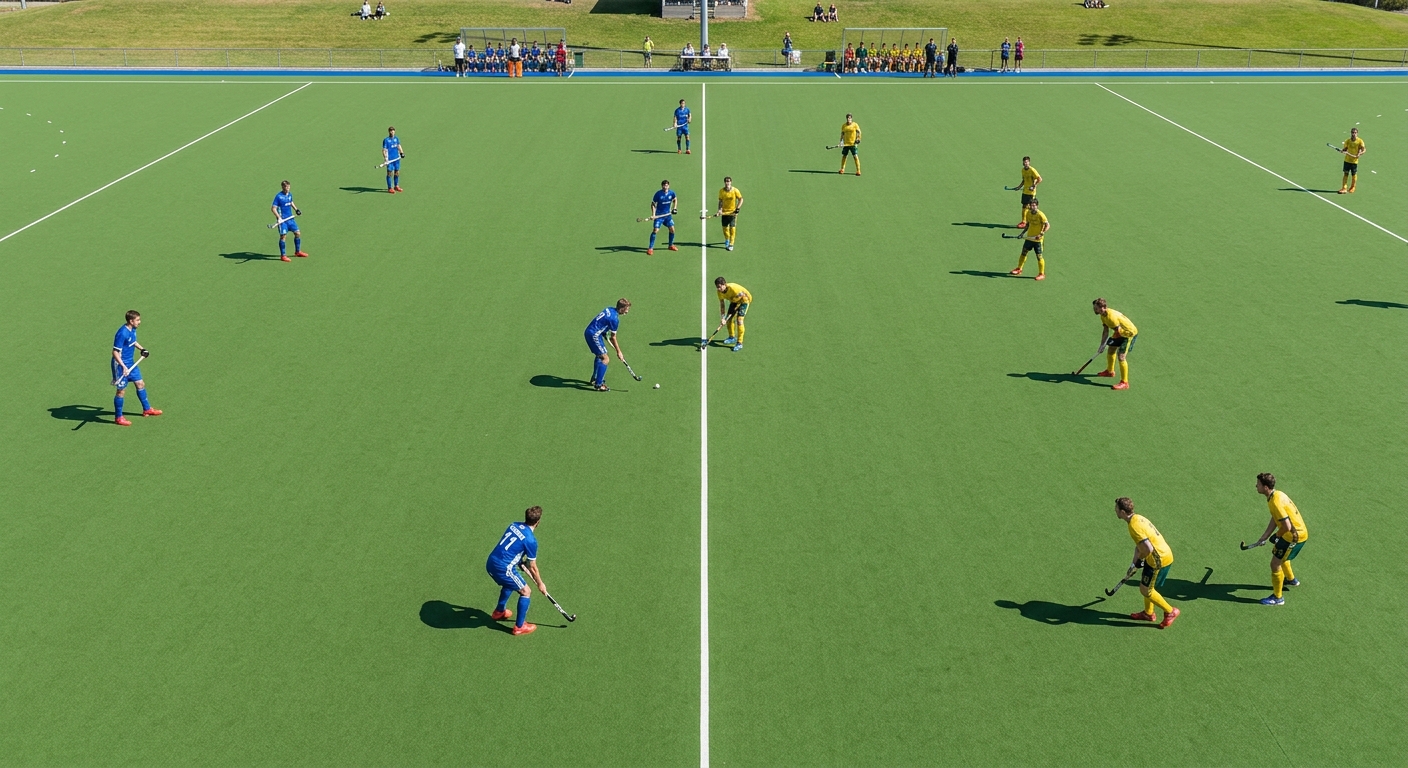
Eleven Players, Four Units, One Shape
Field hockey is an 11-a-side game, and from the sideline the movement can look like organised chaos. The key to understanding it is simple: every team is built from four units that work up the pitch - a goalkeeper, a line of defenders, a midfield, and a forward line. Get the four units clear in your head and any formation suddenly makes sense.
Unlike netball, hockey has no zones a player is locked into, and crucially it has no offside rule. That means positions are about responsibility and shape rather than hard boundaries: a full-back can overlap into attack, a forward must track back to press, and the whole team shuffles together as the ball moves. Below we explain what each of the eleven positions does, then look at the three formations you will see most often and what each one asks of your players. We finish with a pitch diagram and a few drills to train the movement each role demands.
The Goalkeeper
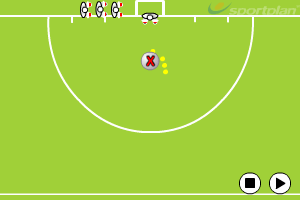
The goalkeeper is the only player allowed to use their body and feet to stop the ball, and only inside the shooting circle - the "D". A good keeper is brave, agile and a strong organiser, constantly talking to the defence and narrowing angles before the shot comes. Modern keepers are also the first line of attack, distributing quickly to a free defender to launch the break. Penalty corners and one-on-ones are where matches are won and lost, so positioning, kicking technique and a cool head matter enormously. It is a specialist role that demands proper kit and dedicated coaching.
The Defenders
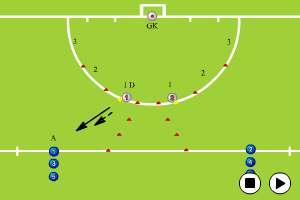
In front of the keeper sits the back line, usually three or four players whose first job is to deny space, win the ball and start play calmly from the back.
Full-backs
The full-backs play wide on the left and right of the defence. They mark the opposition wingers, shepherd attackers towards the sideline, and tackle to win the ball back. Because there is no offside, the modern full-back is also an attacking outlet - overlapping down the flank, delivering balls into the circle and supporting the wingers. Good footwork, a strong tackle and the confidence to carry the ball out of defence are the hallmarks of the role.
Centre-backs
The centre-backs are the heart of the defence, marking the opposition's central forwards and protecting the most dangerous area in front of goal. They need to read the game, intercept passes into the circle, and defend penalty corners. A composed centre-back is also a fine distributor, switching the point of attack with a long diagonal to relieve pressure.
The sweeper
A sweeper plays as the deepest defender, behind the back line, acting as a final safety net who mops up anything that beats the others and covers the space in behind. With no offside in hockey, the sweeper traditionally guarded against long balls over the top. At elite level the role has largely given way to a flatter, higher-pressing back four, but it remains genuinely useful for junior and developing teams who tend to leave gaps in behind.
The Midfield
The midfield is the engine room - the unit that connects defence to attack, covers the most ground and dictates the tempo of the match.
Wing-halves (the halves)
The wing-halves, or simply "halves", operate on the left and right of midfield. They support both the full-back behind and the winger in front, doubling up to defend the flank and overlapping to create overloads in attack. Relentless running, good lungs and the discipline to recover are essential - the halves never stop shuttling up and down their channel.
Centre-midfield
The centre-midfielder is the busiest and arguably hardest outfield position. Involved in almost every phase, the centre-mid screens the back line, wins second balls, recycles possession and drives the team forward. Vision, fitness and the composure to pick the right pass under pressure define a top centre-mid. Many teams play two central midfielders so one can hold while the other gets forward.
The link role
In more attacking shapes one midfielder plays as a link - an advanced playmaker sitting just behind the forwards. The link receives between the lines, turns, and feeds the front three, while pressing the opposition's first build-up pass when out of possession. It suits a clever, technical player with a quick first touch and an eye for a defence-splitting pass.
The Forwards
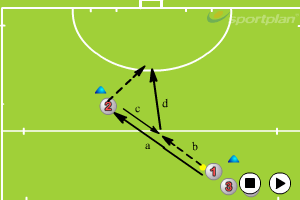
The forward line carries the threat - the players whose job is to create and finish chances inside the circle.
Wingers
The wingers play wide on each flank and provide width, pace and penetration. Their job is to stretch the defence, beat their marker on the outside, and deliver dangerous balls into the circle - or cut inside to shoot. A good winger is a confident dribbler who can eliminate a defender one-on-one, then make the right decision: cross, carry or shoot.
Centre-forward
The centre-forward is the spearhead and the team's main goal threat. Operating through the middle and inside the circle, the number nine leads the press, holds the ball up to bring others into play, and gets on the end of crosses and rebounds. Strength, sharp movement in the D and a ruthless touch in front of goal are what set a top striker apart.
Inside-forwards
In some shapes the front line includes inside-forwards - attackers who play just off the centre-forward, slightly narrower than the wingers. They link midfield and attack, arrive late into the circle, and offer a second and third scoring option. Their movement off the centre-forward, timing their runs to stay onside-free of any marker, makes them hard to pick up.
Common Hockey Formations
A formation is just the way you arrange the ten outfielders in front of the goalkeeper, written from the back. The keeper is the "1", and the remaining numbers describe each line up the pitch. Three formations cover most of what you will see in club and junior hockey.
1-4-3-3
The classic, balanced shape: four defenders, three midfielders and three forwards. It gives you a solid back four, a busy central three and genuine width and threat up front. The 1-4-3-3 is forgiving and easy to coach, which is why it is the go-to for most developing teams. It asks the midfield three to cover a lot of ground and the full-backs to support the wingers down the line.
1-4-4-2
Four defenders, a packed four-player midfield and two forwards. The extra midfielder gives you control of the centre and strong defensive cover, making it useful against a passing side or when protecting a lead. The trade-off is up front: with only two forwards, the strikers and wide midfielders must combine well, and the team relies on midfielders breaking forward to support the attack.
1-3-3-3-1 (the modern shape)
The contemporary international structure: three defenders, three holding midfielders, three attacking midfielders and a lone centre-forward. It creates layered lines, excellent pressing triggers and constant passing triangles all over the pitch. It is demanding - it relies on very high fitness, disciplined pressing and players comfortable rotating positions - so it suits older, well-drilled squads more than juniors. But it shows where the modern game is heading: flexible units that defend and attack as one.
Hockey Pitch Diagram: A 1-4-3-3 in Position
The diagram below shows a vertical hockey pitch with the eleven positions arranged in a 1-4-3-3. You can see the goalkeeper in the goal, the back four, the midfield three and the front three, with the halfway line, the two 23-metre lines and the shooting circle (the "D") at each end marked out.
A 1-4-3-3: goalkeeper (GK), back four (LB, CB, CB, RB), midfield three (LH, CM, RH) and front three (LW, CF, RW), attacking towards the top D.
And here is the same information as a quick-reference list of the lines and positions. Read down through the team from the back, keeper first, the way a formation is written.
The Lines and Positions at a Glance
- Goalkeeper (GK): Last line of defence; only player who may use feet and body, inside the D. Organises and distributes.
- Defence - full-backs (LB / RB): Wide defenders who mark the wingers and overlap in attack.
- Defence - centre-backs (CB): Central defenders who protect the circle and start play from the back.
- Defence - sweeper: Optional deepest defender behind the line; a final safety net (more common in junior hockey).
- Midfield - wing-halves (LH / RH): Shuttle up and down the flanks, linking full-back and winger.
- Midfield - centre-midfield (CM): The engine; covers the most ground and connects defence to attack.
- Midfield - the link: Advanced playmaker behind the forwards in attacking shapes.
- Attack - wingers (LW / RW): Wide forwards providing pace, width and crosses into the circle.
- Attack - centre-forward (CF): The spearhead and main goal threat through the middle.
- Attack - inside-forwards: Support strikers just off the centre-forward, arriving late into the D.
A simple way to remember it: the keeper guards the D; the defenders deny space and start play; the midfield links everything and never stops running; and the forwards create and finish. Because there is no offside, every line both attacks and defends - the formation just decides where each player starts.
How to Use Positions in Training
Knowing the units is the start. The next step is teaching players to hold their shape, support the player on the ball and shuffle together as a team rather than ball-watch. Rotate juniors through every position early in their development - it builds game understanding, stops players being pigeon-holed too soon, and helps you see where each child's strengths really lie. Our junior hockey drills guide gives you ready-made practices for each role, and the team selection guide shows how to keep that balance fair across a season.
When you are ready to build a full session around a unit - say, the back four's circle defence or the midfield's switching of play - drop the relevant drills into the structure in our free session plan template. Browse the full Hockey drills library for hundreds more practices sorted by skill and position.
Frequently Asked Questions
How many players are in a hockey team?
An 11-a-side hockey team has eleven players on the pitch: one goalkeeper and ten outfielders. Squads carry substitutes who can be rolled on and off freely throughout the match. The eleven are usually arranged as a goalkeeper, a line of defenders, a midfield and a forward line - most commonly in a 1-4-3-3 shape.
What are the positions in hockey?
The positions are goalkeeper; defenders (full-backs and centre-backs, sometimes with a sweeper behind them); midfielders (wing-halves out wide, a centre-midfield and often a link or attacking midfielder); and forwards (two wingers and a centre-forward). Exact roles shift with the formation, but every team is built from these four broad units: keeper, defence, midfield and attack.
What does a sweeper do in hockey?
A sweeper is the deepest outfield defender, playing behind the back line as a final safety net. The sweeper covers space in behind, mops up balls that beat the other defenders, and organises the line in front. Because hockey has no offside, the sweeper role has declined at the top level in favour of a flatter, higher pressing back four - but it remains useful for younger and developing teams who concede space in behind.
What is the best hockey position for a beginner?
Many coaches start beginners in midfield or at full-back, where there is time on the ball and a clear job - support play, pass simply and learn to read the game. Centre-forward suits a confident, energetic newcomer who wants to be near the action. Goalkeeping is specialist and should only be tried with proper kit and coaching. The best advice for juniors is to rotate through several positions before settling on one.
Which is the hardest position in hockey?
Centre-midfield is widely seen as the most demanding outfield role because it covers the most ground, links defence to attack and is involved in almost every phase of play. It needs the highest fitness, the best vision and a calm head in traffic. Goalkeeper is the hardest specialist position - one mistake is punished, and it demands nerve, reflexes and bravery in the circle.

 sportplan_hockey