Football: age

September 2026

Most of the FutureFit headlines have been about the new 3v3 game at Under-7s, which we covered in FA FutureFit: What the New 3v3 Format Means for Your Youngest Players. But the change that affects the most coaches this season sits further up the pathway. From 2026/27, every format lasts two years: 5v5 at Under-8s and Under-9s, 7v7 at Under-10s and Under-11s, and 9v9 at Under-12s and Under-13s.

If you coach one of those Under-9, Under-11 or Under-13 groups, your players were expecting to step up this season, and they have not. Some of them, and a few of their parents, will feel that. The job now is to make the second year in a format genuinely harder, not just the same thing again.

What Has Actually Changed

Under the old structure, players moved from 5v5 to 7v7 at Under-9s, from 7v7 to 9v9 at Under-11s, and from 9v9 to 11v11 at Under-13s. Under FutureFit, each of those step-ups comes a year later, so full 11v11 now starts at Under-14s.

The reasoning is the same as the 3v3 change: smaller formats mean more touches, more decisions and more involvement for every player. Keeping a group in a format for a second year gives them time to master it before the pitch and the numbers grow. Leagues are bringing the formats in this season, so check with yours on the detail of your age group.

Why the Second Year Is an Opportunity

In the first year of a new format, a lot of your coaching goes on simply getting players comfortable: where to stand, how big the pitch feels, what the new laws mean. By the second year that is done. You start the season with a group that already understands the game they are playing.

That frees you to coach the next layer. Better decisions, quicker play, playing in more than one position, and handling pressure. The pitch does not get bigger, so the challenge has to come from you.

A Four-Step Framework for Progressing Without a Bigger Pitch

Step One: Raise the standard, not the size. Last season a successful pass was good enough. This season ask for the pass to the right foot, played early enough that the receiver can take it forward. Same game, higher bar.

Step Two: Use constraints to make the game harder. Limit touches in certain zones, shrink the space in training, or add a rule that a goal only counts if every outfield player has touched the ball. Constraints add pressure without adding players.

Step Three: Use overloads and underloads. Play 4v3 so the attackers learn to find the spare player quickly, then flip it to 3v4 so the smaller team has to defend smartly and break out under pressure. Both sides of an overload teach something the even game does not.

Step Four: Rotate positions on purpose. A second year in the same format is the perfect time to stop anyone becoming "just a defender". Give every player time in the back line, in midfield, up front and, where it suits, in goal. They will understand the bigger format far better when they reach it.

How to Train It

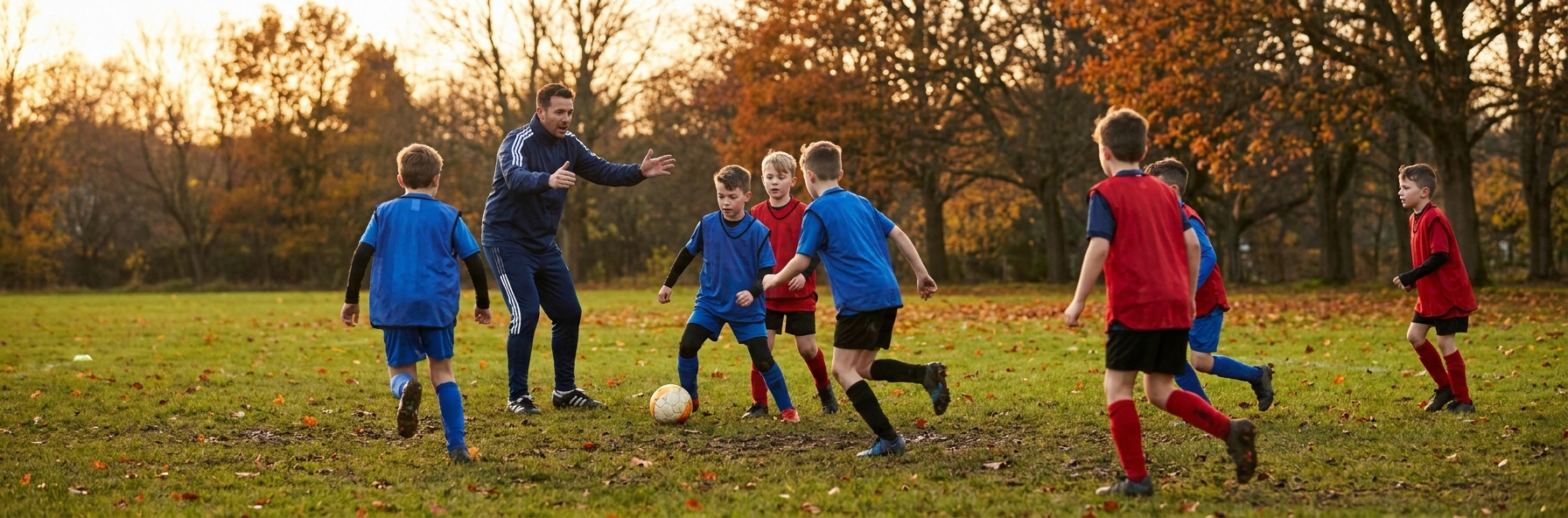
Keep your sessions built around small games, and keep the numbers smaller than matchday. If you play 7v7 on a Saturday, a lot of your Tuesday should be 3v3 and 4v4. Every reduction in numbers is more touches per player, and touches are what this extra year is for.

Plan the season in blocks. Spend a few weeks on a theme such as playing out from the back or defending as a unit, then change the theme and the conditions. Players notice when the challenge changes, and it stops the second year feeling like a rerun of the first.

Talk to parents early, too. A quick explanation that the format is staying put by design, and that you are using the time to stretch their child, heads off a lot of touchline frustration.

Key Coaching Points

  • Treat the second year in a format as a chance to coach the next layer, not to repeat last season.
  • Make the game harder with higher standards and constraints, since the pitch will not do it for you.
  • Use overloads and underloads so players learn both to exploit and to cope with an extra player.
  • Rotate positions deliberately so every player understands the whole team before stepping up.
  • Keep training numbers smaller than matchday to maximise touches and decisions.
  • Explain the change to players and parents so nobody feels they have been held back.

Recommended Drills
VIEW ALL CONDITIONED GAMES DRILLS

Frequently Asked Questions

Some of my players are clearly ready for a bigger game. Are they being held back?

Not if you coach the year well. The strongest players are the ones who benefit most from constraints, such as limited touches or playing in an unfamiliar position. Give them harder problems to solve rather than more space to run into, and they will arrive at the bigger format with more to offer.

How do I stop the season feeling repetitive for the players?

Change the challenge regularly. Work in themed blocks, vary the conditions in your games, and swap positions around. The format is the same, but the problems inside it should look different every few weeks.

Should I start introducing ideas from the next format anyway?

A little, as long as it fits the game they play now. Scanning before receiving, supporting play from behind and defending as a unit all carry straight into bigger formats. Positional rotation is the best preparation of all, because players who have seen the game from every angle adapt quickly when the pitch grows.
age DRILLS
View All
Unfortunately there were no results for your search! Please try again
age SESSIONS
View All
age ANSWERS
View All

Girls U14's Football Team How Far Can I Push Them?

I run a girls football team U14's, 9v9 football team. I want to push them further and harder as they are not as fit as boys of the same age. How far can I push them bearing in mind they are experiencing more changes than girls of a similar age? And should I expect them to do the same as boys of the same age group?
Archived User Coach

Hi there,I am going to be running a soccer (football)?

Hi there, I am going to be running a soccer (football) program at a preschool this Friday for 3-5 year olds. I would like to start teaching them drills. Whick drills are most appropriate for this age group? I also want to make it a lot of fun! Thanks! Victoria %3A)

Archived User Coach

Disciplining for misbehaviour during practice?

Disciplining for misbehaviour? 8-11 year olds, they dont really get bored because i know that sometimes that can be the cause. How or what can i apply a bit of strictness into the team.

Archived User Coach

Swapping players between 3 teams

We have three teams of U8 that play in different leagues all with different skill levels. Is it better to train the three teams seperately so they bond and play as a team or would you swap players around each week.which could mean a league 5 player playing in league 2. Could this knock his confidence?

Andy Coach, England

how do you control an under 16's?

ive just taken over an under 16's side and the manager before was a 19 year old and let them get away with murder, ive tried throwing down ground rules, ive even shouted at them but it just doesnt work, the problem i am also 19 so they think because the last manager was a push over i will be the same, how do i control the team and stop the strops, attitude and negativity?

Archived User Coach

My U'16 team can't get going in the first half

My under 16 team just cant seem to get going in the first half but come out strong in the second! I feel this is a bit of a sports psycology issue! I have heard a few of them say." Well, we know what the opposition are like after 40 mins! I need to install belief!

Archived User Coach

Team thrashed every week - where to start?

Team keep getting thrashed every week - where to start? Having been the sole coach/manager of a little league team for the past two years, this year I lost all my senior players. I was therefore presented with 10 brand new lads, some of whom have never played competitive football. We are 8 games in and my lads are getting thrashed every week. The main problems are that they cannot get the ball out of their half, positions are usually a mess, finishing and chance creation are non-existent, and they don't apply any pressure or are unable to tackle. The main problems are keeping the ball as a team, getting it in the opponents half and staying there, and creating/finishing chances. I only have 1 and a half hours a week with them. I don't really know what to do, and I'm a little desperate. Does anybody have any advice? Thanks for literally anything.

Coach, England

Advice on no-shows for training please...

I usually plan my session the Friday night before Saturday training . I anticipated 12 players but then this sequence of events happened. Friday 8.36pm, parent texts amp; says child can't come as he is doing 11+ mocks (did he only just realise this?). Saturday 8.57am, another parent texts amp; says as they went to a wedding the night before, child is in no fit state to train (again, was this something that only just occured to them may happen?). Saturday 9.26am, parent phones amp; says child is throwing up (fair enough, I guess). Saturday 9.57am, parent texts, another puking child (a bug perhaps doing the rounds? Bit late notice though as we start training in 18 mins). Saturday 9.58am, another text from another child's parent to say child is throwing up (Hmmm, another one. Late notice again?). Saturday 10.15am, training starts but another child is missing. I give it 5 mins then phone. Parent says they are off to theme park amp; he sent me a text. I said that I never received text amp; asked if I sent an acknowledgement to aforementioned text to which he said no which I said meant his text wasn't receieved. I went from 12 players training @ 8.36pm Friday to 6 by start of training in under 10 hours. My session plan went in the bin. I realise the sickness is one of those things but think the last 2 were rather late in notifying me. As for the other 3, I feel these to be lame excuses. What can I implement to try to stop or reduce these issues? Fines? Suspensions? Nothing? #frustrated

Archived User Coach

How do I improve morale when losing?

I coach an U16 girls team. How can I lift morale after going 1 or 2 goals down?

James spink Coach, England

At what age do you make drills more important than games?

Kids get bored of drills and I like to balance the two but I don t want kids falling behind because they not completing drills.

Archived User Coach

Is it possible to search for drills/sessions by age group?

I am possibly missing something obvious but when I search for Under 8s (or varations of) I get little back. Thanks

Adam Barrow Coach, England

what drills can I do for children between 3-7 for two hours?

help create a session for two hours

Waqaar Ahmed Coach, England

Filtering drill by age?

Is it possible to filter the drills by what age they are appropriate for?

Jason Lovell Coach, England

Is there an age catagoty

HelloDo you have the drills sorted by age categories?

Joe Coach, Canada

Passing

Hi, I'm a 16 year old hoping to get into coaching in the future, I currently coach an u8s grassroots team, I'd like to know how I could stop all of them running after the ball and teach them to stay in their positions, while also passing the ball across and making more room and options. Am I asking too much from 8 year olds?

Gwion Davies Coach, Wales

making lesson plans

how do I put the things I want to do in my training session in one place? I would just fav them but I coach 4 Diffrent age groups

Tillie House Coach, England

Kids are very slow and lack re...

Hello all! My kids aged 9 and 7 are very slow when compared to their peers of the same age. They don't seem to fight for the ball and get and watch others play their game. They seem to lack the urgency (heart) needed for the game. (They LOVE football). How can make them move around and react faster. Any help you are able to provide is greatly appreciated. Thanks O

Archived User Coach

Drills for 4 and 5 year olds -...

Hi all, I've just started coaching a soccer team of 4 and 5 year olds and would like to discuss with my fellow coaches any drills which you have found to be safe, fun and valuable to the younger age group. I have my level 1 course under my belt and have difficulty in applying what I've learnt to the small kids. They get bored very quickly and are only interested in playing a match at the end of the session. They have no interest in passing the ball or shooting at goal whilst doing drills. Running with the ball is no problem as they are keeping active and all have a ball at their feet. As soon as they line up or have to share a ball, there are problems. I have a variety of drills which I run through with them, traffic lights, robin hood, alamo, sharks and fishes to name a few with variations of each but I crave more as everywhere I search caters for U6 upwards. I coach an U8 side midweek and have no problem with these lads as they are that bit older and have a greater level of concentration. (not by much mind). So I'm asking for advice from anyone who has coached 4 and 5 YOs and would like to know what has worked for you. PM replies welcome.  Marc

Archived User Coach

Disciplining for misbehaviour ...

Disciplining for misbehaviour? 8-11 year olds, they dont really get bored because i know that sometimes that can be the cause. How or what can i apply a bit of strictness into the team.

Archived User Coach

Under 8's Captaincy - is it ri...

I've got a player who is commanding, brilliant at spreading the play, and is no doubt my best player in my under 8's 5 a-side team. I've decided most times that he's going to be captain. The question is, whether or not you think it's right to give the captaincy to just one player? How do you guys organise yours? Rotate it? Have just one? Give it to the best trainer that week?

Oliver Perkins Coach, England

JOIN SPORTPLAN FOR FREE

  • search our library of 500+ football drills
  • create your own professional coaching plans
  • or access our tried and tested plans

Sportplan App

Give it a try - it's better in the app

YOUR SESSION IS STARTING SOON... Join the growing community of football coaches plus 500+ drills and pro tools to make coaching easy.
LET'S DO IT