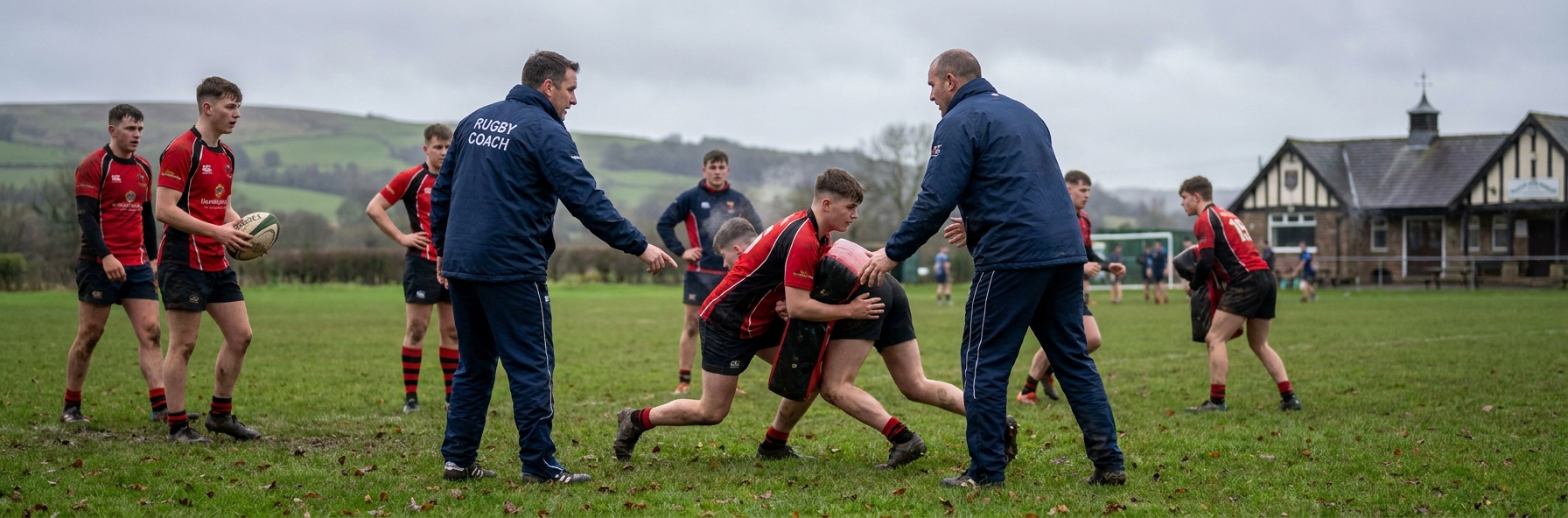
Rugby: junior rugby

The 50:22 law, introduced as a trial and now a permanent fixture, has fundamentally changed how teams approach tactical kicking. A kick from your own half that bounces in-field, crosses the 22, and finds touch rewards the kicking team with the lineout throw-in. This single law change has altered both attacking and defensive strategies across the game.

Understanding the Law

The requirements:

  • Kick must originate from behind your own 10-metre line
  • Ball must bounce in the field of play (not direct to touch)
  • Ball must cross the opposition's 22-metre line
  • Ball must then go into touch
  • Kicking team retains the throw at the lineout

These requirements create specific technical demands. The kick must be long enough to reach the 22, accurate enough to hit the corner, and struck correctly to bounce in-field first.

Why 50:22 Matters

Before the 50:22, kicking from your own half that went to touch gave the throw to the opposition. The only benefit was territorial gain. Now, an accurate 50:22 delivers both territory AND possession - a game-changing combination.

The tactical impact:

  • Lineout attacking platform in the opposition 22
  • Defensive scramble if full-back fails to cover
  • Forces back three to position wider, creating space elsewhere
  • Punishes lazy defensive positioning

Executing the 50:22

The Grubber Option

A well-struck grubber can beat the full-back to the corner. The low trajectory keeps the ball in play, and end-over-end rotation makes the bounce predictable.

Grubber technique:

  • Strike through the middle of the ball, toe down
  • Generate end-over-end spin for predictable bounce
  • Aim for the gap between full-back and touchline
  • Follow up - if it doesn't reach touch, contest the chase

The Chip and Chase

A chip kick over the defensive line that bounces in the 22 and reaches touch. Higher risk - defenders can field it before it reaches touch - but effective against narrow defences.

Chip technique:

  • Get under the ball with angled foot
  • Enough height to clear defenders, not so much that chase time is lost
  • Backspin for controlled bounce toward touchline

The Cross-Field Kick

Against a defence shifted to one side, the cross-field kick to the far corner can find space. This is a longer kick requiring more accuracy but exploits defensive imbalance.

Defensive Adjustments

The 50:22 has forced defensive positioning changes. Full-backs can no longer sit narrow - they must cover the width. Wings must be aware of their touchline responsibilities.

Defending against 50:22:

  • Full-back positions wider to cover both corners
  • Wings drop deeper to provide secondary cover
  • Communication about kick threats: "Watch grubber!"
  • Quick identification and reaction to kicks

These defensive adjustments create space elsewhere. If the full-back is wide, the central channel opens. If wings drop deep, the defensive line loses numbers.

When to Attempt 50:22

Good opportunities:

  • Full-back positioned narrow or deep
  • Wide channel space visible
  • Defence rushed up, leaving back field exposed
  • Slow ball where running attack is risky

Poor opportunities:

  • Full-back already covering the corner
  • Quick ball with attacking momentum
  • Wind against making accurate kicking difficult
  • Kicker not in optimal position

Training 50:22 Execution

Individual kicking practice:

  • Set targets at the corner - grubber to specific zones
  • Practice both feet (advantage when on either side)
  • Vary distances - not every 50:22 opportunity is from the same position

Team practice:

  • Live scenarios with defence - read the full-back position
  • Decision-making: kick, run, or pass?
  • Chase organisation when the kick doesn't reach touch

Alternative Outcomes

Not every 50:22 attempt succeeds. But the threat creates secondary benefits:

If fielded before touch: You've still gained territory and forced the opposition to start from deep. Apply chase pressure and compete for their exit kick.

If it bounces out before 22: Opposition throw, but you've gained significant ground. Reset defensive line.

If full-back covers: Your threat has pulled them wide. Subsequent attacks may find more space centrally.

The Mental Game

The 50:22 threat changes how oppositions defend, even when you don't kick. Simply having players capable of executing the kick forces wider positioning and changes defensive dynamics.

Make sure your opposition knows you have this weapon. Execute it successfully early in matches, and they'll respect the threat throughout.

Key Coaching Points

  • The 50:22 rewards accurate kicking with possession AND territory
  • Grubbers are highest percentage - practise them
  • Read the full-back position before deciding
  • Even unsuccessful attempts gain territory
  • The threat changes defensive positioning

Drills to Master the 50:22

VIEW ALL KICKING DRILLS

JOIN SPORTPLAN FOR FREE

  • search our library of 1100+ rugby drills
  • create your own professional coaching plans
  • or access our tried and tested plans
junior rugby DRILLS
View All
Unfortunately there were no results for your search! Please try again
junior rugby ANSWERS
View All

What are the rules regarding one-handed pass(as in?

What are the rules regarding one-handed pass(as in US 'football')with junior tag-rugby ?

Archived User Coach

does anyone have any research or papers on grading?

does anyone have any research or papers on grading of junior rugby players ?

Archived User Coach

Rugby ball size

I recently saw Gilbert has a VT400 "women's" ball. Is this between a size 4 and 5? Is it legal for matches?

Archived User Coach

my club has a problem with the seniors. Numbers at?

my club has a problem with the seniors. Numbers at training are low every week, I know there is not a quick solution so how can i create a good culture of training ?

Archived User Coach

I have a junior Colt (u17) 6'3" plays 2nd row.?

I have a junior Colt (u17) 6'3" plays 2nd row. He has good skills but want to `bulk-up' to make bigger hits when tackling. Anyone suggest a suitable weight-training routine to help him put on muscle.

Archived User Coach

Hi,i coach under 12 and both the hookers struggle to?

Hi,i coach under 12 and both the hookers struggle to get the ball past the 2nd player, does anyone know of any drill that could help them to improve their distance.<br />Cheers<br /><br />AB

Archived User Coach

Junior rugby captain role - any advice?

Have you got any hints and tips that can be passed onto a captain for under 12s? He needs to get past the shouting encouragement part and learn how to lead the team.

Andy Graham Coach, England

To pad or not to pad...

Hello, my 8 yr old lad starts 'contact' rugby from next year.  He has seen some of his friends with various padded tops and asked me for one before next year. I instinctively said that he doesn't need one to which he replied that it would just make him feel better about tackling. From my point of view I just want him to be as comfortable as he can be.  He is slight of build but not a complete shrinking violet and if it will give him confidence then it seems pretty reasonable - although I wouldn't want him overly reliant and then lose confidence if his protection was lost etc. I'd appreciate feedback as to pro's and cons of pads / protective clothing - particularly from a junior angle. Thanks in anticipation.

chris Coach, England

Do U9's have to have both hands on the ball?

In relation U9's, I've read about the two hands on the ball ruling in U7 tag, Is there a similar requirement in U9's to have both hands on the ball when running etc (this was flagged up by a learned touchline parent?). Can anyone close the loop on this one for me?

P Naylor Coach, England

(U11 Rugby) - How to referee the 'big lad'

I'm coaching and reffing U11 rugby and one of my players is the definitive 'big lad'. His 'strength' is his size and his power, but last weekend he didn't seem to get reffed fairly. The opposition couldn't tackle him down, one on one and when another two joined in to make a mini maul, that didn't slow him down much either. The ref then let other people join in the (one sided) struggle to tackle him down, which seemed very unfair as A) it's outside the laws of U11 rugby,, B) it makes it nigh on impossible for him to offload, C) when he is brought to ground, he has 4-5 players all over him and he got pinged for 'holding on'. He is a recent arrival to rugby and it was our first game for a couple of months, so the situation hadn't reared his head before. We are keen that he learns all of the core skills of rugby and doesn't get used as a battering ram, but after seeing a pack of hyenas trying to pull down the big fella, something just didn't seem right to me.I'd be grateful for any thoughts and opinions.

Archived User Coach

Developing a 1:1 coaching plan for a junior

Hi I’m a proud dad who wants to help his 12 year old son develop as an aspiring number 12/13. No experience at all coaching but willing to give it a go. He already trains with his team of course but only once a week. I’d like to supplement that with a plan that he and I can follow 2 to 3 times a week but limited realisticallly to he and I. Passing and tackling and speed and agility I’m guessing are key? Anything on decision making would also be good. Any advice gratefully received!

Carl Mooney Coach, England

Season Plan - junior rugby

Anyone have a good template example of a season plan for a junior side?

Christian Cano Coach, Australia

Offside confusion - I have bee...

Offside confusion - I have been coaching mini rugby in Scotland for just over a year and had just got used to the idea that the ball is the off side line. Now under the new SRU law variations it is the same as the adult game. Can someone assist with the follwing scenario - A defender comes forward to tackle the ball carrier. The ball carrier side steps the defender and carries on going forward. The defender turns to give chase only to find that the ball carrier has passed the ball backwards across his path in attempt to reach his team-mates. If the defender catches the ball is he off-side? Would the answer to this question change if the defender was on the right side of the ball at the time the interception was made even though he was beyond the ball carrier at the time which the pass was made?

Archived User Coach

Rugby warm-Ups for Mini Rugby ...

Hi. I am in charge of the Mini Rugby (age 8) warm-up and am interested in more ideas. I try and keep them fun, sports specific and interesting for the boys and they seem to like what I do. Can anyone please help? Thanks!

Archived User Coach

Developing a 1:1 coaching plan...

Hi I’m a proud dad who wants to help his 12 year old son develop as an aspiring number 12/13. No experience at all coaching but willing to give it a go. He already trains with his team of course but only once a week. I’d like to supplement that with a plan that he and I can follow 2 to 3 times a week but limited realisticallly to he and I. Passing and tackling and speed and agility I’m guessing are key? Anything on decision making would also be good. Any advice gratefully received!

Carl Mooney Coach, England

Under 9`s rugby, fear of tackl...

I coach under 9`s rugby and a lot of the kids have a bad fear of tackling, they lack the confidence to get stuck in. What is the best thing to help them overcome this?

Archived User Coach

Swearing and Coaching Kids Rug...

Can anyone (because I am maxxed at work and am struggling to find time to verify myself) advise me where in the RFU rules and regs and especially Reg 15 it states anything about the use of swearing or abusive language whilst coaching youngsters please?

Ian G Coach, England

Do U9's have to have both hand...

In relation U9's, I've read about the two hands on the ball ruling in U7 tag, Is there a similar requirement in U9's to have both hands on the ball when running etc (this was flagged up by a learned touchline parent?). Can anyone close the loop on this one for me?

P Naylor Coach, England

(U11 Rugby) - How to referee t...

I'm coaching and reffing U11 rugby and one of my players is the definitive 'big lad'. His 'strength' is his size and his power, but last weekend he didn't seem to get reffed fairly. The opposition couldn't tackle him down, one on one and when another two joined in to make a mini maul, that didn't slow him down much either. The ref then let other people join in the (one sided) struggle to tackle him down, which seemed very unfair as A) it's outside the laws of U11 rugby,, B) it makes it nigh on impossible for him to offload, C) when he is brought to ground, he has 4-5 players all over him and he got pinged for 'holding on'. He is a recent arrival to rugby and it was our first game for a couple of months, so the situation hadn't reared his head before. We are keen that he learns all of the core skills of rugby and doesn't get used as a battering ram, but after seeing a pack of hyenas trying to pull down the big fella, something just didn't seem right to me.I'd be grateful for any thoughts and opinions.

Archived User Coach

Using pads & contact shields -...

an RFU directive states that coaches should not hold pads/shields for juniors to run into during sessions, or even juniors holding pads for each other!!! I notice a lot of drills utilise pads as this was something we always used when I trained years ago! I personally think they are a good thing (especially since some of the juniors I coach are 'not small'!) BUT wondered what the general thoughts were out there in SportPlan world....

Archived User Coach

JOIN SPORTPLAN FOR FREE

  • search our library of 1100+ rugby drills
  • create your own professional coaching plans
  • or access our tried and tested plans

Sportplan App

Give it a try - it's better in the app

YOUR SESSION IS STARTING SOON... Join the growing community of rugby coaches plus 1100+ drills and pro tools to make coaching easy.
LET'S DO IT