









Excellent drills, very detailed videos. Useful site for my U15 boys team.

I am the Skipper of an under-achieving 2XI. Individually most of my players could play 1XI but opted for an easier life lower down the Club. I struggle to get them to training on-mass and so I'm limited to pre-match warm ups to get them all together. We tend to do well against strong oppo but take far too long to get going against weaker teams. Any suggestions to help us start with the correct momentum?

My U19 boys hockey team is still playing on very uneven bumpy grass fields. What are the best ball stopping technique and drills
Hello all, im coaching a ladies first team and im trying to motivate them to take it a lot more seriously then they currently do. They want to train hard but are afraid of making mistakes defensively. Instead of getting back behind the ball when they make a mistake they almost seem embarrassed and stand there with their arm up. I give them as much encouragement as possible without following them round with a pillow!! Also only 2/3 of the squad come to training which is frustrating as both forwards never attend training but the captain wont drop them and come saturday, they have no clue as to what we have been working on. So im having to take 15 minutes out of my pre-game warm up with the rest of the ladies to explain whats going to happen. I get paid to coach them on Tuesday nights but i do saturdays for free. It is frustrating to say the least and i would love any help you can give pleeeaaasseee!!! Mike
I have a team of 12 girls, many are new to the game. How do I prepare them to work together as a team and learn their positions when I can't simulate a game in practice?
Hi Im new to coaching hockey want to know what position do I play some of my weaker players without them losing interest and there confidence.
Hi,I perhaps naively, expected to have most of our team from last year carry over and only have a few new comers to integrate and get up to speed with the rest. However meeting the team at our first practice last night i find I have five players still at school from last year and the rest all new comers, most of whom had not held a hockey stick at all till practice.This being only my second season coaching (year 9 to year 13 boys) has left me feeling a little blindsided, and feeling quite unsure how to prepare practices that target both groups of boys. Do i lump them both groups together, keep them separate? What drills/exercises to best bring the new comers up to speed.I don't want to neglect either group, keep practice worthwhile for the experienced boys, but also bringing the new comers up to a level were they can mix in with the others and learn organically from them while practicing as a team. David
I have a ladies team with slow defenders who insist on playing 5-10 yards (sometimes more) off of their attacker. They do this as they say they are much slower and therefore need the space to catch up to them and as a 'buffer'. This is an argument I have heard used by a lot of slower players.I however have been arguing that they'd have more success if they marked closer and tried to prevent them from turning and gathering speed/or being within range to make the interception in the first place. They may get beaten on occasion if the player has the wherewithal to turn with skill and beat their marker, but I feel for a lot of players, the mere pressure of having a defender in close proximity may discourage them from attempting to turn and force them to play the ball backwards.My argument is that if you give a player with speed 10 yards to build up speed against you then it will be harder to stop them/catch them, especially in a wide space. The way I think about it is, if two cars are in a race, but the first one is allowed to get up to 30 mph before the start line AND is the faster vehicle, it's a no-brainer as to who will win. I'm interested to see what everyone else thinks - am I thinking about this incorrectly or does my thinking make sense?

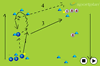
I want to involve some drills that isolate the escaping drill (recognising a threat and turning away to keep possession) and incorporate into a game situation.

in more ways than one
 sportplan_hockey




A few weeks into the league season, poor first touches are costing teams the ball. Coach body shape, scanning and receiving on the move to keep possession.

Pre-season fitness fades fast once the league starts. Build conditioning into ball work and use rolling subs well to keep your squad sharp all season.

The first weeks of the season decide whether a junior or new player sticks with adult hockey. Here is how to keep them safe, give them a clear job and build their confidence from the very first bully.
Coaches from around the world look to Sportplan for coaching confidence.
Excellent drills, very detailed videos. Useful site for my U15 boys team.

I love using Sportplan. It's been a great help for co-ordinating hockey practice and being able to help tweak skills and getting the most out of my players!

Great site. An absolute must for coaches who are willing to change and learn new drills. Superb, simply superb.

Wow what a great website, I have found sportplan an important tool for me when planning my netball sessions with my netball team. There are alot of very helpful tips/ideas/skills that I can learn and teach to my team. Thank you sportplan I hope to continue to use your helpful tips and to learn more about improving my teams netball skills. Thanks again....keep it up....

I have been using Sportplan now for 3 years and can honestly say that I have never repeated the same session twice. My girls are always focused and are improving every year. Thanks Sportplan.
What a fantastic tool. The Chalkboard and session tools make an unbelievable difference in making training plans in both time and organization. I will be instructing all of my assistant coaches that this tool must be used for all sessions during the season, so that we may build a club coaching resource library.
I can't get enough of the Sportplan, It has given me back the enthusiasm i was starting to lose. My girls are so keen and are ready at 14 to take the next up in their game. Sportplan will help no end.



