

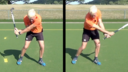
Field Hockey: push shot

July 2026

Every coach knows the feeling of the first pre-season session. Half the squad has spent the summer on the sofa, a few have run themselves into the ground on the road, and almost nobody has held a stick since the last league game. Within twenty minutes the touches are heavy, the decisions are slow, and someone tweaks a hamstring in a sprint that should have been routine. July is the month to fix that before it happens.

The old approach was simple and brutal: lots of laps, lots of shuttles, and the stick left in the bag until the players were "fit enough". Modern conditioning turns that on its head. We now know that hockey fitness is specific, and the fastest way to build it is with the ball in the game, not away from it. This summer, the smartest clubs are treating conditioning as a skill you develop, not a punishment you survive.

Why Running Alone Doesn't Prepare You for Hockey

Hockey is not a steady-state sport. A midfielder rarely jogs at a constant pace; they explode into a press, brake, change direction, hold a low body position over the ball, then repeat it ninety seconds later. Straight-line running builds an engine, but it never trains the stopping, turning and bending that actually break down in the eightieth minute.

Worse, running without a ball teaches the body to move without the demands of stickwork. When you finally add the ball back in September, the extra load on the trunk and shoulders arrives cold. That is exactly when soft-tissue injuries appear. Conditioning with a stick from day one closes that gap.

The principle: if the fitness you build doesn't look like the game, it won't transfer to the game. Build the engine inside hockey shapes wherever you can.

A Four-Week Summer Framework

You don't need a sports science degree to structure a good pre-season. Four progressive weeks, two or three sessions each, will lift the whole squad. The key is to layer intensity gradually so nobody peaks too early or breaks down.

Step One: Rebuild the base (Week 1). Start with continuous, low-intensity work that reintroduces the stick. Long possession games in big grids keep hearts working while hands and eyes wake up. Nothing maximal, plenty of touches, and a deliberate focus on quality of first touch under mild fatigue.

Step Two: Add tempo (Week 2). Introduce interval work using small-sided games with short, sharp bursts and full recoveries. Two or three touch games force quick decisions while the legs are loaded, which is exactly the demand of a real match.

Step Three: Sharpen speed and repeat efforts (Week 3). Now bring in repeated sprint work with the ball, receiving on the move and driving into space. This is where you train the ability to do it again and again, the quality that separates a team in the final quarter.

Step Four: Integrate and taper (Week 4). Pull it together with game-realistic conditioned matches, then ease the volume in the final few days so players arrive for the season fresh, not flat.

Managing the Squad That Turns Up at Different Levels

No two players return in the same shape, and treating them identically is how you injure your keenest athletes. Use conditioned games rather than fixed running targets, because a game self-regulates: the fitter players naturally work harder while those returning can pace themselves without being exposed.

Load monitoring doesn't need to be complicated. A simple session rating out of ten, collected as players leave, will flag who is struggling and who has more to give. If a player reports a nine three sessions running, back them off before the strain becomes an injury.

Key Coaching Points

  • Put the stick in their hands from session one, not week three
  • Progress from continuous work to intervals to repeated sprints across the month
  • Use conditioned games so fitness self-regulates across a mixed squad
  • Protect first touch and decision quality under fatigue, not just heart rate
  • Monitor load simply and back off anyone flagging high strain repeatedly
  • Taper the final few days so players arrive sharp for the opening fixture

Recommended Drills

VIEW ALL FITNESS DRILLS

Frequently Asked Questions

How long should a pre-season fitness block be?

Four to six weeks is ideal for a club side. Four progressive weeks will get an amateur squad match-ready; if you have longer, add an extra base-building week at the front rather than more high-intensity work at the end.

Should players do their own running over the summer?

Some background running helps, but tell them to keep it varied with changes of pace and direction rather than long steady jogs. The most useful thing they can do is get a stick and ball out a couple of times a week to keep their hands alive.

How do I avoid injuries in the first weeks back?

Progress load gradually, always warm up thoroughly, and build conditioning around the ball so the body adapts to real hockey demands. Watch for anyone reporting high fatigue several sessions in a row and give them a lighter day before it becomes a strain.

push shot DRILLS
View All
Unfortunately there were no results for your search! Please try again
push shot ANSWERS
View All

Can you tell me the correct technique for a penalty?

Can you tell me the correct technique for a penalty flick? How you would put it into a training exercise?

Archived User Coach

I need some help with my forwards on the post. They keep missing shots. What is the correct positioning for them and what kind I do to help them score.

Ask a question and have it answered by Coaches from around the world and Sportplan's team of Experts.

Ann Maclean Coach, United States of America

How to lob/chip in a hockey shot?

im twelve, i play for my school team and i am going for a trial at southgate hockey. I  play up front, and i can shoot pretty well but i cant lift it over the keeper. any tips would be much appreiciated

Archived User Coach

Re involving GKs in junior coaching sessions.

I really struggle to make practice fun and useful for the GKs. My attention is naturally focussed on the outfield players, meaning most of the time I simply have drills finishing with a shot on goal to keep the GK involved. Pretty boring for them. Any ideas how I can involve them more? Thanks, Charlie

Carol Ridge Coach, England

Drag-Flicking Tutorial - how to master this skill?

Hi,Out of curiousity, could you list down effective and efficient steps to learn drag-flicking and the drills to master it?

Archived User Coach

Question about a drill in the Sportplan session

Hi, in this week's session "My players lack the ability to pass accurately", there's a progressive exercise called "shoot and recover". Sorry if this is a dumb question but when a player is 'shooting' at their target goal, is the other player allowed to defend the goal?I ask because the diagram makes it look like you're pushing over around 12m and I'd have thought that unless you make the goals huge, with a player defending the goal, people just aren't going to score.Also, if you make the goals really big, it kinda defeats the person of the accuracy element to the exercise.Hope you can assist. Regards,Gary

Gary Thompson Coach, England

Ball "squirting" ahead as players go faster

How to coach fast attackers to control the pace of the ball as they accelerate? At higher speeds, the players' touch on the ball needs to be "softer" but this requires hands and feet to work at varying intensity. I see a lot of speedsters push the ball too far ahead of themselves, the faster they go. The outcome is often a failed shot at goal because the ball runs out of reach or out over the back line.

rachelr Coach, New Zealand

passing drills for girls age 8 to 12

passing drills for girls age 8 to 12

Michelle Hart Coach, Australia

can you give me passing drills for u12

can you give me passing drills for u12

Cathriona Coach, Ireland

indoor pcd

I need something for indoor pcd

Matthias Heine Coach, Germany

How do you hit a reverse stick...

In field hockey, how do you hit a tomahawk flat and accurately?

sarah taylor Coach, Northern Ireland

Problems Clearing the Circle -...

I'm in the U.S., coaching a team of 11-12 year olds, with 1-2 years of experience. Defending the circle, when the ball is loose, my players are not getting control of the ball to hit out of the circle. It's congested with opponent and my team's players. If my players get control, they lose it quickly. If the opponent has control, my players aren't very good at taking the ball or stopping the opponent from taking a shot. Luckily we have a good goalie but she can only do so much. (Full disclosure: I didn't play FH but have a decent understanding of the game. No one else in my community would step up to coach so it's fallen to me.)

Brandon Cowart Coach, United States of America

Re involving GKs in junior coa...

I really struggle to make practice fun and useful for the GKs. My attention is naturally focussed on the outfield players, meaning most of the time I simply have drills finishing with a shot on goal to keep the GK involved. Pretty boring for them. Any ideas how I can involve them more? Thanks, Charlie

Carol Ridge Coach, England

How to lob/chip in a hockey sh...

im twelve, i play for my school team and i am going for a trial at southgate hockey. I  play up front, and i can shoot pretty well but i cant lift it over the keeper. any tips would be much appreiciated

Archived User Coach

low back hand reverse hit - Sp...

lowback hand reverse hit definition

?????????? Coach, United States of America

Identify when the PC shot is a...

When the PC shot is identified as a drag, it seems the defenders should veer away, else suffer the penalty shot if they get a body hit high? Whereas if it is instead identified as a hit, run straight, then if it hits feet, another PC, or if it is higher then it is turnover and maybe pain? If so, I guess the expert defenders are used to quickly deciding whether it is a drag or a hit, so whether to veer off for the drag, or to stay on track for the hit, protect feet, or if the hit is higher then take some pain for the benefit of the team? I am coaching young girls at present, where the penalty shot is not used yet. I dont play hockey myself, but the Olympics shows these events. Although the replays, sunlight reflection and the angles were a bit dissapointing.

Archived User Coach

teaching presses on free hits ...

Hi allI am looking for advice on how to implement processes in my girls school hockey team. processes of setting up presses, defensive structures and counter attacking thinking. I have 14 players in the team from 15 years old to 18. we train twice a week. only a few play club hockey as well. We either play a 3-1-4-2 or a 3-1-3-3.I find it difficult for example, when you want to teach a press on the opposition 16, to simulate gameplay with only 14 players (if they are all at training). I can have my halves setup for taking the 16 and then get my strikers and links to setup, but then I still want defenders to see things from the back but they are taking the 16? Also when taking the 16 they then don't have any support in the drill because everyone else is setting up a press?I know we need to work on our basics in order for the other tactics and skills and game plans to work. However I find it frustrating with this team that on counter attacks for a few reasons which I am struggling to mend;- they only head forward. No one holds up the ball to wait for support.- they run straight and don't use angles- they pass too late and get tackled - they don't have the vision to see an early pass or pass into space- players without the ball do not run into useful positions and angles and get caught out by the person with the ball who then makes a pass to no one and it runs out of play.So suggestions please for;- open, creative but simple counter attacking- teaching processes for presses on free hits and 16s- coaching how to take 16s and work your way out- coaching vision and expecting your players to be in support. RegardsMatt

Matthew Lydall Coach, South Africa

Opposed shooting- how to score...

I need some opposed shooting drills to improve my teams goal scoring ratio. Unopposed drills have not been working, and I really need to avoid cueing - any ideas ?

James Clark Coach, England

Difference between Hit outs an...

What is the difference between hit outs and 16's Asked using Sportplan Mobile App

Archived User Coach

How do you teach a tomahawk hi...

How do you teach a tomahawk hit?

Joe Hill Coach, Australia
push shot COMMUNITY DRILLS
View All

JOIN SPORTPLAN FOR FREE

  • search our library of 1000+ hockey drills
  • create your own professional coaching plans
  • or access our tried and tested plans

Sportplan App

Give it a try - it's better in the app

YOUR SESSION IS STARTING SOON... Join the worlds largest hockey coaching resource for 1000+ drills and pro tools to make coaching easy.
LET'S DO IT









