Rugby: defensive maul

The 50:22 law, introduced as a trial and now a permanent fixture, has fundamentally changed how teams approach tactical kicking. A kick from your own half that bounces in-field, crosses the 22, and finds touch rewards the kicking team with the lineout throw-in. This single law change has altered both attacking and defensive strategies across the game.

Understanding the Law

The requirements:

  • Kick must originate from behind your own 10-metre line
  • Ball must bounce in the field of play (not direct to touch)
  • Ball must cross the opposition's 22-metre line
  • Ball must then go into touch
  • Kicking team retains the throw at the lineout

These requirements create specific technical demands. The kick must be long enough to reach the 22, accurate enough to hit the corner, and struck correctly to bounce in-field first.

Why 50:22 Matters

Before the 50:22, kicking from your own half that went to touch gave the throw to the opposition. The only benefit was territorial gain. Now, an accurate 50:22 delivers both territory AND possession - a game-changing combination.

The tactical impact:

  • Lineout attacking platform in the opposition 22
  • Defensive scramble if full-back fails to cover
  • Forces back three to position wider, creating space elsewhere
  • Punishes lazy defensive positioning

Executing the 50:22

The Grubber Option

A well-struck grubber can beat the full-back to the corner. The low trajectory keeps the ball in play, and end-over-end rotation makes the bounce predictable.

Grubber technique:

  • Strike through the middle of the ball, toe down
  • Generate end-over-end spin for predictable bounce
  • Aim for the gap between full-back and touchline
  • Follow up - if it doesn't reach touch, contest the chase

The Chip and Chase

A chip kick over the defensive line that bounces in the 22 and reaches touch. Higher risk - defenders can field it before it reaches touch - but effective against narrow defences.

Chip technique:

  • Get under the ball with angled foot
  • Enough height to clear defenders, not so much that chase time is lost
  • Backspin for controlled bounce toward touchline

The Cross-Field Kick

Against a defence shifted to one side, the cross-field kick to the far corner can find space. This is a longer kick requiring more accuracy but exploits defensive imbalance.

Defensive Adjustments

The 50:22 has forced defensive positioning changes. Full-backs can no longer sit narrow - they must cover the width. Wings must be aware of their touchline responsibilities.

Defending against 50:22:

  • Full-back positions wider to cover both corners
  • Wings drop deeper to provide secondary cover
  • Communication about kick threats: "Watch grubber!"
  • Quick identification and reaction to kicks

These defensive adjustments create space elsewhere. If the full-back is wide, the central channel opens. If wings drop deep, the defensive line loses numbers.

When to Attempt 50:22

Good opportunities:

  • Full-back positioned narrow or deep
  • Wide channel space visible
  • Defence rushed up, leaving back field exposed
  • Slow ball where running attack is risky

Poor opportunities:

  • Full-back already covering the corner
  • Quick ball with attacking momentum
  • Wind against making accurate kicking difficult
  • Kicker not in optimal position

Training 50:22 Execution

Individual kicking practice:

  • Set targets at the corner - grubber to specific zones
  • Practice both feet (advantage when on either side)
  • Vary distances - not every 50:22 opportunity is from the same position

Team practice:

  • Live scenarios with defence - read the full-back position
  • Decision-making: kick, run, or pass?
  • Chase organisation when the kick doesn't reach touch

Alternative Outcomes

Not every 50:22 attempt succeeds. But the threat creates secondary benefits:

If fielded before touch: You've still gained territory and forced the opposition to start from deep. Apply chase pressure and compete for their exit kick.

If it bounces out before 22: Opposition throw, but you've gained significant ground. Reset defensive line.

If full-back covers: Your threat has pulled them wide. Subsequent attacks may find more space centrally.

The Mental Game

The 50:22 threat changes how oppositions defend, even when you don't kick. Simply having players capable of executing the kick forces wider positioning and changes defensive dynamics.

Make sure your opposition knows you have this weapon. Execute it successfully early in matches, and they'll respect the threat throughout.

Key Coaching Points

  • The 50:22 rewards accurate kicking with possession AND territory
  • Grubbers are highest percentage - practise them
  • Read the full-back position before deciding
  • Even unsuccessful attempts gain territory
  • The threat changes defensive positioning

Drills to Master the 50:22

VIEW ALL KICKING DRILLS

JOIN SPORTPLAN FOR FREE

  • search our library of 1100+ rugby drills
  • create your own professional coaching plans
  • or access our tried and tested plans
defensive maul DRILLS
View All

Maul Touch Warm Up - Rugby Dri...

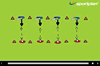
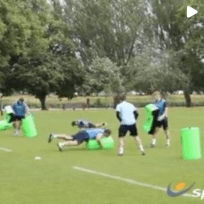
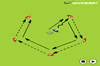
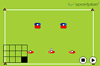
Be brief when telling the players the laws of this game, it's important to get them moving quickly. This is not a contact game, but there will be some light contact. Break your players into two teams, giving each team their own colour of bibs if necessary. One team goes to attack, and one to defence. Nominate a Scrum Half for each team, it will be their job to move the ball from the back of the maul and out to an attacking line. There is no kicking in this game. Normal laws of rugby apply e.g. a forward pass will result in the ball being turned over to the opposition. If an attacking player is touched: they must stop and turn, a maul is then built based on how you have trained your players to Maul. Only four players should be in the maul - but every player should be able to maul - including the backs! When you start playing this game make sure that the defence is employing your defensive pattern around the maul. They will commit 4 players, but will not do anything more than provide light resistance. Once formed the maul can take four steps before moving the ball. If there is a delay in creating the maul, or the quality of the maul is poor - the ball can be turned over. Depending on your goals decide on the number of touches you wish to allow e.g. unlimited is not a bad option as mistakes will be made! If a team has been in possession for a long time, don't forget to turn the ball over to give the opposition a run. Don't hesitate to shape the game to focus on your session goals, and let us and other coaches know what worked for you.

General

Attack Vs Defence Continuous D...

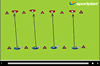
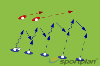
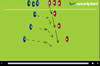
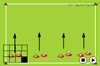
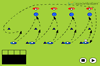
<span style=&quot;background-color: transparent;&quot;>Set a cone 2 meters from the defensive line. This will mark where the ball will passed from (feed) preferably from a scrum half.<span style=&quot;background-color: transparent;&quot;>Set a cone 0.5 meters each side from the mid point of the passing cone to simulate the sides of the ruck.<span style=&quot;background-color: transparent;&quot;>Set a cone a cone 5 meters from the ruck on the defensive line. 4 players start as attackers3 defenders start on their stomaches on the other side of the defensive cone (ruck) and 1 player on the defensive cone 5 metres from the ruck<span style=&quot;background-color: transparent;&quot;>The player on the 5 meter cone (defence) starts the drill by shouting ‘FOLD’ (or whatever call your team may use).<span style=&quot;background-color: transparent;&quot;>Defenders on their stomachs get up and fold around the ruck to take up a defence position. Players fold wide first, and ensure that 2 players are close to the ruck (Guard and Body Guard). <span style=&quot;background-color: transparent;&quot;>The player on the defensive cone bounces out (takes space in the defence line), the first player who folds takes up a position on the 5 meter defence cone (or inside the first attacking player)<span style=&quot;background-color: transparent;&quot;>Once the defence line is set the scrum half can pass the ball.<span style=&quot;background-color: transparent;&quot;>The attackers work to beat the defence, setting up a 'tip' (running a hard line) and 'pull back' option. They should read the defensive movements and make a decision to hit the tip option or pull out the back<br><br>

General

Unfortunately there were no results for your search! Please try again
defensive maul ANSWERS
View All

My fowards seem afraid to ruck and stand around the?

My fowards seem afraid to ruck and stand around the ruck while in the way of the scrum half trying to get the ball out to the backs. They also don't support the ball carrier while he is being tackled. Please help me with any suggestions!!!

William Barrett Coach, United States of America

Please supply me with the positional play for a No8 at the maul,defence,and attack

Ask a question and have it answered by Coaches from around the world and Sportplan's team of Experts.

Buddy Walker Coach, New Zealand

I am trying to put together a season long coaching?

I am trying to put together a season long coaching schedule for under 13s and under 14s covering all the aspects of the game

Archived User Coach

I need to keep a training diary and I have no clue?

I need to keep a training diary and I have no clue as how to start one

Archived User Coach

Vision and Anticipation??!!!

Hi guys, Thanks for everyone that answered my question on Stats!!! I am in the process of drawing up a sheet and sharing it with those that want. Next Question%3A I have come up with a few drills that I think will improve my players Vision, anticipation and decision making. I am wondering if anyone will share their ideas and process to improve these aspects of players especially VISION? I know the 2v1 and 3v2 drills ext for decision making but I want to focus more on VISION and ANTICIPATION. Any ideas??? Thanks again. Shaun

Archived User Coach

When a scrum is awarded following an unsuccessful end to a maul

When a scrum is awarded following an unsuccessful end to a maul, which team throws the ball in?

Arthur Johannes Coach, South Africa

When a scrum is awarded follow...

When a scrum is awarded following an unsuccessful end to a maul, which team throws the ball in?

Arthur Johannes Coach, South Africa

Interpretation of the maul - f...

I will be coaching under 10 next season and need some guidance on how to interpret the rules for the maul?

Ezra rushen Coach, England

U10s organisation in defence. ...

I have started an under 10s team up, and I would say about 8 from the 13 children I have , did not play rugby until about 6 months ago. Of these players, there seems to be a lot of potential, as we are scoring tries against teams, that very rarely concede tries.the problem I got with them, is that we are very poor at organising our selves in defense when the opposition has the ball, which does result in us conceding quite a few tries. We have some very good tacklers in the team. Can anyone offer some ideas on how I can get them to organise themselves? Thanks . Chris.

christopher jenkins Coach, Wales

(U11 Rugby) - How to referee t...

I'm coaching and reffing U11 rugby and one of my players is the definitive 'big lad'. His 'strength' is his size and his power, but last weekend he didn't seem to get reffed fairly. The opposition couldn't tackle him down, one on one and when another two joined in to make a mini maul, that didn't slow him down much either. The ref then let other people join in the (one sided) struggle to tackle him down, which seemed very unfair as A) it's outside the laws of U11 rugby,, B) it makes it nigh on impossible for him to offload, C) when he is brought to ground, he has 4-5 players all over him and he got pinged for 'holding on'. He is a recent arrival to rugby and it was our first game for a couple of months, so the situation hadn't reared his head before. We are keen that he learns all of the core skills of rugby and doesn't get used as a battering ram, but after seeing a pack of hyenas trying to pull down the big fella, something just didn't seem right to me.I'd be grateful for any thoughts and opinions.

Archived User Coach

Is there any kind of offside i...

Is there any kind of offside in the open play? Like, after a ruck or maul being cleared? Or like my defense being broken so I can't intercept a pass from the offense when I'm chasing him?

Archived User Coach

Tips on breaking through a def...

Hi my name is Mac and i am a 8 man and i struggle to push through a defensive line when i have the ball due to how my coaches make us practice so i wanted to know tips on how to push/break through a defensive line when i have the ball.

Mac Coach, United States of America

Law no. 16 Maul | Sportplan

When a scrum is awarded following an unsuccessful end to a maul, which team throws the ball in?

Paula Peniasi Coach, Fiji

Off side in general play. Can ...

Off side in general play. Can anyone explain this better as it seems to be a bit ambiguous. When are you off side in general play? Rugby Unoin.

Karen Thornton Coach, England

Unsuccessful end to a maul whe...

Following the TV explanation of a referee's decision on an unsuccessful maul from a kick-off, I looked up the following rule (the latest version on the IRB site).----------------------------------------------------------------------------17.6 UNSUCCESSFUL END TO A MAUL (h) Scrum after a maul when catcher is held. If a player catches the ball direct from an opponent’s kick, except from a kick-off or a drop-out, and the player is immediately held by an opponent, a maul may form. Then if the maul remains stationary, stops moving forward for longer than 5 seconds, or if the ball becomes unplayable, and a scrum is ordered, the team of the ball catcher throws in the ball.---------------------------------------------------------------------------- It states "except from a kick-off or a drop-out", but then nowhere can I find what happens IN the case of a kick-off or a drop-out. Does anyone know the answer?  The referee's decision and the explanation given on Sky was as though the exception above were not there.

Philip Ratcliffe Coach, Italy

defensive pattern | Sportplan

explain the ABC breadown defense drill

bredget mdhluli Coach, South Africa

My fowards seem afraid to ruck...

My fowards seem afraid to ruck and stand around the ruck while in the way of the scrum half trying to get the ball out to the backs. They also don't support the ball carrier while he is being tackled. Please help me with any suggestions!!!

William Barrett Coach, United States of America

coaching under 9s next year, w...

Hi, I’m coaching under 9s next year which involves tackling, mauls, rucks etc. I’m after advise on what to coach first and the amount of time spent on each area. Added to this I’ve somehow become the lead coach after a couple of coaches stepped down (feeling a little under pressure!) Would anybody be willing to share any sessions so I can plan the first month or so. Cheers

Archived User Coach

JOIN SPORTPLAN FOR FREE

  • search our library of 1100+ rugby drills
  • create your own professional coaching plans
  • or access our tried and tested plans

Sportplan App

Give it a try - it's better in the app

YOUR SESSION IS STARTING SOON... Join the growing community of rugby coaches plus 1100+ drills and pro tools to make coaching easy.
LET'S DO IT