







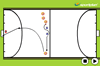
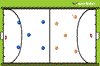
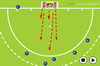
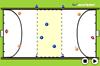

Excellent drills, very detailed videos. Useful site for my U15 boys team.

How do I save a session in pdf format?

How do I convert training plan to PDF?
Saving individual drills to PDF would be extremely helpful!

Is it possible to export the clipboards to PDF to allow me to print, I am unable to directly print of the internet from my laptop. Fantastic site, will defiantly be considering the full package. Thank you
when creating a PDF of my plan it inserts blank pages in the PDF. e.g. a plan that should fit on 2 pages of A4 comes through as a 4 page PDF with content on pages 1 and 3 and blank pages on pg 2 and 4. How do i avoid this?
Hey here! I would like to export files/maps a .pdf's. Is this possible? I can't find the option :)Thanks for your answer!
my plan is ready and now i want to share it with the trainers. how can i share the link or pdf Arthur i m in great need. training start in a few hours

How do i save my work as a pdf
pdf does not print now?
how do you print out a coaching plan ?
For some reason, I am unable to open the pdf, just send me back to the homepage? Is there a new link for this as this would be perfect to help me introduce this formation to my team. Any help would be appreciated.
when I download pdf of plan, its blank. Ive created plan and I've printed it, but I need to email pdf
When I try to create a PDF of the plan I want it does not create a PDF

how to move from clipboard to pdf
Every time I go to create a PDF of my plan I get stuck with this spinning wheel which will not progress. I have tried on the web browser and app and get the same problem

Hi, when I try and download a PDF it doesn't open. Adobe gives an error. I tried multiple browers but none of them download a good PDF. Is there another way to get the download?ThanksCharlie
Is it possible to export the clipboards to PDF to allow me to print, I am unable to directly print of the internet from my laptop. Fantastic site, will defiantly be considering the full package. Thank you
Hi all, after "volunteering" at the last minute to coach last season, I'm looking forward to coaching again this season but would like to be a bit more organised starting the season. Last season I used drills from here (thank you contributors) and put together a practice plan each week addressing what I thought were our weakness from the game just played. This got us through the season, we were promoted after grading and finished the season in the top 4 playoffs for our grade.I wonder if there is some kind of guide to putting a more coherent training plan together for the season.I'm coaching a boys secondary school team, aged 12-18. What kind of skills should they have mastered?What should they be attempting, working towards mastering (individually and as a team)?I last played as a collage boy on grass fields, the change to turf pitches has obviously obsoleted (along with age) much of what I knew as a player.Any pointers appreciated.David
diagram of hockey pitch
Suggestions on how to play this system. I have very young 1st team so feel i must play defensive hockey. Thanks

in more ways than one
 sportplan_hockey




A few weeks into the league season, poor first touches are costing teams the ball. Coach body shape, scanning and receiving on the move to keep possession.

Pre-season fitness fades fast once the league starts. Build conditioning into ball work and use rolling subs well to keep your squad sharp all season.

The first weeks of the season decide whether a junior or new player sticks with adult hockey. Here is how to keep them safe, give them a clear job and build their confidence from the very first bully.
Coaches from around the world look to Sportplan for coaching confidence.
Excellent drills, very detailed videos. Useful site for my U15 boys team.

I love using Sportplan. It's been a great help for co-ordinating hockey practice and being able to help tweak skills and getting the most out of my players!

Great site. An absolute must for coaches who are willing to change and learn new drills. Superb, simply superb.

Wow what a great website, I have found sportplan an important tool for me when planning my netball sessions with my netball team. There are alot of very helpful tips/ideas/skills that I can learn and teach to my team. Thank you sportplan I hope to continue to use your helpful tips and to learn more about improving my teams netball skills. Thanks again....keep it up....

I have been using Sportplan now for 3 years and can honestly say that I have never repeated the same session twice. My girls are always focused and are improving every year. Thanks Sportplan.
What a fantastic tool. The Chalkboard and session tools make an unbelievable difference in making training plans in both time and organization. I will be instructing all of my assistant coaches that this tool must be used for all sessions during the season, so that we may build a club coaching resource library.
I can't get enough of the Sportplan, It has given me back the enthusiasm i was starting to lose. My girls are so keen and are ready at 14 to take the next up in their game. Sportplan will help no end.



