

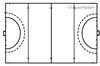
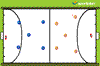
Field Hockey: full pitch template

May 2026

Watch any FIH Pro League fixture this season and you'll see the same pattern again and again. A team loses the ball, and instead of dropping back to reorganise, three or four players sprint forward to surround the new ball carrier. Within five seconds the ball is back, often closer to the opposition goal than when it was lost. This is counter-pressing, and in 2026 it has become the defining habit of elite hockey.

The principle is borrowed from football's gegenpressing, but hockey suits it better. With no offside line, fewer touch restrictions and a small playing surface, the moment after a turnover is genuinely chaotic for the team that has just won possession. Their shape isn't set, their heads are down on the ball, and the simple outlet pass is rarely available. Five seconds is enough to punish all of that.

Why the First Five Seconds Matter

When you lose possession, the opposition is in their most vulnerable state. Their players are still moving forward in attacking shape, their goalkeeper isn't set, and the ball carrier has barely controlled the tackle. If you can apply pressure before they organise, you create three scoring scenarios: a turnover deep in their half, a hurried clearance that comes straight back, or a foul that hands you a free hit in dangerous territory.

Wait six or seven seconds and the moment is gone. The ball carrier has lifted their head, the support runners have arrived, and an outlet down the line is available. The counter-press has to happen now, by the players nearest the ball, without waiting for instructions from the bench.

The mindset shift: The instant you lose the ball, your closest three players are no longer attackers. They are pressers. Teach this as an automatic reaction, not a tactical decision.

The Two Counter-Pressing Models

There are two ways to organise the counter-press, and most teams use a hybrid of both. Knowing the difference helps you coach it deliberately.

Space-oriented pressing targets the area around the ball rather than specific opponents. The nearest player closes the carrier hard, the next two cut off forward and lateral passing lanes, and the rest of the team squeezes the pitch from behind. The aim is to suffocate the space, force a poor pass, and intercept rather than tackle.

Man-oriented pressing sees each player pick up the nearest opponent the moment possession is lost. With no offside in hockey, this is highly effective because every potential outlet is marked. The risk is that one missed pickup creates a free runner; the reward is that successful counter-presses almost always lead to interceptions in dangerous areas.

For most club teams, start with man-oriented counter-pressing for the first five seconds, then drop into a zonal shape if the ball isn't won. This gives you the upside of intensity without the chaos of pure space-pressing in transition.

How to Train It

Counter-pressing fails when it is taught as a tactic in a team talk. It only sticks when players experience it again and again in training, with feedback in the moment.

Step one - the rondo with consequence. Play 5v2 in a 12m square. When the two defenders win the ball, they have five seconds to score by stopping it on a target line. The five attackers must counter-press immediately to prevent it. This compresses the whole concept into a 90-second exercise that you can run as a warm-up every session.

Step two - the transition game. Set up a 7v7 game across half a pitch. Every time possession changes, start a five-second clock. If the team that lost the ball wins it back inside the count, they score double on the next attack. If they fail, the new attacking team gets a free pass forward. Watch the intensity of those first five seconds rise sharply.

Step three - the full-pitch conditioned game. Play 11v11 with one rule: whenever a team loses the ball in the opposition half, they must counter-press for five seconds before retreating. Use a whistle to mark the five-second cut-off in the first few sessions, then let the players self-manage.

What to Coach When You See It Live

Freeze play in training the moment a counter-press starts. Ask three questions: who is pressing the ball, who is closing the forward pass, and who is covering behind? If all three roles aren't filled in the first second, the press will fail. Most counter-presses break down because the player furthest from the ball doesn't move - they assume someone else will cover, and a simple bounce pass releases the carrier.

Communication is the second checkpoint. The presser needs to be told what to take away. A simple call of "force left" or "lock the line" gives the chasing player a job. Without it, they go in flat and the ball carrier finds the gap.

Key Coaching Points

  • The moment of turnover is the trigger, not the bench
  • Three players minimum: presser, cover, screen
  • Five seconds is the limit - then drop into shape
  • Talk constantly to force the carrier into one decision
  • Reward turnovers in training with extra points or bonus possession

Recommended Drills

VIEW ALL PRESSING DRILLS

full pitch template DRILLS
View All
Unfortunately there were no results for your search! Please try again
full pitch template ANSWERS
View All

diagram of hockey pitch | Spor...

diagram of hockey pitch

Archived User Coach

teaching presses on free hits ...

Hi allI am looking for advice on how to implement processes in my girls school hockey team. processes of setting up presses, defensive structures and counter attacking thinking. I have 14 players in the team from 15 years old to 18. we train twice a week. only a few play club hockey as well. We either play a 3-1-4-2 or a 3-1-3-3.I find it difficult for example, when you want to teach a press on the opposition 16, to simulate gameplay with only 14 players (if they are all at training). I can have my halves setup for taking the 16 and then get my strikers and links to setup, but then I still want defenders to see things from the back but they are taking the 16? Also when taking the 16 they then don't have any support in the drill because everyone else is setting up a press?I know we need to work on our basics in order for the other tactics and skills and game plans to work. However I find it frustrating with this team that on counter attacks for a few reasons which I am struggling to mend;- they only head forward. No one holds up the ball to wait for support.- they run straight and don't use angles- they pass too late and get tackled - they don't have the vision to see an early pass or pass into space- players without the ball do not run into useful positions and angles and get caught out by the person with the ball who then makes a pass to no one and it runs out of play.So suggestions please for;- open, creative but simple counter attacking- teaching processes for presses on free hits and 16s- coaching how to take 16s and work your way out- coaching vision and expecting your players to be in support. RegardsMatt

Matthew Lydall Coach, South Africa

Rolling player substitution pl...

Need help with planning a rolling subs with 11 players and 5 subs.Keeper,4 backs, 4 midfied, 2 strikers.Any ideas please

Barry Prestney Coach, New Zealand

Tournament prep -building fitn...

I have just returned from coaching my first high school hockey tournament. It was great fun but the girls really felt it by the end of the tournament. I want to offer guidance in the form of a fitness build up to the girls for next season but am not sure what my expectations should be. How fit should you be looking to get if you are preparing to play 7 50min games over 5 days? And what types of fitness should I be suggesting? Sprinting and Intervals along with Swimming are things I feel that could be introduced. Ideally it needs to be accessable (not expensive or require special equipment), self managed (to an extent) and let it fit in with their daily rountine as best possible to give them the best chance to commit (i.e. I feel like suggesting they power walk to school rather than get dropped off will work better than asking them to join a gym to do the pelaton classes) Any ideas? Or things that have worked in the past?

Archived User Coach

I'm a new Varsity head coach a...

Hi all- I am 37 years old. I played field hockey for 3 years only (in high school). As you can imagine, I'm not very good/experienced. I was a competitive soccer player which made me good enough athletically to play field hockey but anyway, the point is: I never played field hockey at a high level.I now find myself in a head coaching position. (Long story-I did coach some field hockey some years ago and had a blast but it was a while back). Anyway, I have three assistant coaches who aren't much more experienced than I am. Our high school program is VERY weak and so nobody really steps up to coach there.Basically, my question is: what do I do? I have some girls who have played but not much. Then I have girls who literally don't know how to hold their stick and are quite I athletic. We barely have enough girls to field a team. As for drills, I'm trying to use this site but if you were in my position, what specifically would you be doing with these girls so they don't lose 7-0 every game? Right now, I'm focusing on body control and comfort with the ball- (we are playing possession and they are so uncomfortable they just hit the ball away because they don't have the skills to hold). Any help you can give is greatly appreciated!Brooke Asked using Sportplan Mobile App

Archived User Coach

Midfield positioning on 16yd h...

hi there I'm using 4-4-2 and on sometimes 3-1-4-2 with a lower level hockey team.I've chosen this over other formations, simply because the hockey experience and ability of my players is not of a high level (and most people have an approximate understanding of 442). Also, I believe that one must choose a formation based on players traits and what they can deliver. For example, I'd ideally prefer to have 3 forwards, to help with more height and width but then would have to either play 3 in the middle or 3 at the back... and my player strengths don't permit this. In short, I simply don't believe I have a strong enough CH / CM to handle 3 in the middle and I'm not convinced that the off-the-ball support from other players is strong enough to allow 3 in the middle. OFFENSIVE PLAYS Anyway, I'm not 100% where to get my centre mids to stand when we have a 16 yd hit to take (i.e. our possession). Obviously one of the CMs comes deep to offer a potential direct outlet from the centre backs or offer an overload option if the ball goes out to the sides (which is more likely, since I've pretty much banned the high risk play of releasing up the middle - we've had far too many turnovers in our final third or quarter because we tried to play up the middle). My players are 'aware' of posting up and leading runs. However, I'm not sure about the 2nd CM. On the one hand I'd ideally like the 2nd CM to come deep as well, in order to potentially help break up the opposition press but by doing so, I distort the midfield and if we do manage to get the ball to one of the CMs, he won't have the 2nd CM in a higher position to release to, etc. DEFENSIVE POSITIONING Can someone suggest, again, about midfield positioning using 4-4-2 or 3-1-4-2, when we are setting up a general press? I have traditionally encouraged man marking, simply because our general positional awareness is weak (which makes zonal play a no-no IMO) + our tracking and attitude to committed defending (i.e. you don’t give up if one tackle fails) could be better! However, looking at suggested presses on Sportplan, some zonal positioning seems a necessity and I think if I can help my players make the step, success will come because they've been forced to become more aware of their pitch positioning, etc. Also, looking at some of the presses, it looks like the midfield can go 'flat' to create a barrier... and as I encourage a diamond shape in midfield, I need to explain to my players what to do and when. Sorry for the wordy question. I hope this all makes sense. Regards, Gary

Gary Thompson Coach, England

1-2-1 coaching with u12 son ? ...

1-2-1 coaching with u12 son (forward-JDC level) need to keep it fresh and fun any ideas? Andy Batch

Archived User Coach

help! A divided U14 girls team...

I've got some girls aged 11-14, basically made up from two different clubs. We're playing 7 a side and have a squad of 12. One club dominates in terms of numbers (75% of the squad) and although they are not doing anything 'wrong' at all, the 9 players are accustomed to their own company and there's a bit of a divide that has emerged. I can't understand why the players aren't just getting on with things but I'm getting some reactionary behaviour from some players, because of this 2 camp scenario. Any tips?Thanks.

Gary Thompson Coach, England

I am a new coach and need poin...

I just became the head coach of a middle school field hockey team and would like some pointers on how to coach. I have experience with goal keeping and defensive drills, I was a keeper, so I would like to learn more about offense as well. Any help is appreciated!!

Amanda Emerich Coach, United States of America

How can I stop my team from di...

I am coaching my first season as head coach. I am confident that my team has improved on alot of skills (mostly due to sportplan.net, thank you!). The only thing that is driving me crazy that my team has not improved on is the over committing block tackle. When an opponent is coming down the field on a breakway, my defense runs up and block tackles, and the opponent shoots right past them. This will happen two or three times in a row, one defender after the other. I've told them to keep their feet moving and to keep off their toes, keeping their momentum with the opponent. I don't know how to practice this with them. We only have 9 players (this is a high school varsity team) so we can't scrimmage full field during practice. Please help! I'm desperate for a solution.

Archived User Coach

Right-Wing Position | Sportpla...

My daughter plays U13 hockey in the position of right wing.She gets different advice from her school coach and her club coach.I want to make sure that she is getting the right advice as she is passionate about her hockey. Firstly, exactly what is the full function of a right wing at this level of hockey (she will be going to U15 club hockey and U14 school hockey next season) She has a good understanding of the game and appears to me to read it well (I only played school level many years ago and things change) When her team is in the offensive position in the “D” she mostly waits at goal post to deflect ball into goal.  She appears to not be involved.  Comments from spectators have been made as to why she just stands there. There is a very skilled player in her team who hits the ball EXTREMELY hard.  I believe that at this level of hockey these extremely hard hits/passes do not achieve anything, they just keep going out. However, please can you advise on how to stop and control these very hard passes (that is if one can get to them) in order to move on with the game. Lastly, can you send some drills/exercises to get her eye in as well as positioning her body correctly for goal shooting.  The “hard hitter” and my daughter seem to be the main goal shooters of the team. Many thanks Lynne

Archived User Coach

Difference between full and ha...

Please can you explain the difference in the full court press press and the half court press

Carole Quill Coach, England

Attacking Mindset - Sportplan

Hi,I coach a university team that has a group of mixed abilities, ranging good players with some previous hockey experience to some who are starting from the basics. We've managed to polish on basics and now the team is able to play together. They move the ball well around the pitch using the wider areas, good defence and tackles, but the big problem is creating scoring opportunities. Without goals we can't win matches... The best is draws which we get most times. I was wondering if anyone could share a small sided game or drill that could help create the attack mindset so my team can have that hunger for goas and go for it.

Ian Smith Coach, Kenya

Coaching plan (season outline)...

Hi all, after "volunteering" at the last minute to coach last season, I'm looking forward to coaching again this season but would like to be a bit more organised starting the season. Last season I used drills from here (thank you contributors) and put together a practice plan each week addressing what I thought were our weakness from the game just played. This got us through the season, we were promoted after grading and finished the season in the top 4 playoffs for our grade.I wonder if there is some kind of guide to putting a more coherent training plan together for the season.I'm coaching a boys secondary school team, aged 12-18. What kind of skills should they have mastered?What should they be attempting, working towards mastering (individually and as a team)?I last played as a collage boy on grass fields, the change to turf pitches has obviously obsoleted (along with age) much of what I knew as a player.Any pointers appreciated.David

David Smith Coach, New Zealand

Full court, half court and 3/4...

Hi all, thank you for taking the time to read my question. I was hoping for some clarity around 'presses'Pressing oppositions 16- Full press3/4 pressHalf courtWhat are the pro's and cons offensively of each and in what situation would you suggest using each?

Joel Forrester Coach, England

Best way to teach shape and po...

hi allI'm currently coaching 12 and 13 yr olds and the team has a massive problem with shape and being disciplined positionally.Any tips, ideas, drills etc for helping with / teaching this?many thanks,Gary

Gary Thompson Coach, England

1st ever training Session Stru...

I have been given my first team ever!! They are 11 year old girls and I wanted guide/ recommendation on how I should structure my one hour sessions? E.g. how long should I spend on a warm up, drill etc. .Cheers,Freya

Archived User Coach

JOIN SPORTPLAN FOR FREE

  • search our library of 1000+ hockey drills
  • create your own professional coaching plans
  • or access our tried and tested plans

Sportplan App

Give it a try - it's better in the app

YOUR SESSION IS STARTING SOON... Join the worlds largest hockey coaching resource for 1000+ drills and pro tools to make coaching easy.
LET'S DO IT









