

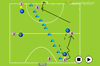

Field Hockey: free hit into the circle

July 2026

Every coach knows the feeling of the first pre-season session. Half the squad has spent the summer on the sofa, a few have run themselves into the ground on the road, and almost nobody has held a stick since the last league game. Within twenty minutes the touches are heavy, the decisions are slow, and someone tweaks a hamstring in a sprint that should have been routine. July is the month to fix that before it happens.

The old approach was simple and brutal: lots of laps, lots of shuttles, and the stick left in the bag until the players were "fit enough". Modern conditioning turns that on its head. We now know that hockey fitness is specific, and the fastest way to build it is with the ball in the game, not away from it. This summer, the smartest clubs are treating conditioning as a skill you develop, not a punishment you survive.

Why Running Alone Doesn't Prepare You for Hockey

Hockey is not a steady-state sport. A midfielder rarely jogs at a constant pace; they explode into a press, brake, change direction, hold a low body position over the ball, then repeat it ninety seconds later. Straight-line running builds an engine, but it never trains the stopping, turning and bending that actually break down in the eightieth minute.

Worse, running without a ball teaches the body to move without the demands of stickwork. When you finally add the ball back in September, the extra load on the trunk and shoulders arrives cold. That is exactly when soft-tissue injuries appear. Conditioning with a stick from day one closes that gap.

The principle: if the fitness you build doesn't look like the game, it won't transfer to the game. Build the engine inside hockey shapes wherever you can.

A Four-Week Summer Framework

You don't need a sports science degree to structure a good pre-season. Four progressive weeks, two or three sessions each, will lift the whole squad. The key is to layer intensity gradually so nobody peaks too early or breaks down.

Step One: Rebuild the base (Week 1). Start with continuous, low-intensity work that reintroduces the stick. Long possession games in big grids keep hearts working while hands and eyes wake up. Nothing maximal, plenty of touches, and a deliberate focus on quality of first touch under mild fatigue.

Step Two: Add tempo (Week 2). Introduce interval work using small-sided games with short, sharp bursts and full recoveries. Two or three touch games force quick decisions while the legs are loaded, which is exactly the demand of a real match.

Step Three: Sharpen speed and repeat efforts (Week 3). Now bring in repeated sprint work with the ball, receiving on the move and driving into space. This is where you train the ability to do it again and again, the quality that separates a team in the final quarter.

Step Four: Integrate and taper (Week 4). Pull it together with game-realistic conditioned matches, then ease the volume in the final few days so players arrive for the season fresh, not flat.

Managing the Squad That Turns Up at Different Levels

No two players return in the same shape, and treating them identically is how you injure your keenest athletes. Use conditioned games rather than fixed running targets, because a game self-regulates: the fitter players naturally work harder while those returning can pace themselves without being exposed.

Load monitoring doesn't need to be complicated. A simple session rating out of ten, collected as players leave, will flag who is struggling and who has more to give. If a player reports a nine three sessions running, back them off before the strain becomes an injury.

Key Coaching Points

  • Put the stick in their hands from session one, not week three
  • Progress from continuous work to intervals to repeated sprints across the month
  • Use conditioned games so fitness self-regulates across a mixed squad
  • Protect first touch and decision quality under fatigue, not just heart rate
  • Monitor load simply and back off anyone flagging high strain repeatedly
  • Taper the final few days so players arrive sharp for the opening fixture

Recommended Drills

VIEW ALL FITNESS DRILLS

Frequently Asked Questions

How long should a pre-season fitness block be?

Four to six weeks is ideal for a club side. Four progressive weeks will get an amateur squad match-ready; if you have longer, add an extra base-building week at the front rather than more high-intensity work at the end.

Should players do their own running over the summer?

Some background running helps, but tell them to keep it varied with changes of pace and direction rather than long steady jogs. The most useful thing they can do is get a stick and ball out a couple of times a week to keep their hands alive.

How do I avoid injuries in the first weeks back?

Progress load gradually, always warm up thoroughly, and build conditioning around the ball so the body adapts to real hockey demands. Watch for anyone reporting high fatigue several sessions in a row and give them a lighter day before it becomes a strain.

free hit into the circle DRILLS
View All
Unfortunately there were no results for your search! Please try again
free hit into the circle ANSWERS
View All

I'm looking for suggestions on set plays for free hits?

I'm looking for suggestions on set plays for free hits going into the circle. High school rules in the US now state that all players (attack/defense) must be 7 yards from the ball. What plans will work for drawing corners and goal scoring opportunities?

Ali Collins Coach, United States of America

Can any one help me with the new mandantory rule. If?

Can any one help me with the new mandantory rule. If a free hit is taken in the 23mts square and is hit back into the centre square am I correct in coaching that it still must be touched by another stick in the 23mts square before entering the circle

Bev Brooks Coach, Australia

how do i stop my defenders form panicking when they have possession in there own circle

Ask a question and have it answered by Coaches from around the world and Sportplan's team of Experts.

luke connolly Coach, Ireland

self pass rule confusion

Hi everyone, I have been hunting for a more detailed explanation on the self pass rule for hockey. My under standing of it is that a self pass must involve the ball moving five meters before it is hit by the player or it must be hit from a dead positon (not moving) I have umpired many games where the players 'tap and hit' the ball, often with another player rushing in to tackle just as the 'tap' is played. This seems dangerous but im not sure if the tackler is playing dangerously or if the 'tap and hit' player is dangerous? I have read the rule book but this rule is not explicit enough. Any interpretaions welcome. Thanks

Archived User Coach

Defending the ball carrier

With the new own goal rule it's getting very critical to defend the player who is carrying the ball.The team that I coach had a major problem on this area last season.I've already told them what they sould do in order to make it difficult for the ball carrier to scan for a pass or hit the ball inside our defending circle,or at least make him to drible instead of making a dangerous pass.But,they are not used to doing it and we have conceived a lot of goals that way.We have the same problem at defending a free hit inside our 25 yards,when the attacker dribles with the ball for the neccessary 5 meters and then smashes it into our circle.I am trying to think of a way or an excersise that will make them do it,but I haven't found one.Any ideas for both ways could be very helpful.

Archived User Coach

5-yard rule in hockey?

could someone comment on the 5 yard rule when entering the scoring area? There always seams to be a lot of wrong information regarding this rule.

Gaby Coach, United States of America

claiming fouls by hitting the ball at the opposing player body.

if a player in possession of the ball intentionally hits the ball at the foot of the opposing player in order to slow down the game or for any other advantage is it permissible,what if the same scenario occurs in the shooting circle.

Archived User Coach

rules of free hit

rules of free hit

Coach, United Kingdom

5-yard rule in hockey? - Sport...

could someone comment on the 5 yard rule when entering the scoring area? There always seams to be a lot of wrong information regarding this rule.

Gaby Coach, United States of America

rules of free hit | Sportplan

rules of free hit

Coach, United Kingdom

claiming fouls by hitting the ...

if a player in possession of the ball intentionally hits the ball at the foot of the opposing player in order to slow down the game or for any other advantage is it permissible,what if the same scenario occurs in the shooting circle.

Archived User Coach

Long corners (attacking and de...

Dear all, what are best practices for playing long corners? Please advice for playing long corners while attacking and defending long corners.

Marco Koudijs Coach, Netherlands

Midfield positioning on 16yd h...

hi there I'm using 4-4-2 and on sometimes 3-1-4-2 with a lower level hockey team.I've chosen this over other formations, simply because the hockey experience and ability of my players is not of a high level (and most people have an approximate understanding of 442). Also, I believe that one must choose a formation based on players traits and what they can deliver. For example, I'd ideally prefer to have 3 forwards, to help with more height and width but then would have to either play 3 in the middle or 3 at the back... and my player strengths don't permit this. In short, I simply don't believe I have a strong enough CH / CM to handle 3 in the middle and I'm not convinced that the off-the-ball support from other players is strong enough to allow 3 in the middle. OFFENSIVE PLAYS Anyway, I'm not 100% where to get my centre mids to stand when we have a 16 yd hit to take (i.e. our possession). Obviously one of the CMs comes deep to offer a potential direct outlet from the centre backs or offer an overload option if the ball goes out to the sides (which is more likely, since I've pretty much banned the high risk play of releasing up the middle - we've had far too many turnovers in our final third or quarter because we tried to play up the middle). My players are 'aware' of posting up and leading runs. However, I'm not sure about the 2nd CM. On the one hand I'd ideally like the 2nd CM to come deep as well, in order to potentially help break up the opposition press but by doing so, I distort the midfield and if we do manage to get the ball to one of the CMs, he won't have the 2nd CM in a higher position to release to, etc. DEFENSIVE POSITIONING Can someone suggest, again, about midfield positioning using 4-4-2 or 3-1-4-2, when we are setting up a general press? I have traditionally encouraged man marking, simply because our general positional awareness is weak (which makes zonal play a no-no IMO) + our tracking and attitude to committed defending (i.e. you don’t give up if one tackle fails) could be better! However, looking at suggested presses on Sportplan, some zonal positioning seems a necessity and I think if I can help my players make the step, success will come because they've been forced to become more aware of their pitch positioning, etc. Also, looking at some of the presses, it looks like the midfield can go 'flat' to create a barrier... and as I encourage a diamond shape in midfield, I need to explain to my players what to do and when. Sorry for the wordy question. I hope this all makes sense. Regards, Gary

Gary Thompson Coach, England

JOIN SPORTPLAN FOR FREE

  • search our library of 1000+ hockey drills
  • create your own professional coaching plans
  • or access our tried and tested plans

Sportplan App

Give it a try - it's better in the app

YOUR SESSION IS STARTING SOON... Join the worlds largest hockey coaching resource for 1000+ drills and pro tools to make coaching easy.
LET'S DO IT









