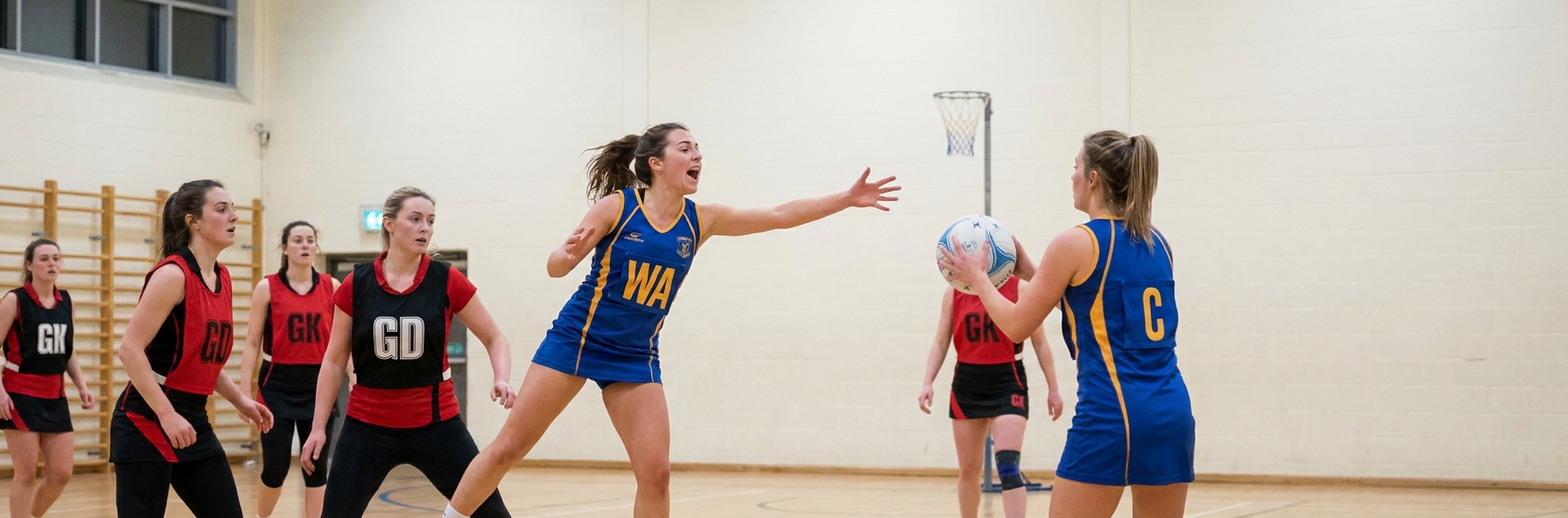
Several weeks into the winter league, most teams have their bibs settled and their basic patterns learned. Yet under floodlights, on a noisy indoor court, with fatigue creeping in by the third quarter, those same patterns start to break down. Two players call for the same ball. A defender switches onto an attacker without telling anyone. A feed goes down the middle because nobody shouted that the space was there.
None of this is a skills problem. It is a communication problem, and it is one of the cheapest things a coach can fix. Players who talk constantly, not just when something has already gone wrong, make faster decisions, cover for each other's mistakes and turn scrappy indoor netball into clean, controlled netball.
Why Teams Go Quiet
Communication tends to disappear exactly when a team needs it most. Early in a game, when everyone is fresh and the score is close, players talk. By the third quarter, with legs tired and concentration dipping, calls get shorter or stop altogether. Add an indoor venue with echoing acoustics and spectators close to the court, and quiet players simply cannot be heard.
There is also a confidence element. Younger or newer players often stay silent because calling for the ball risks being wrong, and calling a defensive switch risks sounding like they are telling a teammate what to do. Left unaddressed, this becomes the loudest, most experienced player doing all the talking while everyone else reacts.
Building a Team That Talks
Step One: Separate the two jobs. Attacking communication is about calling for the ball early and clearly, using a name or a simple word, so the player with the ball can commit to the pass. Defensive communication is about covering, switching and warning teammates about space or a player driving in behind them. Coach them as two distinct habits, not one vague instruction to "talk more".
Step Two: Give players a shared vocabulary. Agree simple, consistent calls as a team: a name for "I'm free", "switch" for taking over a mark, "ball side" or "behind you" for warning a teammate about danger they cannot see. A shared vocabulary means a call means the same thing to every player, every time.
Step Three: Make calling early non-negotiable. The most common fault is calling for the ball at the same moment you want to receive it, which gives the passer no time to react. Coach players to call the instant they start their movement, not when they arrive in space.
Step Four: Reward quality over volume. A court full of noise is not the same as a court full of useful information. In training, stop play when a call is late, unclear or missing, and ask the player what they should have said and when. This builds the habit faster than simply telling players to be louder.
Step Five: Practise under fatigue and noise. Communication that works in a quiet, fresh training drill often collapses in a loud, tired game. Build calling into conditioning work and small-sided games late in a session, when players are breathing hard and want to default to silence.
How to Train It
Warm up with a simple calling game: players move in pairs and must call a teammate's name before every pass, with no ball transfer allowed until the name is heard. This forces early, clear calls before any pressure is added.
Move into technical work with a feeding or movement drill where receivers must call for the ball as they start to move, not once they arrive. Coaches should deliberately ignore any late or silent calls, even if the movement itself was good.
Add decision-making with a small defensive unit practising switches and cover calls in a restricted area, so defenders have to talk to avoid leaving a gap. Finish with a small-sided or full game where the only coaching point is communication; let skill errors go and focus entirely on who is talking and who has gone quiet.
Key Coaching Points
- Treat attacking calls and defensive calls as separate habits, each with its own cues.
- Agree a shared, simple vocabulary so every call means the same thing to every player.
- Calls must come at the start of a movement or a switch, not after the fact.
- Stop and reset when a call is missing or late, rather than letting it slide.
- Build communication drills into the tired, noisy parts of a session, not only the fresh parts.
- Praise the quiet players who start talking before praising the players who were always loud.
Recommended Drills
VIEW ALL DECISION MAKING DRILLS
Frequently Asked Questions
How do I get quiet players to start calling for the ball?
Start with low-pressure drills where every player must call before anything happens, so there is no option to stay silent. Build their confidence with short, simple calls like a name, then gradually add pressure and pace once the habit is established.
What is the single most useful call for a junior or developing team?
A clear name, called early, solves more problems than any other call. It removes doubt about who is receiving the ball and gives the passer confidence to commit. Get this right before layering in defensive calls like "switch" or "behind you".
Our team talks fine in training but goes silent in matches, why?
Training is usually quieter and less tiring than a real match, so the habit has not been tested under the conditions it needs to survive. Practise communication specifically when players are tired and the session is noisy, not only in calm technical drills.
 sportplan_netball