

Field Hockey: talk

May 2026

Watch any FIH Pro League fixture this season and you'll see the same pattern again and again. A team loses the ball, and instead of dropping back to reorganise, three or four players sprint forward to surround the new ball carrier. Within five seconds the ball is back, often closer to the opposition goal than when it was lost. This is counter-pressing, and in 2026 it has become the defining habit of elite hockey.

The principle is borrowed from football's gegenpressing, but hockey suits it better. With no offside line, fewer touch restrictions and a small playing surface, the moment after a turnover is genuinely chaotic for the team that has just won possession. Their shape isn't set, their heads are down on the ball, and the simple outlet pass is rarely available. Five seconds is enough to punish all of that.

Why the First Five Seconds Matter

When you lose possession, the opposition is in their most vulnerable state. Their players are still moving forward in attacking shape, their goalkeeper isn't set, and the ball carrier has barely controlled the tackle. If you can apply pressure before they organise, you create three scoring scenarios: a turnover deep in their half, a hurried clearance that comes straight back, or a foul that hands you a free hit in dangerous territory.

Wait six or seven seconds and the moment is gone. The ball carrier has lifted their head, the support runners have arrived, and an outlet down the line is available. The counter-press has to happen now, by the players nearest the ball, without waiting for instructions from the bench.

The mindset shift: The instant you lose the ball, your closest three players are no longer attackers. They are pressers. Teach this as an automatic reaction, not a tactical decision.

The Two Counter-Pressing Models

There are two ways to organise the counter-press, and most teams use a hybrid of both. Knowing the difference helps you coach it deliberately.

Space-oriented pressing targets the area around the ball rather than specific opponents. The nearest player closes the carrier hard, the next two cut off forward and lateral passing lanes, and the rest of the team squeezes the pitch from behind. The aim is to suffocate the space, force a poor pass, and intercept rather than tackle.

Man-oriented pressing sees each player pick up the nearest opponent the moment possession is lost. With no offside in hockey, this is highly effective because every potential outlet is marked. The risk is that one missed pickup creates a free runner; the reward is that successful counter-presses almost always lead to interceptions in dangerous areas.

For most club teams, start with man-oriented counter-pressing for the first five seconds, then drop into a zonal shape if the ball isn't won. This gives you the upside of intensity without the chaos of pure space-pressing in transition.

How to Train It

Counter-pressing fails when it is taught as a tactic in a team talk. It only sticks when players experience it again and again in training, with feedback in the moment.

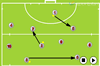
Step one - the rondo with consequence. Play 5v2 in a 12m square. When the two defenders win the ball, they have five seconds to score by stopping it on a target line. The five attackers must counter-press immediately to prevent it. This compresses the whole concept into a 90-second exercise that you can run as a warm-up every session.

Step two - the transition game. Set up a 7v7 game across half a pitch. Every time possession changes, start a five-second clock. If the team that lost the ball wins it back inside the count, they score double on the next attack. If they fail, the new attacking team gets a free pass forward. Watch the intensity of those first five seconds rise sharply.

Step three - the full-pitch conditioned game. Play 11v11 with one rule: whenever a team loses the ball in the opposition half, they must counter-press for five seconds before retreating. Use a whistle to mark the five-second cut-off in the first few sessions, then let the players self-manage.

What to Coach When You See It Live

Freeze play in training the moment a counter-press starts. Ask three questions: who is pressing the ball, who is closing the forward pass, and who is covering behind? If all three roles aren't filled in the first second, the press will fail. Most counter-presses break down because the player furthest from the ball doesn't move - they assume someone else will cover, and a simple bounce pass releases the carrier.

Communication is the second checkpoint. The presser needs to be told what to take away. A simple call of "force left" or "lock the line" gives the chasing player a job. Without it, they go in flat and the ball carrier finds the gap.

Key Coaching Points

  • The moment of turnover is the trigger, not the bench
  • Three players minimum: presser, cover, screen
  • Five seconds is the limit - then drop into shape
  • Talk constantly to force the carrier into one decision
  • Reward turnovers in training with extra points or bonus possession

Recommended Drills

VIEW ALL PRESSING DRILLS

talk DRILLS
View All
Unfortunately there were no results for your search! Please try again
talk ANSWERS
View All

What is the best drill for teach hit outs at 16's?

My team have asked for drills to help them at 16s, can anyone help me

Jax Pheiffer Coach, England

Anybody got any ideas on how to earn respect from teenage girls when your a first time coach?

Anybody got any ideas on how to get 14-15 year old girls to treat a first time coach as a coach and not just a friend?

Archived User Coach

Start of a game

How do I get my girls to show more consistency at the beginning of a game? The longer the game goes the better they get.

Glenn Hutchinson Coach, Australia

My u/15 girls can't play as a team.

I really have a big problem with my u/15 girls.  They just can't play as a team. Any advice please. There's always a fight between someone. Mariette

Archived User Coach

Right-Wing Position

My daughter plays U13 hockey in the position of right wing.She gets different advice from her school coach and her club coach.I want to make sure that she is getting the right advice as she is passionate about her hockey. Firstly, exactly what is the full function of a right wing at this level of hockey (she will be going to U15 club hockey and U14 school hockey next season) She has a good understanding of the game and appears to me to read it well (I only played school level many years ago and things change) When her team is in the offensive position in the “D” she mostly waits at goal post to deflect ball into goal.  She appears to not be involved.  Comments from spectators have been made as to why she just stands there. There is a very skilled player in her team who hits the ball EXTREMELY hard.  I believe that at this level of hockey these extremely hard hits/passes do not achieve anything, they just keep going out. However, please can you advise on how to stop and control these very hard passes (that is if one can get to them) in order to move on with the game. Lastly, can you send some drills/exercises to get her eye in as well as positioning her body correctly for goal shooting.  The “hard hitter” and my daughter seem to be the main goal shooters of the team. Many thanks Lynne

Archived User Coach

What should I do? Team Captain's stepping on my toes with these emails?

I have taken over a club as head coach this year and inherited a captain. She is a good player but is not my ideal captain and is used to communicating almost exclusively by email. I had a successful meeting setting objectives for the 1st team last weekend and following that meeting received lots of feedback for how well it was received. My captain yesterday sent a long email about her thoughts on the meeting and where we are and what the players should be doing in order to progress from her perspective. It is a long rambling email that I think has no objective or point to it that I think is completely inappropriate, now I know her heart is in the right place but this is really stepping on my toes as a coach as it is my place to do these type of emails. I am looking for advice on how I should be dealing with this, I am happy to pull her up but as she is very unconfident about herself I feel this might push her back into her shell even more and then she might do something daft like send another email apologising to the team! I am not sure if I should just ignore it as I wonder if it undermines me? Thoughts?

Ian Hardingham Coach, England

good warm up for professional hockey team?

What is a good warm up for a professional hockey team?

Archived User Coach

help! A divided U14 girls team. Tips to bring them together?

I've got some girls aged 11-14, basically made up from two different clubs. We're playing 7 a side and have a squad of 12. One club dominates in terms of numbers (75% of the squad) and although they are not doing anything 'wrong' at all, the 9 players are accustomed to their own company and there's a bit of a divide that has emerged. I can't understand why the players aren't just getting on with things but I'm getting some reactionary behaviour from some players, because of this 2 camp scenario. Any tips?Thanks.

Gary Thompson Coach, England

URGENT!!! Hockey coaching plan needed for A level PE

I am doing A level PE and I need to find a coaching plan that includes a number of drills that get progressively harder. The plan has to be game based, I was thinking of doing one on possession but I cannot find drills that link together and get harder. Please help, Thanks

Erin Parry Coach, Wales

How to coach school team with novices and experienced players?

Hi,I perhaps naively, expected to have most of our team from last year carry over and only have a few new comers to integrate and get up to speed with the rest. However meeting the team at our first practice last night i find I have five players still at school from last year and the rest all new comers, most of whom had not held a hockey stick at all till practice.This being only my second season coaching (year 9 to year 13 boys) has left me feeling a little blindsided, and feeling quite unsure how to prepare practices that target both groups of boys. Do i lump them both groups together, keep them separate? What drills/exercises to best bring the new comers up to speed.I don't want to neglect either group, keep practice worthwhile for the experienced boys, but also bringing the new comers up to a level were they can mix in with the others and learn organically from them while practicing as a team. David

David Smith Coach, New Zealand

Is being strict at training good?

The girls don't always listen to our coach and they talk over her when she is explaining drills. I am getting really fed up with it. Is it a good thing to start giving out punishments like laps or star jumps or corners to encourage them to listen and do the skills at match pace? Asked using Sportplan Mobile App

Siobhan Edwards Coach, England

Coaching for six a side u9 girls team.

We need to talk about the basics of hockey but any advice re coaching them on not bunching and drills to help with this would be much appreciated. Thank you.

Kathryn Hallock Coach, South Africa

Drills for large numbers?

Has anyone got good drills/practices for Under 12s. I have a very large group of kids and looking for drills that work with large numbers?

megan Coach, Scotland

voucher problems

I had a free membership and am trying to add a voucher provided by my hockey club Forestville. I think I have foolwed the steps.... when i try and add in the club password , it tells me my log in has already used this password. How do I get help with this ?

Susie hewitt Coach, Australia

Adding coaches with their own login

Hi, I am trying to work out how I am able to add our 5 coaches with their own login details so they can use all the conent available.Kind RegardsJessica Smith

Sturt Netball Club Coach, Australia

Log Books

Good day i see you talk about Sportplan Log Books.Where is this availableRegardsJac0

Jaco Booysen Coach, South Africa

Team loyalty, not talking down...

Hi all,I coach a school boys teams, ages 12-18.Late last season after a disappointing loss, one of the younger boys made the comment 'Its all xxxx's fault that we lost'. This was made at the end of the game while I was packing away our gear and most, but not all, of the boys had already departed. XXXX wasn't there to hear the comment. Being dumbfounded by this comment, I let it go at the time and have stewed on it during the our off season. I'm of the opinion that this type of comment is unacceptable and should result in disciplinary action of some kind. My thinking at the moment is that I would be remove the player from the game ( if made during the game, even if it leaves us short), pass them on to the school for whatever punishment is deemed appropriate with a request to remove them from the team. Am I being too harsh or unreasonable in my thinking? Are there any strategies that I could employ to stop this kind of commentary? I'm going to discuss it with the school when we get back together before the season starts.

David Smith Coach, New Zealand

My u/15 girls can't play as a ...

I really have a big problem with my u/15 girls.  They just can't play as a team. Any advice please. There's always a fight between someone. Mariette

Archived User Coach

I'm a new Varsity head coach a...

Hi all- I am 37 years old. I played field hockey for 3 years only (in high school). As you can imagine, I'm not very good/experienced. I was a competitive soccer player which made me good enough athletically to play field hockey but anyway, the point is: I never played field hockey at a high level.I now find myself in a head coaching position. (Long story-I did coach some field hockey some years ago and had a blast but it was a while back). Anyway, I have three assistant coaches who aren't much more experienced than I am. Our high school program is VERY weak and so nobody really steps up to coach there.Basically, my question is: what do I do? I have some girls who have played but not much. Then I have girls who literally don't know how to hold their stick and are quite I athletic. We barely have enough girls to field a team. As for drills, I'm trying to use this site but if you were in my position, what specifically would you be doing with these girls so they don't lose 7-0 every game? Right now, I'm focusing on body control and comfort with the ball- (we are playing possession and they are so uncomfortable they just hit the ball away because they don't have the skills to hold). Any help you can give is greatly appreciated!Brooke Asked using Sportplan Mobile App

Archived User Coach

Right-Wing Position | Sportpla...

My daughter plays U13 hockey in the position of right wing.She gets different advice from her school coach and her club coach.I want to make sure that she is getting the right advice as she is passionate about her hockey. Firstly, exactly what is the full function of a right wing at this level of hockey (she will be going to U15 club hockey and U14 school hockey next season) She has a good understanding of the game and appears to me to read it well (I only played school level many years ago and things change) When her team is in the offensive position in the “D” she mostly waits at goal post to deflect ball into goal.  She appears to not be involved.  Comments from spectators have been made as to why she just stands there. There is a very skilled player in her team who hits the ball EXTREMELY hard.  I believe that at this level of hockey these extremely hard hits/passes do not achieve anything, they just keep going out. However, please can you advise on how to stop and control these very hard passes (that is if one can get to them) in order to move on with the game. Lastly, can you send some drills/exercises to get her eye in as well as positioning her body correctly for goal shooting.  The “hard hitter” and my daughter seem to be the main goal shooters of the team. Many thanks Lynne

Archived User Coach

JOIN SPORTPLAN FOR FREE

  • search our library of 1000+ hockey drills
  • create your own professional coaching plans
  • or access our tried and tested plans

Sportplan App

Give it a try - it's better in the app

YOUR SESSION IS STARTING SOON... Join the worlds largest hockey coaching resource for 1000+ drills and pro tools to make coaching easy.
LET'S DO IT









