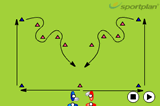
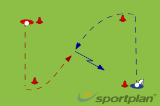
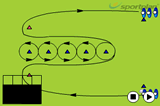
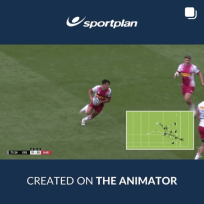
4 players are required for this drill; 1 attacker, 2 defenders and 1 scrum half.
Once the defenders are set up in either corner of the try line they are assigned a coloured ball.
The attacker is to start in one corner of the baseline.
The drill begins when the attacking player is fed a coloured ball by the scrum half.
The defender associated with that coloured ball will then come out to defend the try line from their corner.
This drill relies on both the reaction speeds of the defenders noticing which ball is in play and also that of the attacker noticing which defender is in play and consequently where there is space to attack.
Ensure that you make a screen so that the defenders can’t see the colour ball which the scrumhalf is about to pass to the attacker.
Use your whistle to set off the scrum-half's pass. Make sure that there are enough players so that the drill can flow, one attacker after the next.
Swap the defenders every two minutes ensuring you assign the new defenders a ball colour.
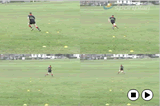
Focus on drawing the player across as much as possible, and at the right moment, stepping off the outside leg and beating the player on the inside.
Lean towards the side that you want to draw the player towards, before making the step shorten your strides and slow down.

in more ways than one
 sportplan_netball


in more ways than one
sportplan_rugby

Tacklers are aiming lower, so carriers who dip late put heads at risk. Teach footwork, a strong early body height and leg drive to win the collision safely.

The hooker's brake foot moved from trial into full law in July 2026. Here is how to coach it so your front row stays stable, legal and safe.

Your players can pass beautifully in a warm-up grid. Then a defender closes, their lungs are burning, and the ball goes to ground. Here is how to build catch-pass skills that hold up when it matters.