Why Footwork Is Everything in Netball
Unlike almost every other team sport, netball does not allow the player with the ball to run. This single rule makes footwork the most important technical skill in the game. Every catch, every pass, every shot, and every defensive contest is built on the player's ability to land cleanly, establish a grounded foot, pivot effectively, and release the ball within the rules. Get the footwork wrong, and the umpire's whistle ends the play before it starts.
For coaches working with junior players, footwork is where development must begin. It is tempting to jump straight into passing drills and positional play, but without a solid footwork foundation, players will constantly give away free passes through stepping violations. Investing time in footwork training early pays dividends throughout a player's career - it becomes automatic, freeing them to focus on reading the game and making better decisions.
The Stepping Rule: A Clear Explanation
The stepping rule is often misunderstood, particularly by new players and parents watching from the sideline. Here is how it works in simple terms.
When a player catches the ball, the first foot to make contact with the ground (or the foot already on the ground at the moment of catching) becomes the "grounded foot" or "landing foot." This foot cannot be lifted and re-grounded while the player still has the ball. The player may pivot on this foot - rotating around it - but if it lifts off the ground and comes back down, that is a step, and the umpire will penalise it.
If a player catches the ball while both feet are on the ground simultaneously (a two-foot landing), the player may choose either foot as the grounded foot but must decide immediately. Once they step with one foot, the other becomes the grounded foot by default.
If a player catches the ball while in the air, the first foot to land becomes the grounded foot. The second foot can then step in any direction, but the first foot must not be re-grounded. This is why the one-foot landing is so powerful - it gives the receiver a step to use after landing, creating more passing angles.
One-Foot Landing: When and How
The one-foot landing is the preferred technique for most receiving situations in netball because it preserves the player's ability to take a step after catching. This step creates additional passing angles and allows the receiver to adjust their body position toward their target.
Technique
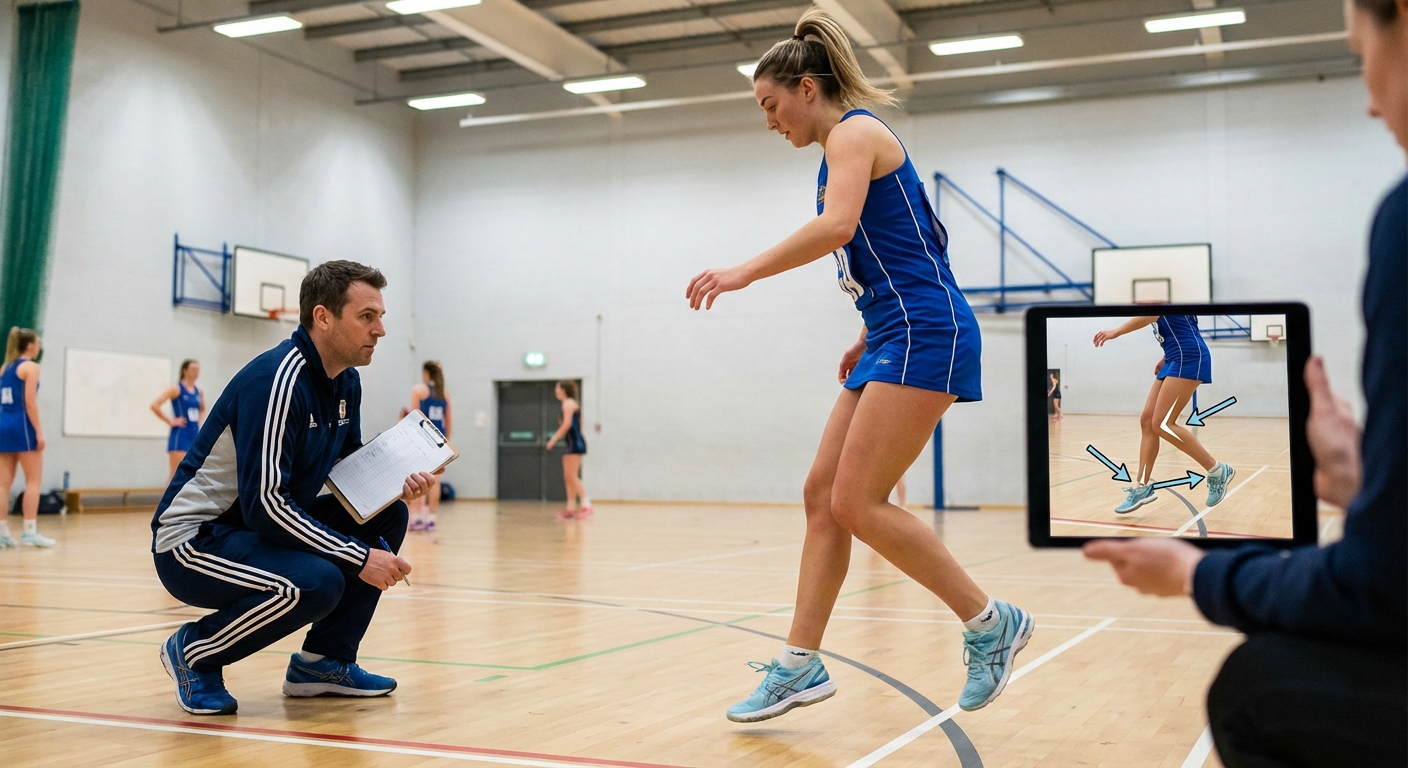
As the ball approaches, the receiver should aim to catch it while in the air with one foot forward. That front foot lands first and becomes the grounded foot. The receiver then has the option to step with the back foot in any direction. The landing should be controlled - knees slightly bent to absorb impact, core engaged for balance, eyes up to scan for passing options immediately.
The most common error is landing too heavily on the heel. This jars the knee and makes it harder to pivot smoothly. Coach players to land on the ball of the foot with a slight forward lean, which keeps the body balanced and ready to move.

Two-Foot Landing: When and How
The two-foot landing is used when the player needs maximum stability, typically when receiving the ball at pace and needing to stop quickly, or when catching a high ball. While it does not give the extra step that a one-foot landing provides, it offers a more stable base for shooting and for absorbing hard passes.
Technique
Both feet land simultaneously with approximately shoulder-width spacing. The knees bend on impact to absorb force. The body weight should be evenly distributed. From this position, the player chooses a pivot foot and can rotate to find passing angles. Shooters often prefer the two-foot landing in the circle because it gives them a balanced base for the shooting motion.
A common coaching error is telling all players to always land on one foot. Both landing types have their place, and players should be proficient in both. The situation dictates which is appropriate.
Pivoting: The Skill That Creates Passing Angles
Once a player has established their grounded foot, pivoting allows them to rotate their body to find the best passing angle. Good pivoting technique is the difference between a pass that flows smoothly into the next phase and a forced, awkward delivery that results in a turnover.
Technique
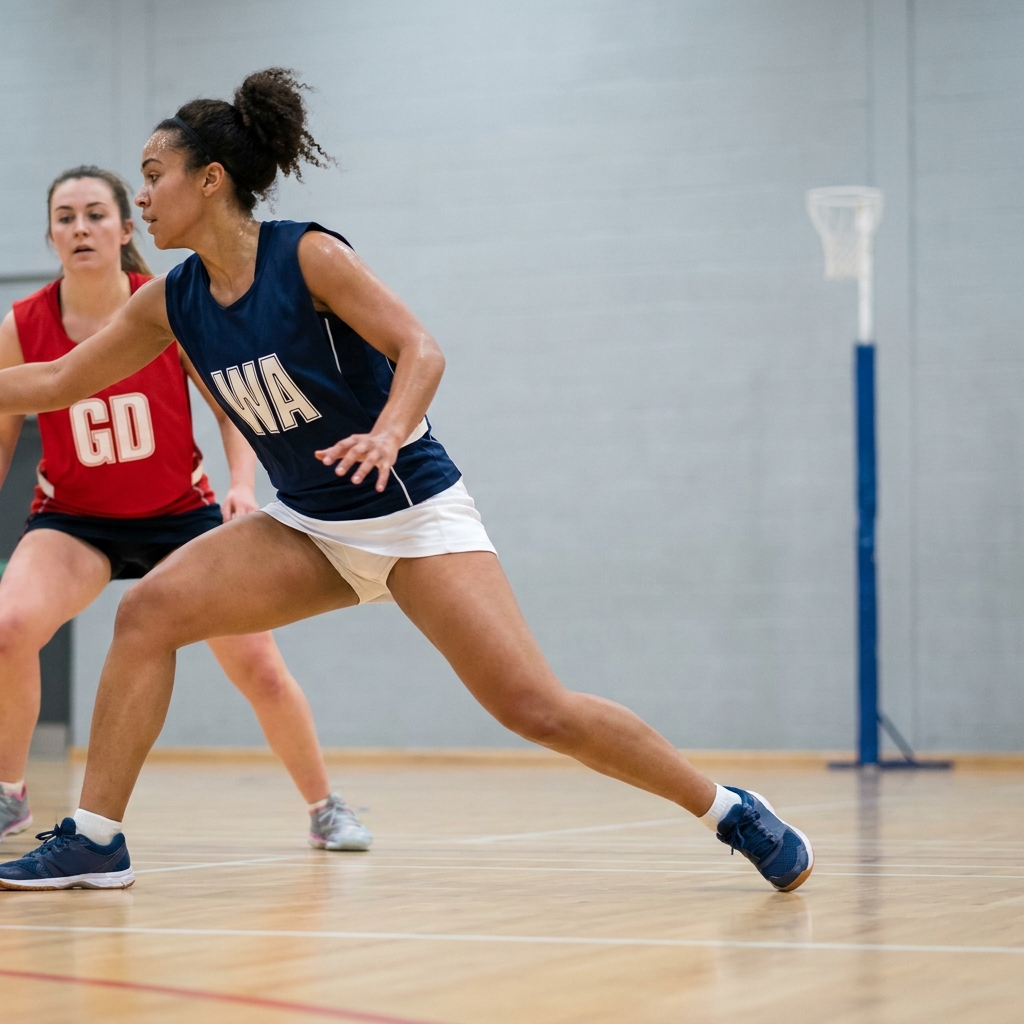
The pivot happens on the ball of the grounded foot. The heel should be slightly raised to allow smooth rotation. The player pushes off with their free foot to rotate, keeping the grounded foot planted. Common pivoting directions are: 90 degrees (to face a new passing target), 180 degrees (to turn away from a defender), and 360 degrees (a full spin to create space and confusion).
The upper body leads the pivot - the head and shoulders turn first, with the hips and lower body following. The ball should be held firmly in two hands, away from the defender, and at chest height ready to pass. Eyes should be scanning throughout the pivot, not looking down at the feet.
Common Pivot Errors
The most frequent pivot error at junior level is dragging or sliding the grounded foot. Even a small slide can be penalised as a step. The grounded foot must rotate on the spot without travelling. The second common error is pivoting with the weight on the heel rather than the ball of the foot, which makes the rotation slow and clumsy. The third is holding the ball too close to the body during the pivot, making it easy for the defender to reach in and tip the ball.

Progressive Footwork Drills
Footwork training must be progressive, starting with the basic mechanics and building toward game-speed execution under defensive pressure. Here is a four-stage progression suitable for any age group.
Stage 1: Static Fundamentals
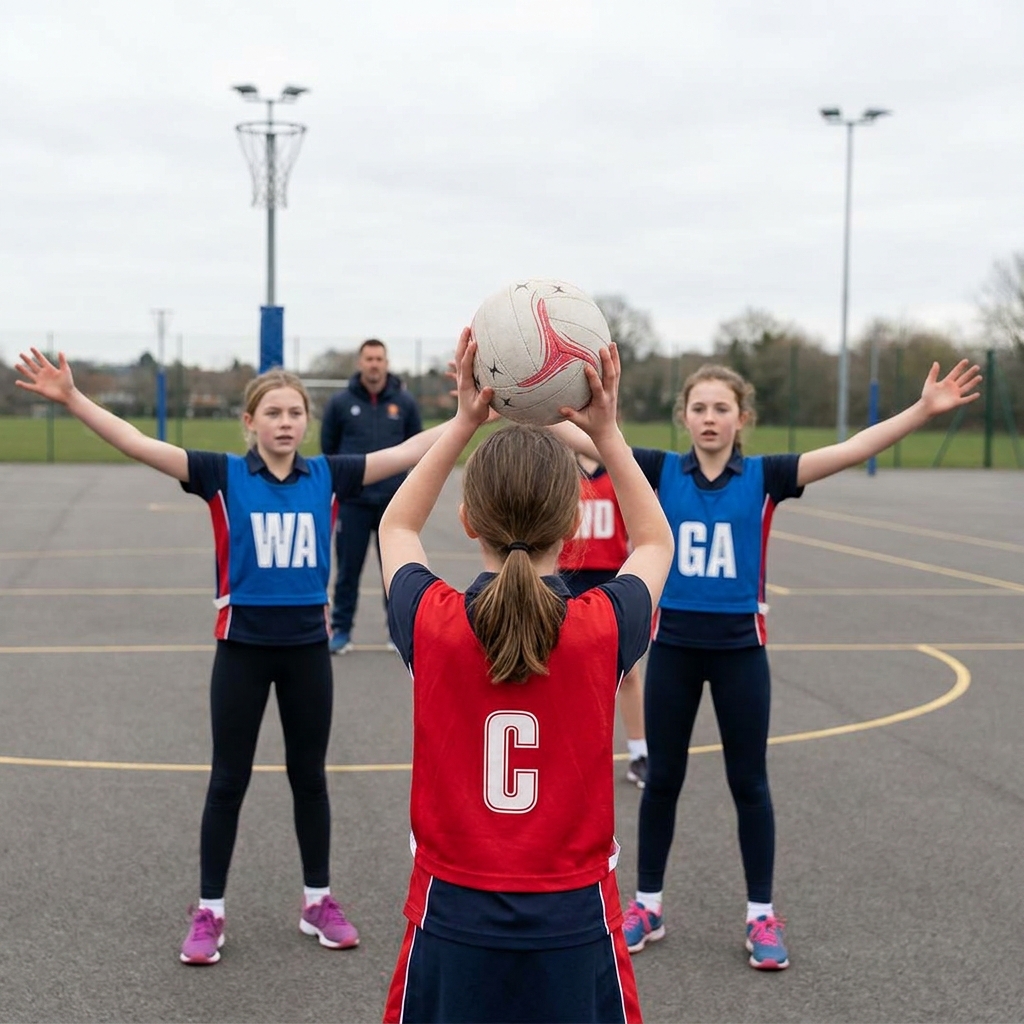
Players stand on one foot, catch a pass from a partner, and pivot to face different directions before returning the ball. No movement, no pressure - just repetition of the catch-land-pivot sequence. Focus on ball-of-foot contact, knee bend, and smooth rotation. Ten reps on each foot.
Stage 2: Moving Into the Catch
Players jog toward a feeder, catch on one foot, take their step, pivot to face a second target, and pass. The jogging pace forces them to control their momentum on landing. Gradually increase the pace from jog to three-quarter speed. Add variety: catch high balls, low balls, balls from the left and right.
Stage 3: Adding Defensive Pressure
Introduce a passive defender who stands within arm's reach but does not contest the ball. The receiver must land, protect the ball, pivot away from the defender, and find a passing option. The defender's presence forces the receiver to be aware of their body position and ball protection during the footwork sequence.
Stage 4: Game-Speed Contests
Full-speed 1v1 receiving contests. The attacker must get free, receive the ball with clean footwork, and deliver a pass to a target within three seconds. The defender actively contests. This stage combines all footwork elements with decision-making and pressure.

Sample Session Plan: Footwork Fundamentals (60 Minutes)
Session Structure
- Warm-Up (10 min): Ladder drills for foot speed and coordination. Progress to cone-based agility: sprint to cone, stop on one foot, pivot 180 degrees, sprint to next cone. Focus on controlled landings and balanced stops throughout.
- Technique Block (15 min): Stage 1 and 2 progressions. Static catch-pivot-pass in groups of three (5 min). Moving catch-pivot-pass at jogging speed, increasing to three-quarter pace (10 min). Coach walks around correcting grounded foot placement, pivot technique, and landing balance.
- Development Block (15 min): Stage 3 progression with passive defenders. Pairs work where receiver must catch, pivot away from defender, and deliver to a target. Swap roles every 8 reps. Then progress to two attackers vs one defender - the receiver must use footwork to find the passing angle to the second attacker.
- Game Scenario (15 min): "No-step netball" modified game. Play 5v5 half-court but any stepping violation costs your team the ball AND a bonus penalty pass to the other team. This heightened consequence makes players hyper-aware of their footwork during game play. Run two 6-minute halves with a brief coaching break between them.
- Cool-Down (5 min): Gentle jogging, calf and quad stretches. Group discussion: what footwork felt most natural? Where did you feel unstable? What will you practise at home?
Common Mistakes at Junior Level
Running with the ball: Young players instinctively want to keep moving after catching. This is the single most common violation in junior netball. Coach the "catch and stick" - as soon as the ball is caught, the feet must stop. Use exaggerated freezing in early training to build the habit.
Shuffling the grounded foot: The pivot foot slides or shuffles rather than rotating on the spot. This is usually caused by landing on the heel. Correct the landing mechanics and the pivot becomes cleaner automatically.
Catching off-balance: Players who lunge for the ball land in an unstable position that makes clean footwork impossible. Coach players to move their feet to get behind the ball rather than reaching with their arms. Good foot positioning before the catch leads to clean footwork after it.
Forgetting which foot is grounded: Under pressure, players sometimes lose track of their grounded foot and lift it accidentally. Build the habit through constant repetition so that awareness of the grounded foot becomes automatic rather than a conscious thought.

Frequently Asked Questions
At what age should footwork training begin?
Footwork training should begin as soon as a child starts playing netball, typically around age 7-8 in most development programmes. At this age, keep it simple and fun - games that involve stopping on a line, balancing on one foot, and catching while stationary are all building the foundation. Formal stepping rule enforcement usually begins around Under-10s, but building the habits earlier means fewer violations when the rules start being called strictly. Make footwork games competitive and engaging rather than repetitive drill-based at young ages.
How do I help a player who keeps getting called for stepping?
First, identify which type of stepping they are doing. Is it running with the ball (momentum issue), sliding the pivot foot (technique issue), or lifting and re-grounding (awareness issue)? Each requires a different correction. For momentum issues, slow everything down in training and gradually increase pace. For pivot technique, do isolated pivot drills until the ball-of-foot rotation is natural. For awareness, use verbal cues - have a partner call "landed!" when the grounded foot touches down to build conscious awareness. Video review can also be powerful: show the player their footwork so they can see what the umpire sees.
Should shooters use one-foot or two-foot landing in the circle?
Both have their place. A two-foot landing gives the most stable base for shooting and is preferred when the shooter receives the ball in a good shooting position and wants to set quickly. A one-foot landing is better when the shooter needs to adjust their position - the extra step can be used to move closer to the post or to step around a defender. Elite shooters practise both and choose based on the situation. In general, if the feed is accurate and the shooter is in the right spot, two-foot is preferred. If the feed requires adjustment, one-foot gives more options.
Can footwork training be done at home without a court?
Absolutely. Many footwork fundamentals can be practised in a backyard or even a living room. Balance exercises on one foot (try closing your eyes for an extra challenge), pivot drills using a marked spot on the floor, and catch-and-freeze exercises with a family member tossing a ball are all effective. Ladder drills or cone drills in the garden build foot speed and coordination. Even simply practising jumping and landing on one foot with a controlled, balanced stop helps build the muscle memory. Five to ten minutes of focused footwork practice three times a week will make a noticeable difference in match performance.
 sportplan_netball