








Excellent drills, very detailed videos. Useful site for my U15 boys team.

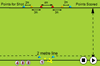
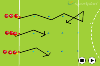
Here is one example I use.I put out this slalom as the test whenever confronted with a large group of mixed ability players that need to be put into equal ability groups to play a game or to be coached. The slalom incorporates lots of the aspects of the techniques required by the individual players to play the game of hockey. I.e. running with the ball, fast and controlled, changing direction with the ball pivoting, stopping the ball etc.I normally set up 2 - 4 identical slaloms, see attachment, and have 4 coaches or helpers with a stopwatch (mobile phones are great for this).To record the score I normally put a label on the stick of each player so they can write down their time. Once all players have recorded a time, ask the players to stand in time order on the sideline. Once the players are in order you can put the 10 fastest times to play a 5 aside game across 23 meter area and the next 10 in the next 23 meter area and so on up to 40 players playing on one full pitch. The last few changes you might now need to make are the players that perform better or weaker on any particular pitch (should not be to many).

We have 40 under 15, under 13 and under 11 and would like to do an assessment of their skills. Is there any proformas we can use. We then intend granting bronze gold and silver certificates to recognise skills acquired.

I have an assessment and the task is "Working the ball out of the back left hand corner of defence" - I have a mixed ability group of male and female players including a goalkeeper and have to train them for a one hour session including warm up skills sessions and game related play including progression. Does anyone have any ideas? At presnt I am thinking about focusing on positional play and perhaps doing a bit on possessional play/posting up before the game play situation...any thoughts?
I need to set up a technical training session covering midfield to attack please can anyone help ?
Need help with assessment-roll out to shoot need help with coaching points and progression just to make sure I have covered all the bases in my session plan thank you
need some help with preparing a lesson plan for an assessment
Hi all,I've got my level 2 assessment coming up on Sunday and I just wanted to quickly check whether there's a 'recommended' structure to the session plan.Btw, this is a level 2 practical assessment and is with juniors (U14s).One coach has suggested a 3 part approach:1) techniques and skills required2) unopposed 3) opposedThe theme I'm choosing, which is a bit of a generic one, is defending in a channel (as I'm a defender and it's pretty straight forward).I'm not really looking for info on what exactly to include (i.e. theme specific) but rather general structure or whether E.H. have an approved structure to sessions?My session's on Sunday, so a quick reply would be awesome.Thanks,Gary

For an assessment I need to develop a coaching plan for two groups of 8 juniors on circle entry. Any ideas please! I am concerned about keeping the players all active attacking one circle. Can I use another part of the pitch for one group of 8 whilst the others use the D?
Hi,I need to play 4 linked hockey sessions to a specific theme I don't know which one to chose such as I can't say attack because there can be so much to cover . So any help?
I want to use a training circuit with various stations that's sole purpose is to test if their strengths lie in attacking or defending. Pre-season training before hockey trials.
Hi,I need to play 4 linked hockey sessions to a specific theme I don't know which one to chose such as I can't say attack because there can be so much to cover . So any help?
For an assessment I need to develop a coaching plan for two groups of 8 juniors on circle entry. Any ideas please! I am concerned about keeping the players all active attacking one circle. Can I use another part of the pitch for one group of 8 whilst the others use the D?
We have 40 under 15, under 13 and under 11 and would like to do an assessment of their skills. Is there any proformas we can use. We then intend granting bronze gold and silver certificates to recognise skills acquired.
information on 1442 and 11333 systems. I am fairly new to sportplan so hopefully someone can point me in the right direction. I am from Australia so know the GK-2-3-5 set up well. I would like to possibly employ a GK-4-4-2 / GK -1-3-4-2 set up or a GK-1-3-3-3. What I need is information on How players are set up, Forward press set ups, defencive zone set ups and attacking methods. For a bonus it would be great to know how they set up against a GK-2-3-5 as most of our oposition teams play this or a gk-2-3-3-2 Cheers
If there are two defenders trying to tackle one player. Do you pull up for two on one or do all three sticks need to be making contact with the ball?
Hi,I perhaps naively, expected to have most of our team from last year carry over and only have a few new comers to integrate and get up to speed with the rest. However meeting the team at our first practice last night i find I have five players still at school from last year and the rest all new comers, most of whom had not held a hockey stick at all till practice.This being only my second season coaching (year 9 to year 13 boys) has left me feeling a little blindsided, and feeling quite unsure how to prepare practices that target both groups of boys. Do i lump them both groups together, keep them separate? What drills/exercises to best bring the new comers up to speed.I don't want to neglect either group, keep practice worthwhile for the experienced boys, but also bringing the new comers up to a level were they can mix in with the others and learn organically from them while practicing as a team. David

in more ways than one
 sportplan_hockey




A few weeks into the league season, poor first touches are costing teams the ball. Coach body shape, scanning and receiving on the move to keep possession.

Pre-season fitness fades fast once the league starts. Build conditioning into ball work and use rolling subs well to keep your squad sharp all season.

The first weeks of the season decide whether a junior or new player sticks with adult hockey. Here is how to keep them safe, give them a clear job and build their confidence from the very first bully.
Coaches from around the world look to Sportplan for coaching confidence.
Excellent drills, very detailed videos. Useful site for my U15 boys team.

I love using Sportplan. It's been a great help for co-ordinating hockey practice and being able to help tweak skills and getting the most out of my players!

Great site. An absolute must for coaches who are willing to change and learn new drills. Superb, simply superb.

Wow what a great website, I have found sportplan an important tool for me when planning my netball sessions with my netball team. There are alot of very helpful tips/ideas/skills that I can learn and teach to my team. Thank you sportplan I hope to continue to use your helpful tips and to learn more about improving my teams netball skills. Thanks again....keep it up....

I have been using Sportplan now for 3 years and can honestly say that I have never repeated the same session twice. My girls are always focused and are improving every year. Thanks Sportplan.
What a fantastic tool. The Chalkboard and session tools make an unbelievable difference in making training plans in both time and organization. I will be instructing all of my assistant coaches that this tool must be used for all sessions during the season, so that we may build a club coaching resource library.
I can't get enough of the Sportplan, It has given me back the enthusiasm i was starting to lose. My girls are so keen and are ready at 14 to take the next up in their game. Sportplan will help no end.



