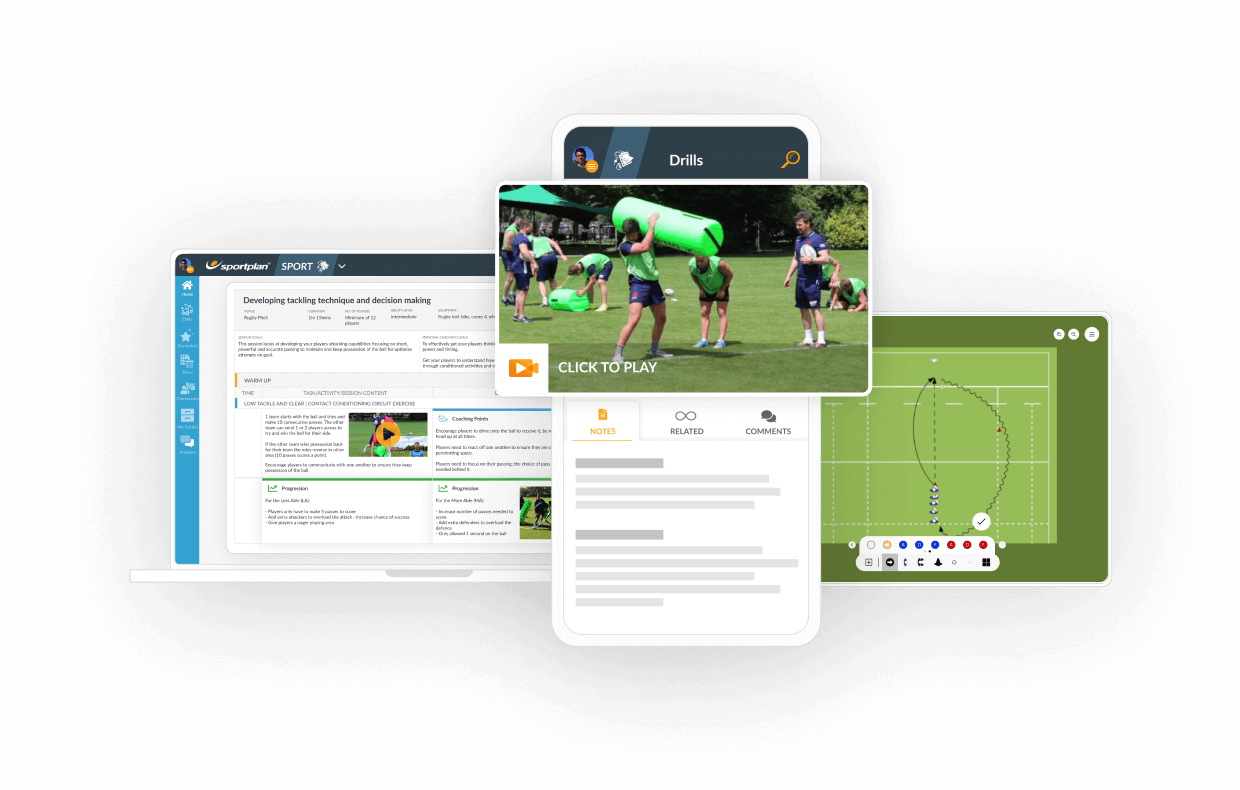
2 people are on the tackle shields or 2 on each side about 5 metres apart facing each other, there is a ball carrier standing in the middle of the two defenders with one or two attackers. Ball carrier runs into defender/s and places the ball, the supporting player/s must clear away the defenders. Each attacker must have a go at hitting the defender and placing the ball.
Hit with the leading shoulder holding the ball with both hands at the furthest point away from the defender, as you would in a game. This would be on the hip furthest away from the defender.
When making contact it should be a low to high body position using your leg power to your advantage this is for the ball carrier and the support runners. Support runners should not join arms to be more effective as this is unrealistic in game time.
Defenders should only be cleared one or two yards past the ball carrier. When clearing out, heads should be up to minimise chance of falling towards ground. Clearing the defenders out should push them straight back and out, to take defenders away from the contact area.
Scrum half could be involved so that there is a different ball carrier for each consecutive go.
More numbers on the defence to make it harder to clear out.
More stations for defenders, so you could use 8 defenders in a square sequence and attackers must hit each one.
in more ways than one
The offload is one of rugby's most devastating weapons when executed well, turning a defensive collision into a second-phase attacking opportunity. This article breaks down the technique, timing, and training progressions coaches need to develop confident offloaders at every level.
Defensive line speed is the single most important factor in shutting down attacking opportunities before they develop. This guide explores how to coach your defensive line to push up as a connected unit, communicate under pressure, and deny the opposition time and space.
The teams winning in 2026 aren't taking risks - they're grinding out territory with relentless pick-and-go phases. Here's how to coach it.