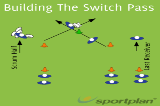
Drill to practice inside running lines (switches) in attack.
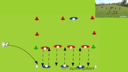
Set up a 10m x 10m square (green cones) with two attackers (blue) on one side of the square, and one defender (red) on the other side of the square on the left hand side (see diagram).
The attacker with the ball runs forward, then diagonally across the square towards the diagonally opposite cone, to get the defender to chase him.
The second attacker also runs forward, then switches back across the square towards where the defender has come form.
The ball carrier turns towards his outside and passes to the other attacker who is running a switch. They then score over the try-line marked by the green cones.
If the defender holds for the switching player, the ball carrier should continue running and score over the try-line marked by the green cones.
Switch technique - ensure the ball carrier runs at pace to get the defender chasing them before running the switch.
The supporting attacker needs to identify the space behind the chasing defender before calling the switch. Important that the supporting player doesn't run too early as this will allow the defender to read the switch and cover both attacking players.
Deep switch to ensure defender can't change direction.

in more ways than one
 sportplan_netball


in more ways than one
sportplan_rugby

Tacklers are aiming lower, so carriers who dip late put heads at risk. Teach footwork, a strong early body height and leg drive to win the collision safely.

The hooker's brake foot moved from trial into full law in July 2026. Here is how to coach it so your front row stays stable, legal and safe.

Your players can pass beautifully in a warm-up grid. Then a defender closes, their lungs are burning, and the ball goes to ground. Here is how to build catch-pass skills that hold up when it matters.