Why Shooting Is a Mental Skill First
Ask any elite netball coach what separates a 75 percent shooter from a 90 percent shooter and almost none will name a technical adjustment. They talk about composure. Decision-making. The ability to repeat the same shot at the start of the first quarter and at the end of the fourth. Shooting is, at the top level, a mental skill carried by a technical foundation. The technical foundation is built in the off-season. The mental skill is built in the ten minutes before the whistle goes.
Yet at most club levels, the pre-game mental preparation of shooters consists of stretching, a couple of warm-up shots, and waiting around. There is no structured plan. The shooter walks onto court with whatever mental state they happened to arrive at the venue with. The good shooters get away with it. The great shooters - the ones who deliver in finals and under pressure - have a routine. They have rehearsed it. And they trust it.
What a Pre-Game Routine Actually Does
The science is well-established. Pre-performance routines do three things at once. They calm the nervous system by activating familiar physical patterns. They direct attention away from disruptive thoughts (the score, the opponent, the parents on the sideline) and onto controllable cues (the breath, the release, the ring). And they activate motor memory through visualisation, priming the brain to execute the technique without conscious interference.
For shooters specifically, the routine is even more important than for other positions. A shooter has multiple discrete moments of high-pressure execution within a match. Every shot is a fresh test. A routine that resets the shooter to their optimal state before each shot, and before the match itself, is the single most reliable way to keep their conversion rate stable across the four quarters.
The 10-Minute Pre-Game Mental Routine
This routine is designed for shooters at any level above under-13. It takes ten minutes, can be done at the venue regardless of facilities, and requires no equipment. It is structured around three phases - settle, prepare, activate - each lasting roughly three minutes.
Minutes 0-3: Settle
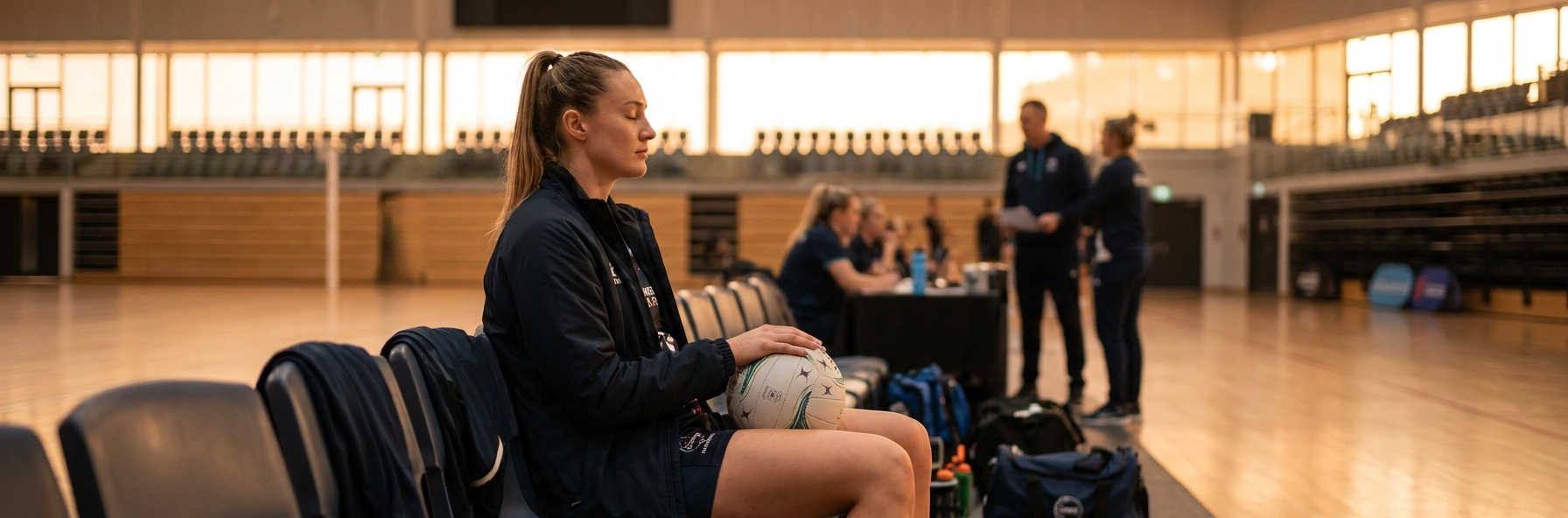
The shooter finds a quiet spot. A corner of the changing room, a bench off the court, even a parked car. The goal of these three minutes is to slow the breathing, calm the nervous system, and let the noise of arrival fade. Use a structured breath - four counts in, hold for four, six counts out. Repeat for three minutes. The longer exhale shifts the body from sympathetic to parasympathetic mode and lowers the resting heart rate by five to ten beats per minute. That is the physiological baseline that good shooting depends on.
Minutes 3-6: Prepare
The shooter mentally rehearses their shot. Eyes closed, they visualise themselves catching the ball at the post, setting their feet, releasing, watching the ball arc through and drop. Five or six full repetitions. The detail matters - the feel of the ball, the sound of the ring, the position of the defender. The brain does not distinguish strongly between vivid mental rehearsal and physical practice. By the time the shooter walks onto the court, they have already taken six successful shots in their head.
Minutes 6-9: Activate
Physical activation. Light dynamic movement - shoulder rolls, hip openers, calf raises, a few quick jumps. Nothing strenuous. The goal is to lift the heart rate moderately, mobilise the joints, and bring the body to the state in which it shoots best. End with three quick "ready position" rehearsals - feet set, knees bent, hands up, eyes on an imagined ring. This bridges the mental rehearsal back into the body.
Minute 9-10: Anchor
The final sixty seconds are for the personal anchor. Every shooter develops one - a phrase, a breath, a hand gesture - that they associate with their best shooting state. The anchor is repeated at the end of the routine and again before every shot during the match. Over time the brain learns to trigger the calm, focused state whenever the anchor appears. It is the bridge between the routine and the live performance.
The Pre-Shot Mini-Routine
The pre-game routine sets the foundation, but the work is not done. Every individual shot during the match needs its own micro-routine, lasting around three to four seconds. This is the consistent ritual that the brain uses to switch from receiving mode to shooting mode. Elite shooters never skip it. Club shooters often do, and their conversion rates suffer.
A standard pre-shot routine has four steps. Receive the ball and land. Take one slow breath. Lock eyes on the ring at a single fixed point (most shooters choose the front of the rim). Release. The whole sequence is over in under four seconds. The key is consistency - the same four steps, in the same order, on every shot, whether the score is 0-0 or 30-30 with five seconds left.
Coaches should explicitly teach the pre-shot routine in training and then make it non-negotiable. A shooter who skips the routine on a routine shot will skip it under pressure. Build the habit when it does not matter so that it is automatic when it does.
The Score-Aware Reset
A common problem at every level is the shooter whose accuracy collapses in the final five minutes of a tight match. Almost always, the cause is mental, not physical. The score has entered the mind. The body responds to that mental shift with rushed footwork, shortened breath, and inconsistent release. The fix is a reset routine - a thirty-second mental refresh that the shooter can run between quarters or during a stoppage.
The reset is a compressed version of the pre-game routine. Three slow breaths. One mental rehearsal of a successful shot. The personal anchor. Done. The shooter steps back into the game in the same mental state they started in. This is the difference between a 90 percent first-quarter shooter who fades to 70 percent in the fourth, and a 90 percent shooter who stays at 90 percent all the way through.
Coaching the Routine - Not Just Teaching It
The hardest part of building these routines into a club shooter's game is not the routine itself - it is the willingness to commit to it. Players, especially younger ones, often see mental preparation as something they will get to later, after they have fixed their footwork or extended their range. The job of the coach is to refuse that framing. Mental skill is not the icing. It is part of the cake.
Practical steps to build the habit: schedule routine practice into training sessions. Spend five minutes at the start of every shooting session running the pre-game routine before any shots are taken. Hold shooters to their pre-shot routine in pressure drills. Talk about it in the same matter-of-fact way as you talk about technique. The athletes who hear you take it seriously will take it seriously themselves.
Sample Session Plan: Embedding the Mental Routine (60 Minutes)
Session Structure
- Warm-Up (10 min): Full pre-game routine. Three minutes settle, three minutes prepare, three minutes activate, one minute anchor. Coach guides the shooters through every step out loud the first time. From the second session, shooters run it themselves.
- Technique Block (15 min): Pre-shot routine attached to every shot. Shooters take fifty attempts from various circle positions. Each shot must be preceded by the four-step pre-shot routine - land, breathe, lock eyes, release. Any rushed shot is recorded and discussed afterwards.
- Development Block (15 min): Pressure shooting. Pairs of shooters compete - first to convert ten from inside the circle while running the pre-shot routine on every attempt. The loser must explain which shots felt rushed. Builds the discipline of holding the routine under stress.
- Game Scenario (15 min): 3v3 circle play with a scoreboard. The score is announced before each possession - 1-1, then 5-5, then 8-9 with two minutes left. Shooters must hold their routine regardless of the simulated score. Discuss after every possession.
- Cool-Down (5 min): The thirty-second reset routine, practised twice. Discussion of what the personal anchor will be for each shooter. Homework - rehearse the routine at home before the next session.
Common Mistakes to Avoid
Treating the routine as optional: A routine that only happens when the shooter feels nervous is not a routine. It is a coping mechanism. The whole point is that it happens every single time, regardless of mood, score or context. Drill it as a non-negotiable.
Making it too elaborate: A pre-shot routine that takes ten seconds is too long. It will be skipped under pressure. Keep it to three or four steps, total duration under four seconds. The best routines are the simplest ones.
Forgetting the anchor: The personal anchor is what carries the routine from the changing room into the live shot. Without it, the pre-game routine fades within the first quarter. Help each shooter find an anchor that feels authentic to them - never impose one from outside.
Frequently Asked Questions
Is a pre-game mental routine appropriate for junior shooters?
Yes, but in age-appropriate form. Under-13s can handle a simplified three-minute version with one minute of structured breathing, one minute of mental rehearsal, and one minute of activation. The principles are the same as the elite version. Starting young builds the habit before performance pressure ever arrives, which is when habits are hardest to install.
How long before a shooter sees results from a mental routine?
The acute effects - calmer breathing, lower anxiety, sharper focus - appear immediately, often in the first session. The performance effects on conversion rate typically show up over four to six weeks of consistent use. The transfer to high-pressure moments (finals, close matches) usually takes a full season. The work is real and it takes time. Players who commit for one match and quit will see nothing.
What is a personal anchor and how do I help my shooter find one?
An anchor is a short, repeatable physical or verbal action that the shooter associates with their best performing state. It might be a deep breath, a particular word ("calm", "ring", "smooth"), a finger tap on the thigh, or a specific image. The shooter chooses their own anchor - it cannot be imposed. Help them by asking what they were doing or thinking on their best shooting day. Whatever they describe is the raw material for the anchor.
Does the routine help with the Super Shot specifically?
Particularly. The Super Shot, taken in the final five minutes of each quarter, is one of the most pressure-loaded moments in the modern game. A composed shooter who runs their pre-shot routine on every Super Shot attempt will convert far better than one who relies on adrenaline alone. The routine is the difference between a Super Shot taken in confidence and one taken in hope.
 sportplan_netball